I am holding a paintmaking workshop at Oxford Gallery toi o Waimakariri on 25 August 2024 at 1 pm – 2 pm; $10 per person

Visit the gallery’s website for more information.

https://oxfordgallery.org.nz/activities/:
Concurrently I am also taking part in an exhibition ‘Pigment Pottery Paint’ with June Inch which finishes on 1 September. See – https://oxfordgallery.org.nz/exhibitions/

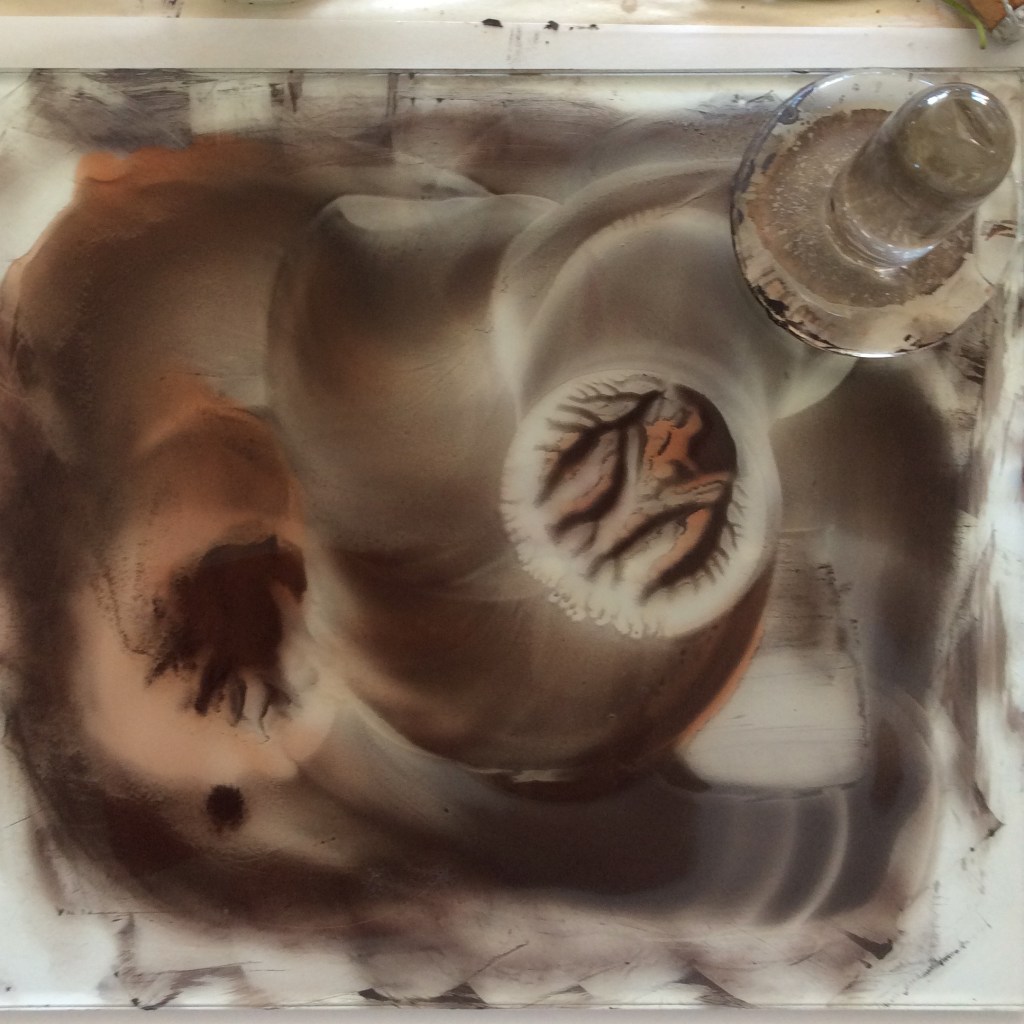
Here is an amazing pigment – black with undertones of red: it is being mixed into the binder with a muller.
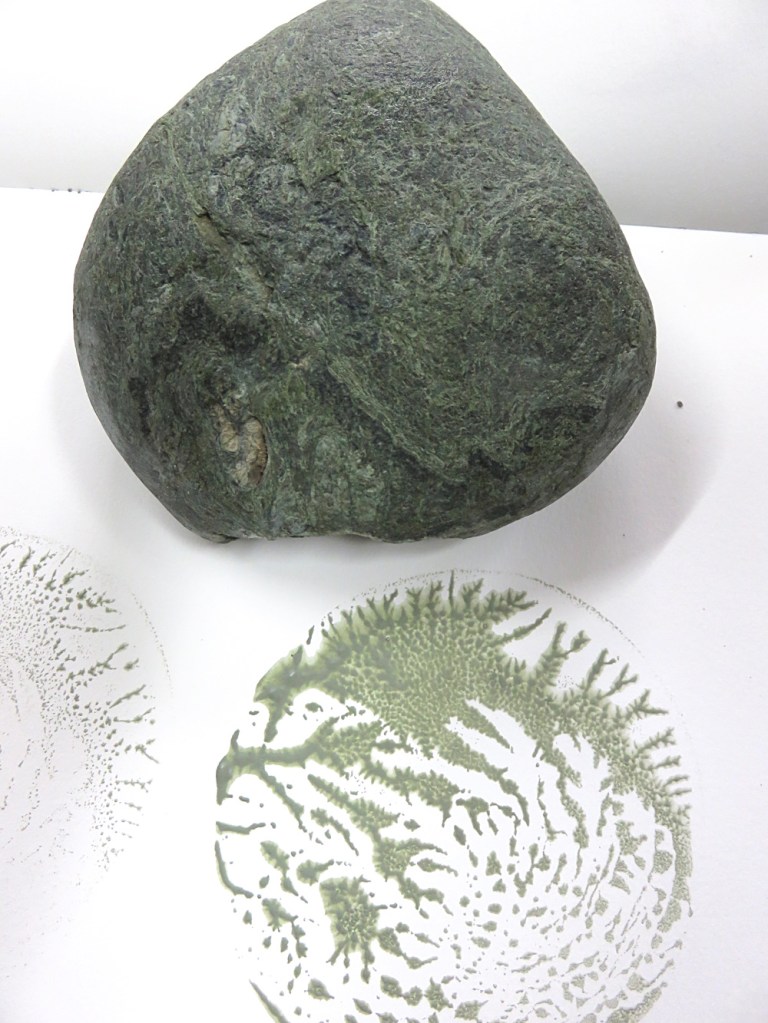
Braided River Rock

While not much appearing on this blog for a while, I have none the less been very busy. It’s either Housework and no art, or Art and no housework! I have had a few surges of paint making, and been learning about gouache paint, done some eco prints on paper with autumn leaves etc, made quite a few books.

As a member of the paper making group at the local art gallery, we have been busy making paper with vegetation from the local braided river, Waiaraki/Eyre. Every month we make pulp and paper from a different invasive weed – fennel, spurrey, viper’s bugloss, evening primrose, mullein and yarrow. As the seasons unfold we manage to get quite a collection of different colours and weights of paper.

I just love walking the rivers, but it’s a great pity that the wild life, especially the birds, are under great pressure from the thoughtless and dangerous incursions of some people, on foot with dogs, or in vehicles. The rivers are used as rubbish and garden waste dumping grounds.

Waiaraki/Eyre River rock

This rock will be going back to the river… Many thanks to my friend June who gave it to me.

Paint making workshops and demonstrations 2020/2021

Catching up a little, I seem to have neglected my website…

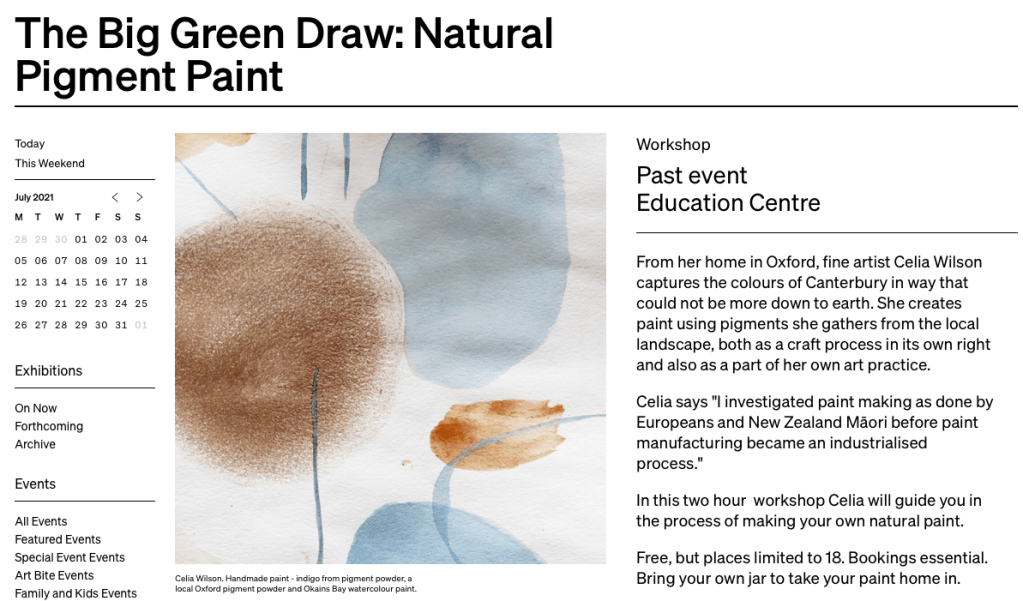
I was very pleased to be able to hold a paint making workshop at Christchurch’s art gallery on 26 October 2020. It was very enjoyable and the eighteen attendees made lots of paint to take home. Unfortunately I took no photos of this workshop (too busy to remember!) but, for the record, here is the announcement by the Christchurch Art Gallery from their website. However, below is one of the test sheets of paint that I made during the workshop.

Makers’ Day at Arts in Oxford Gallery

After “Open House”, at Arts in Oxford Gallery, we had a Makers’ Day on Sunday 27 September, 2020. There was a wide choice: Areta – Stone Tools; Jo – Printmaking; Celia – Pigment paint; Charlotte – Painting; Bret – Spatial Design; Young-Oak and Team – Spinners and Weavers; Katie – Collage; Casey, June, Alison, Tessa – Papermaking; Lynley – Stained Glass.

As you can see from the photo, Philip Trusttum’s exhibition “What have we got here?” was current at the time, and he was at the gallery that day. Here, at the start of Makers’ Day, he is in conversation with me about the muller paint prints in one of my record books.

Photo credit: Arts in Oxford Gallery

Recent work 2021

I have been making books, prints and other things…

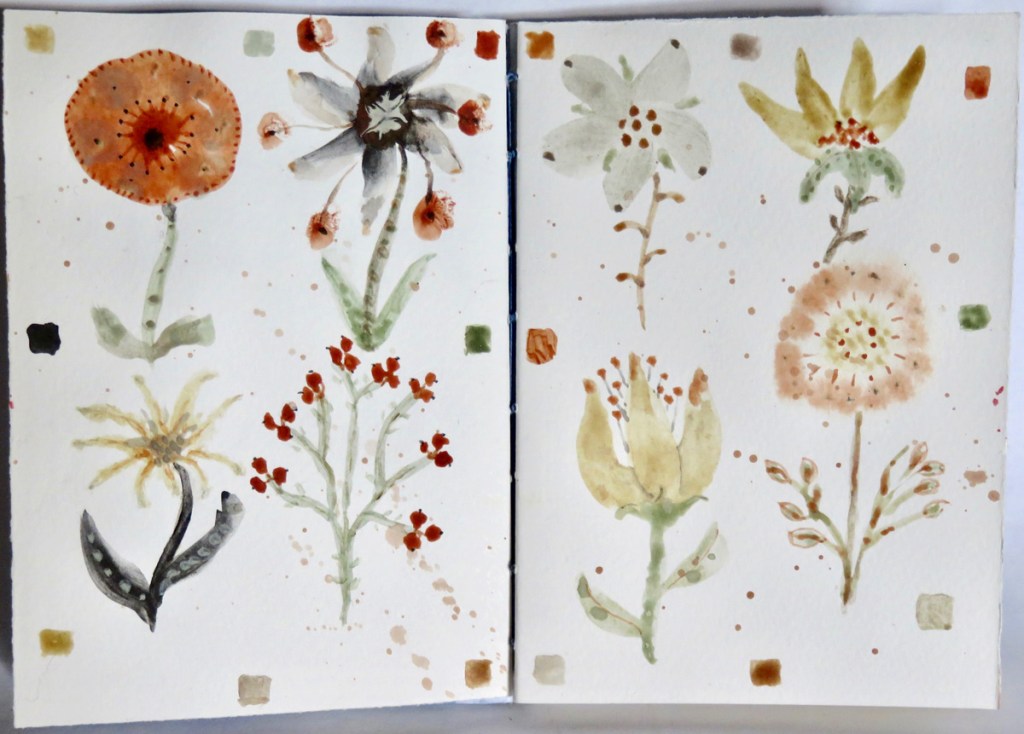
Imaginary botanicals with rock paints.
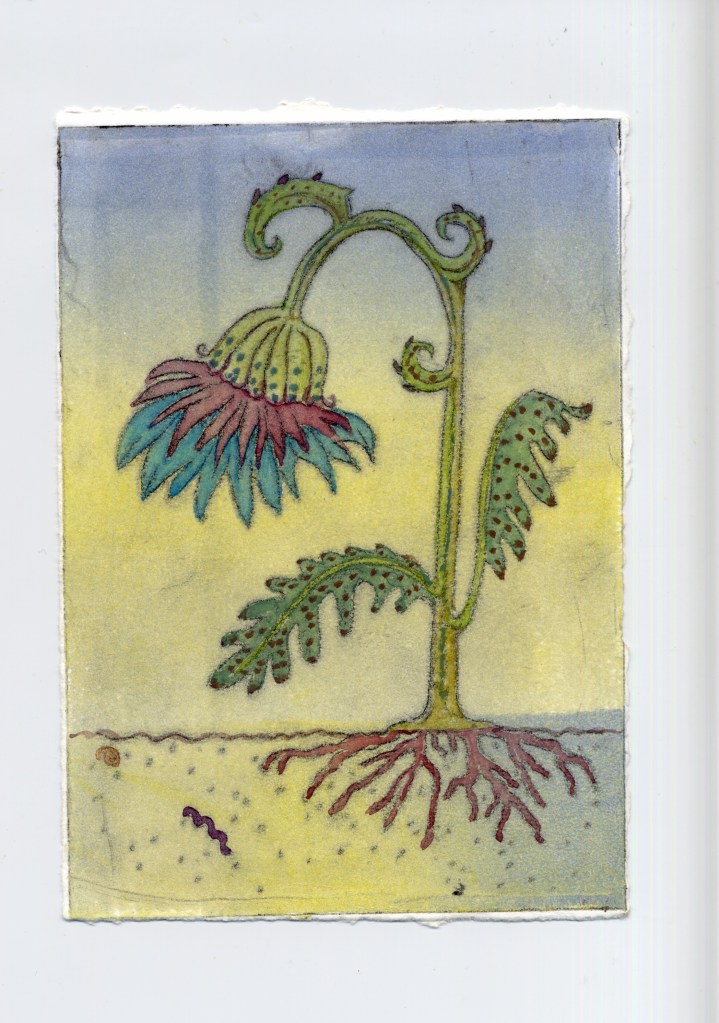
5/10 EV Herbarium Exotica I C Wilson 2021

A Travellers Journal. I followed the Handmade Book Club instructions and made a 2022 Planner – don’t know how I will cope with that concept… Canvas painted with runs of Golden Acrylic High Flow ink.
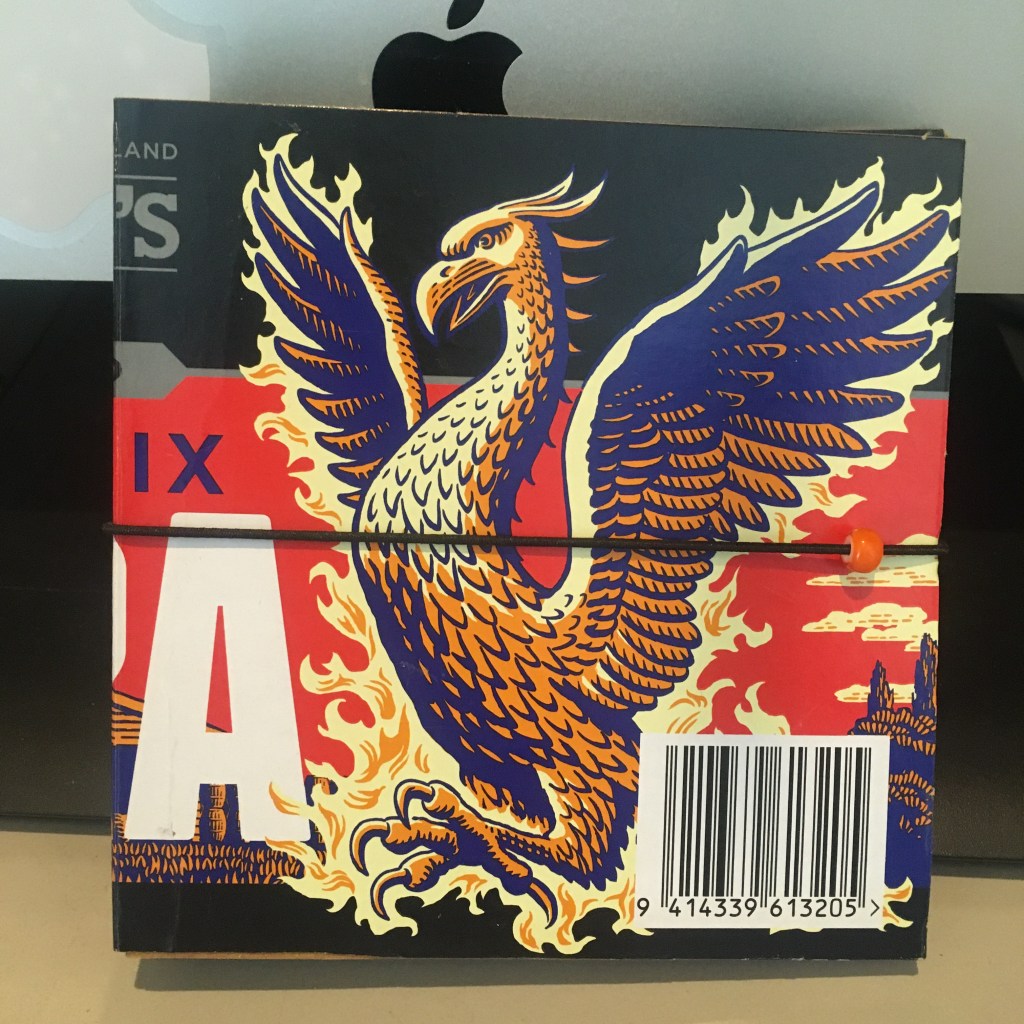
Before Christmas I made a few small travellers journals to give as presents. This one’s cover was made from the carton of a six pack beer – just loved the colours.

I took part in the show – Oxford Papermakers: Waiaraki Eyre River Project 4 – 28 November 2021
Alison Fleetwood, Katie Hallam, June Inch, Casey Macaulay, Elaine Steenhart, Tessa Warburton and Celia Wilson

  1. A collage of dry point prints showing the exotic weeds, coloured with local rock pigments, that thrive on the local braided river, Waiaraki/Eyre River. The course of the river near Oxford is depicted – adapted from images on Google Earth. I have used some paper that we made from these weeds. I started this work at the Printmakers Open House at the Oxford Gallery.
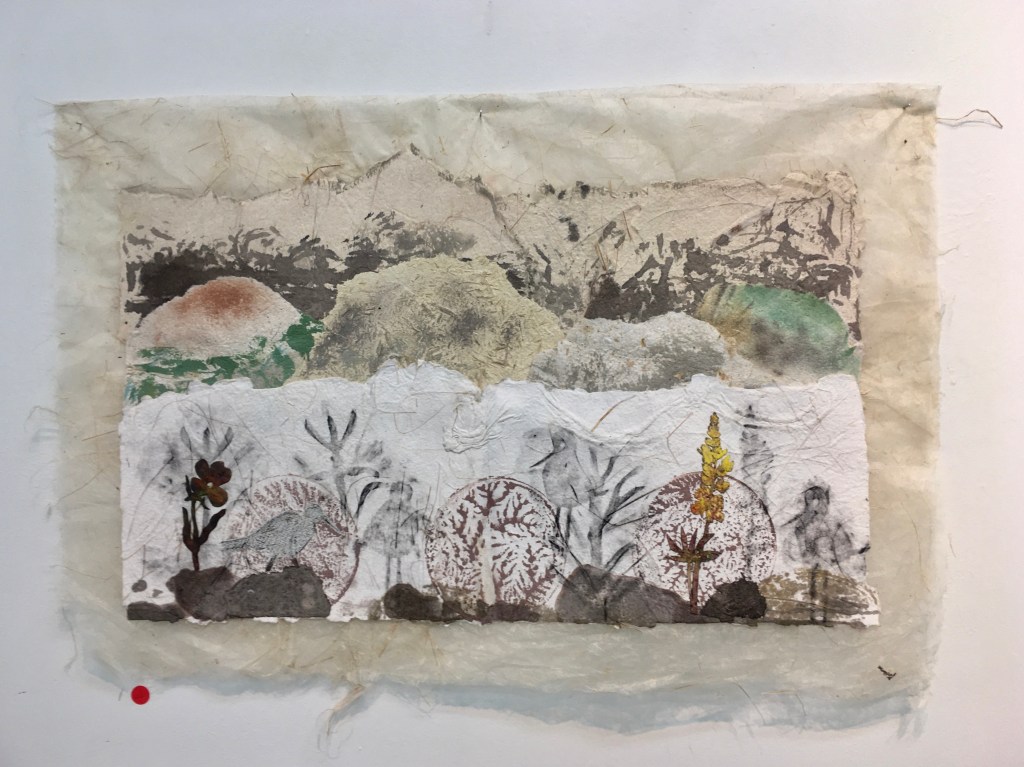
2. A bit of fantasy to show the local environment from river bed to mountains: Collaged handmade papers from the river plants, local rock pigments, and home made charcoal rubbings of collagraph plates. The backing paper is Harakeke paper made by Mark Lander who made the hollander beater that the Oxford Gallery Papermakers use. The Tree Lupin is painted with ink from gorse petals.

More about this show can be found at the gallery website under ‘Exhibitions’:- https://oxfordgallery.org.nz/

Waikawa Walks Pigments

Waikawa Bay is near Waitohi/Picton on Queen Charlotte Sound, and they are connected by a track through the Victoria Domain Park. There are other tracks in the Domain and you can walk to end of the peninsula; The Snout. We tried most of these three tracks and here are a couple of photos:

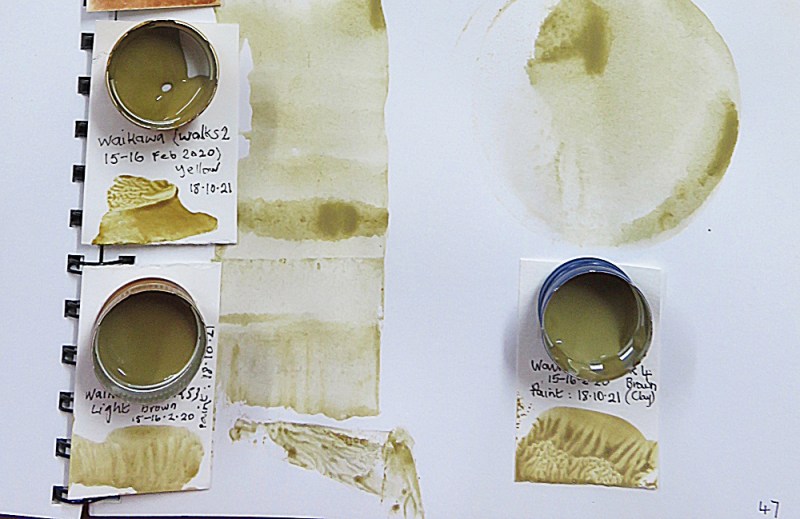
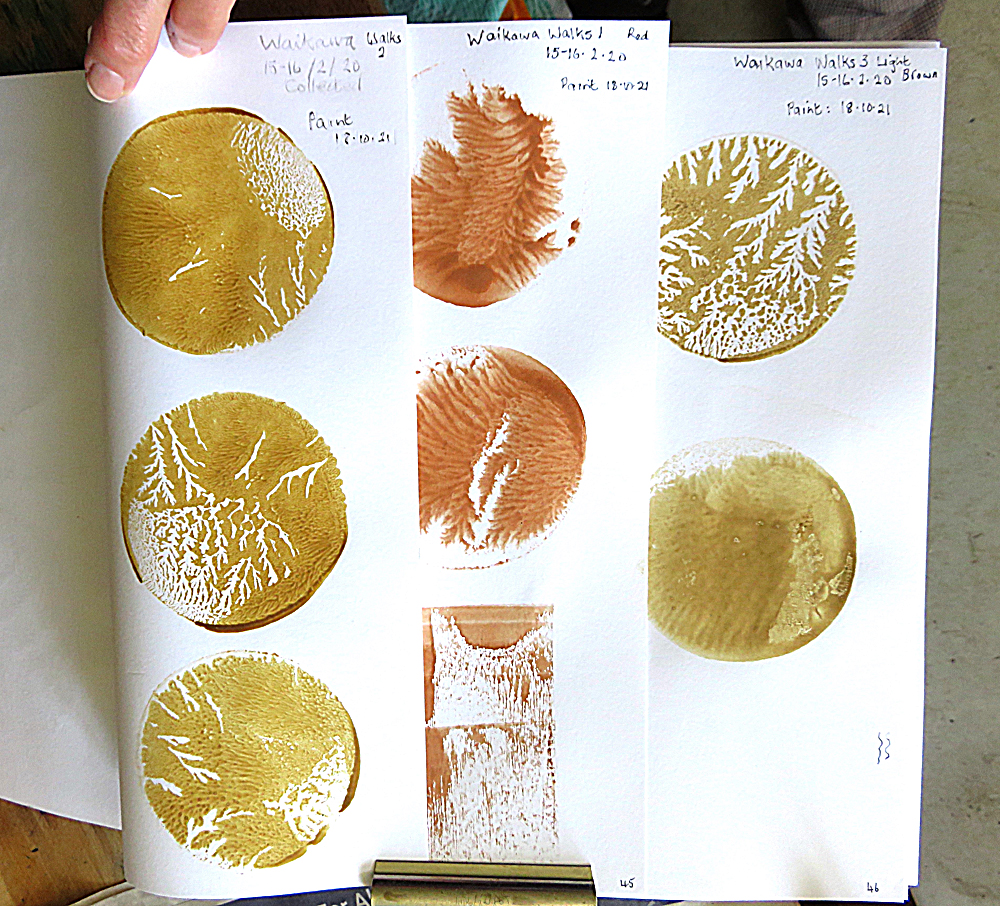
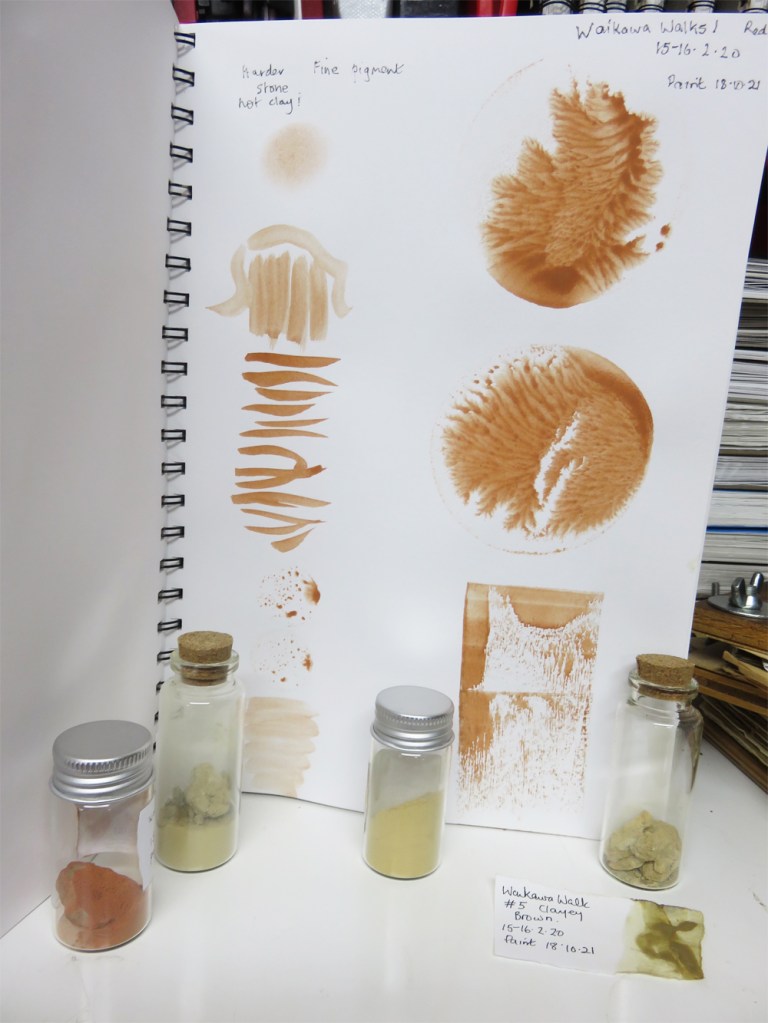
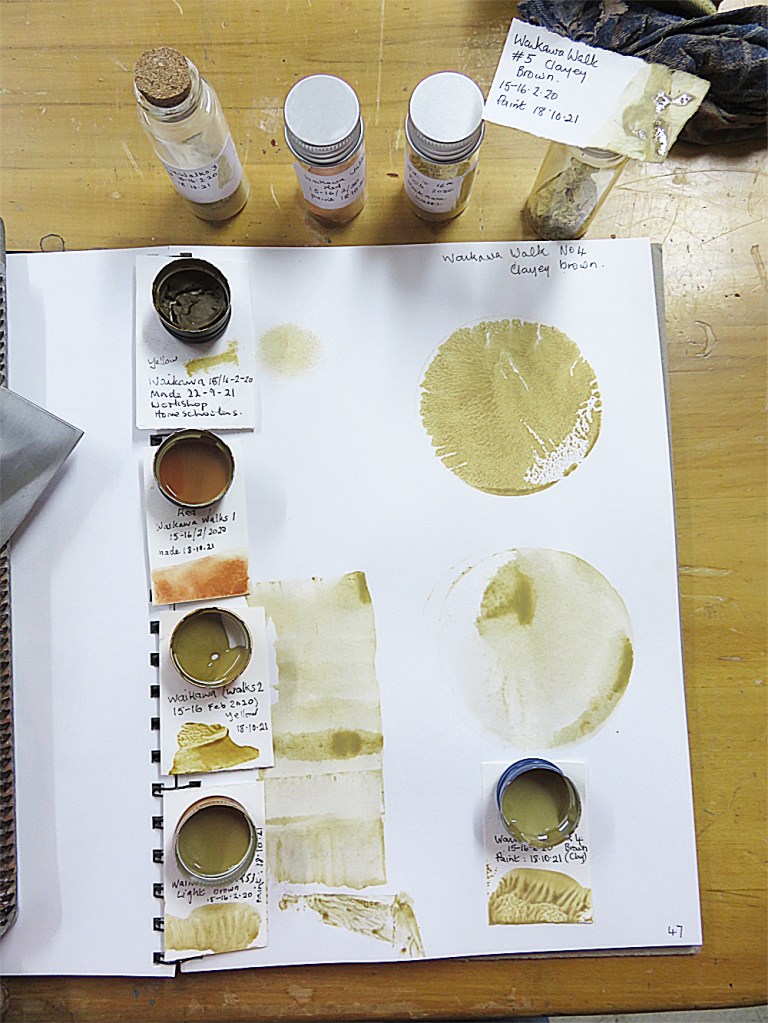
We were staying in Waikawa in February 2020, and these pigments I collected during the walks. These were three different clays and one harder rock (the red pigment). I am trying to catch up with testing these pigments. It made a relaxing task compared to working towards exhibitions!

I rather like the #4 pigment, has an slight green colour to the brown. The sample “#5” in the photos above is the first paint I made at the workshop in September and is #4. Just to confuse us all. It is interesting how yellow pigments can give a variety of darker colours. After the last Workshop in September I posted images of some of the paints made. These paint tests are made with the full strength paint, so the colours are quite dark. I have watered down the red paint, and I also rub some of the pigment powder on to the test page, for the record.

Paint Making Workshop

My most recent workshop was held for a group of local school children.

They were very quick to understand the paint making process, and made lots of bottle tops of paint – on average four each.

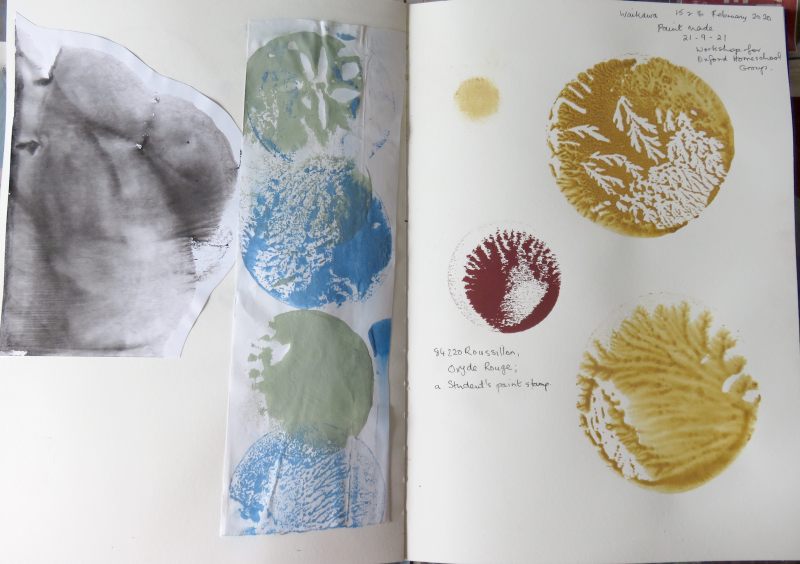
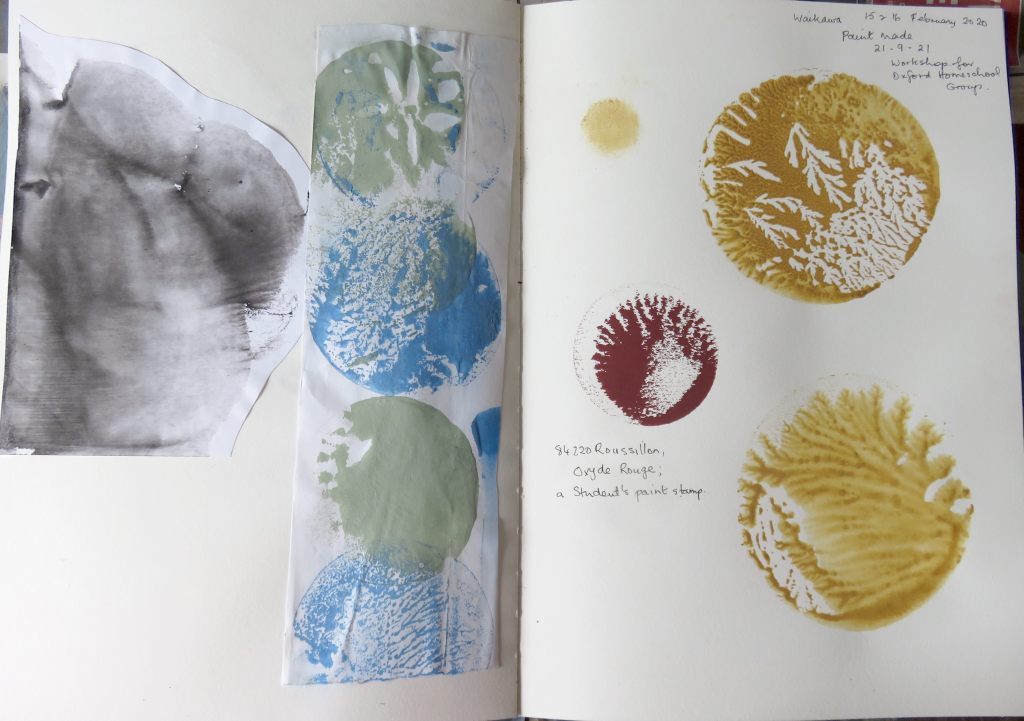
I had not tested the Waikawa ochre pigment before, so I chose it for the paint making demonstration. I used watercolour medium of course, as that is my favourite binder. Another muller print to add to my collection.

The students used commercially ground natural pigments, as I do not have enough of my own hand ground pigments for a large group and, anyway, the fineness of these pigments makes it easier for the students to mix into the binder. We used pigments from Roussillon and Natural Earth and Mineral Pigments.

They really enjoyed painting with their own paints! Some of their paint is shown below.

Birdlings Flat Pigment

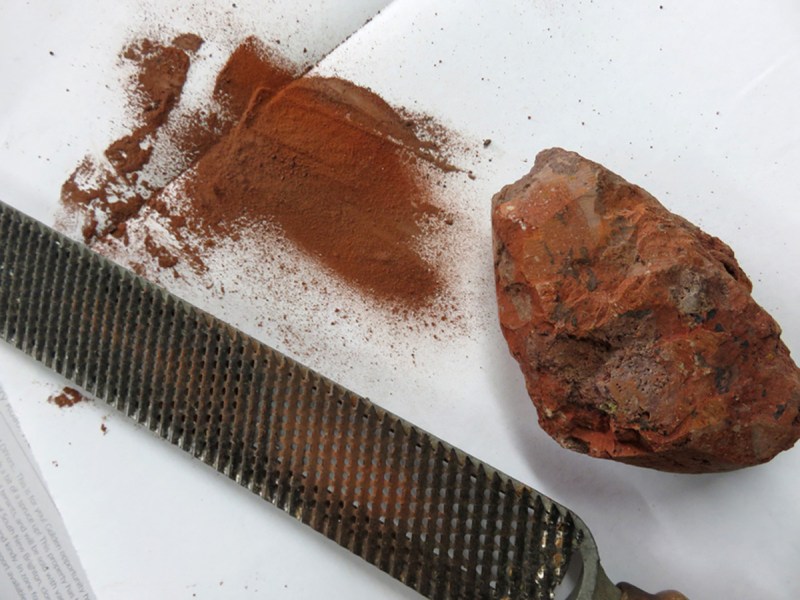
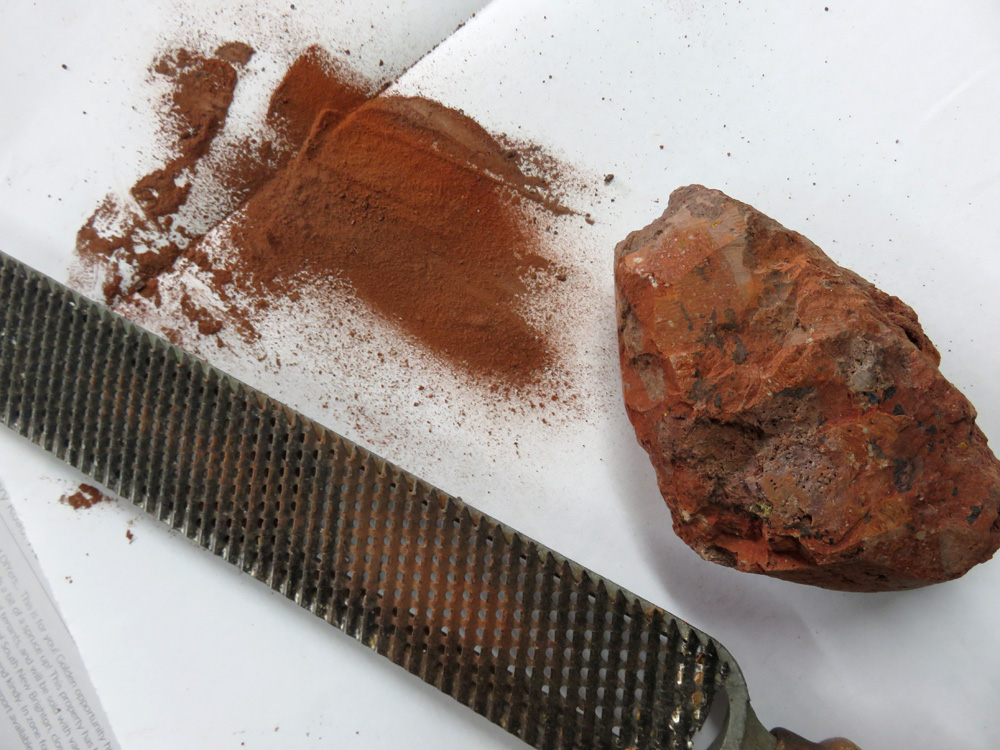
rock, pigment, file

Not sure why I had not tried this method of making pigment before. The volcanic rock is mainly red but has a lot of other minerals in it, and as you can see the ground pigment varies in red-brown colours. The ground pigment fell through the file onto the paper. I made paint with the pigment you see here.

Brown-red watercolour paint

The lower left swatch of paint wet in wet shows how the different pigments can separate out. This is on 100gsm paper in my test book, so the cockling of the wet paper has enhanced the separation of the different pigments.

I had been reading up on middle stone age pigment manufacture which included tests of possible way of extracting the powder. The article discussed direct grinding on the grindstone and I wondered why I had not tried this before (even though I knew about this method). I don’t have a grindstone, so the file was substituted. This method will work well on this type of rock which is relatively soft compared with some of the water-shaped rocks of rivers I see. So on rocks similar to the one here, I will definitely use this in preference to my hammer!

‘Direct grinding is the most efficient method to extract fine powder from softer shales and siltstones.’

Rifkin, Riaan F. “Processing Ochre in the Middle Stone Age: Testing the Inference of Prehistoric Behaviours from Actualistically Derived Experimental Data.” Journal of Anthropological Archaeology 31.2 (2012): 174–195. Web.

Earth Paints

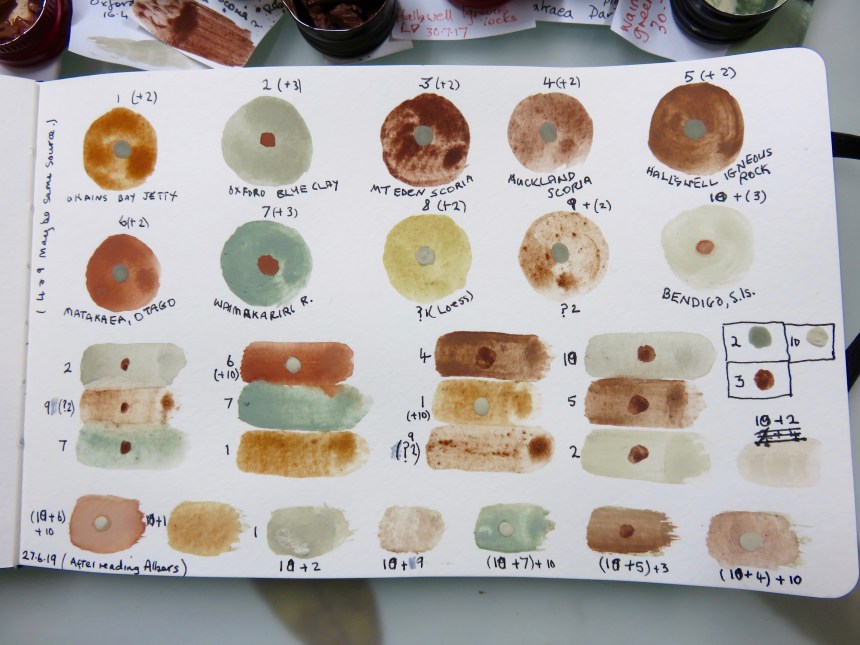
I usually put left over paint from my tests into wine bottle tops and attach a piece of paper to record the location, the date made and/or date collected and the colour. Here’s a selection that I pulled out the other day.

Waimakariri Green Pigment

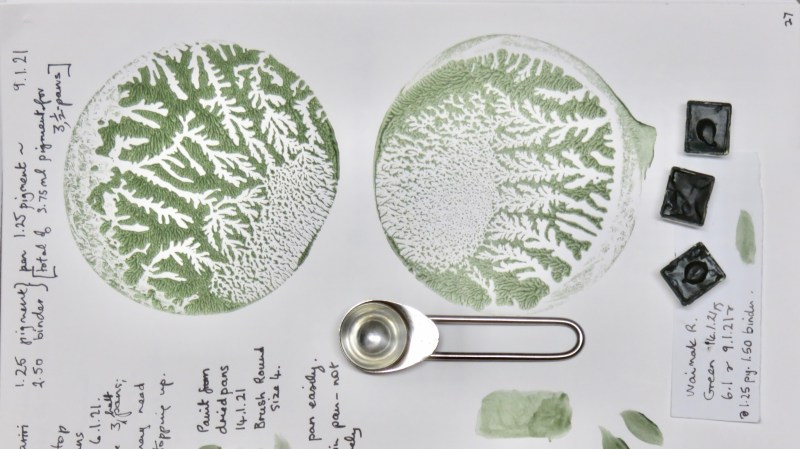
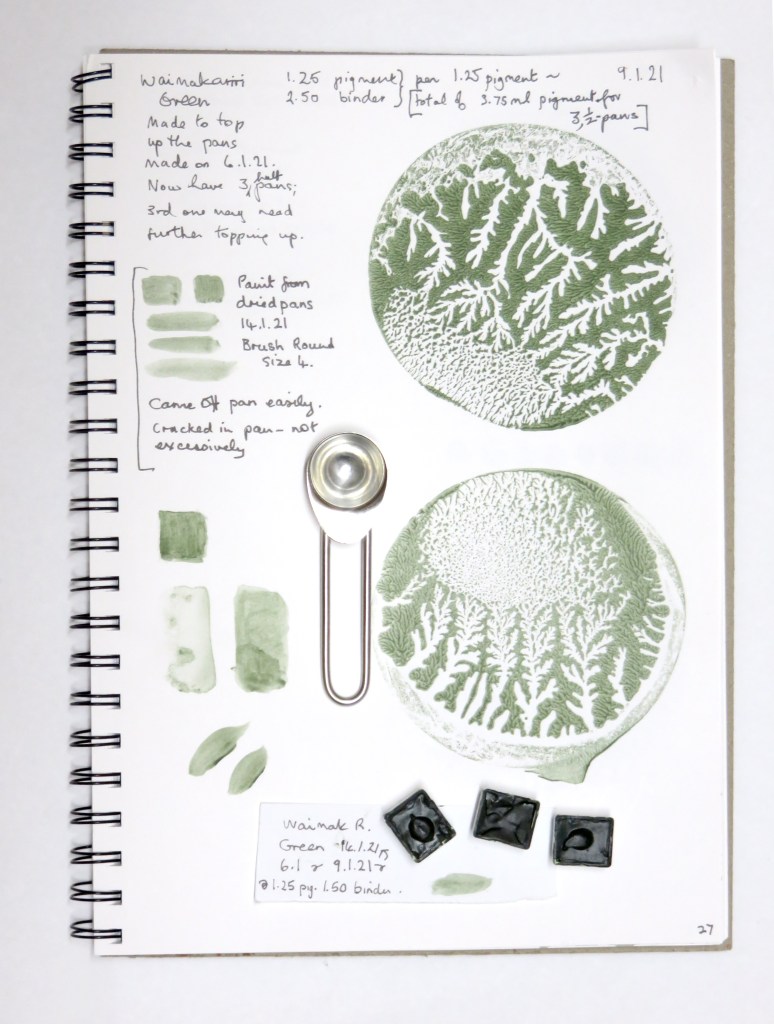
A page from one of my test books, showing this green sedimentary rock from the Waimakariri river. I make these tests every time a new paint is made. This in my ninth A4 book.

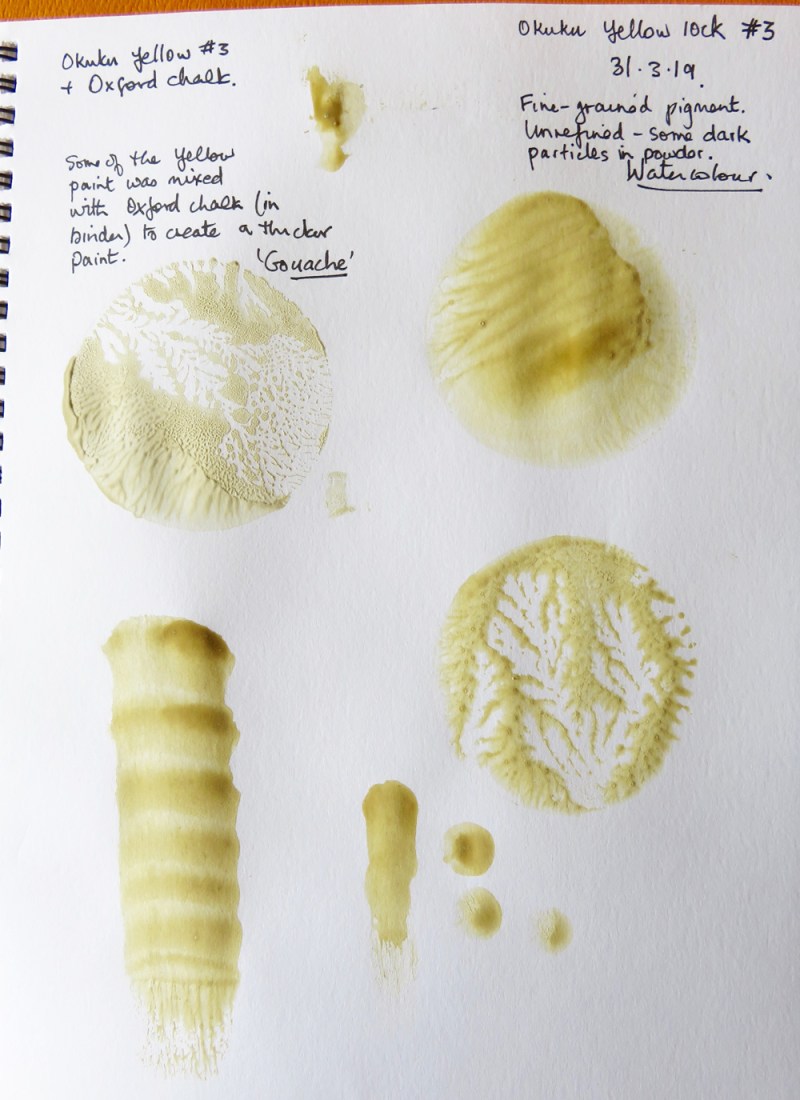
Okuku Yellow

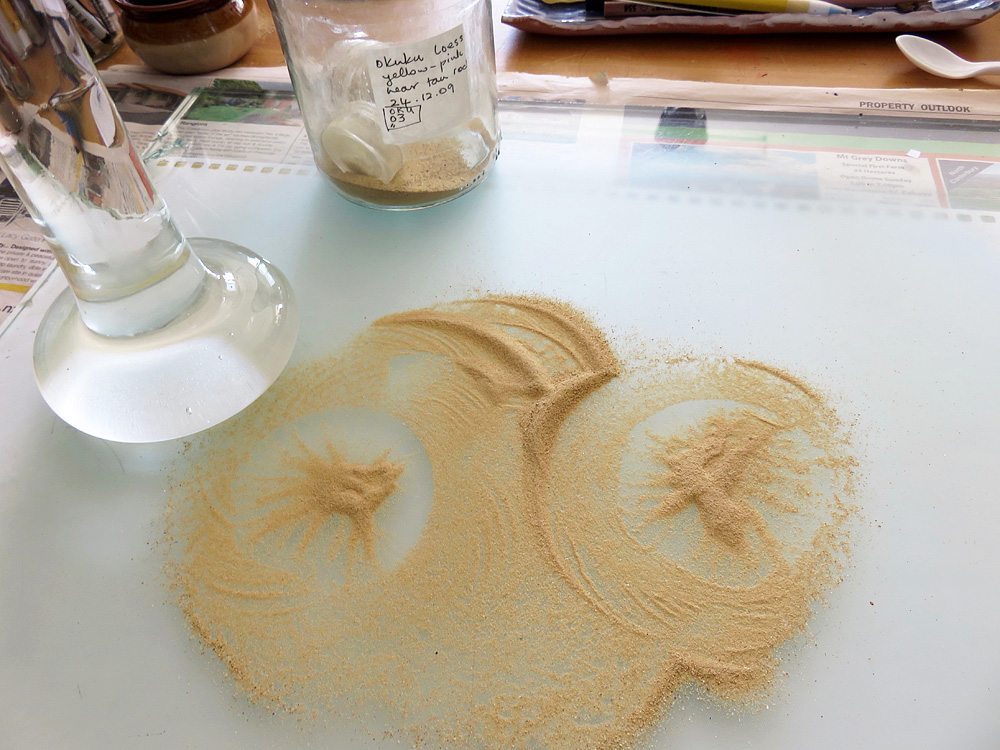
I found this pigment at Okuku Saddle, situated north of Oxford, in the Lees Valley.

This was a chunk of loess from beside the road and above is the watercolour and gouache paint made from this pigment. The colour of the paint is reasonably true – varying from light tan when thick, to yellow when diluted with more water. The circular shapes are created by pressing the muller on to the paper and the patterns form as the muller is lifted. The top right impression was made with a wetter paint than the impression just below. The paint is reasonably opaque when thickly applied; and the chalk gives a lovely pastel colour. I made this paint again (pigment collected in 2009) as part of research for an artists book I have planned.