Cotinus Dye Journey

Dye Pre history:

29 January 2013

Solar dye created with Cotinus coggygria and a small iron nail.

Cotonus-jar

Added pink silk and white cotton bundles containing honesty seed pods, aquilegia seeds and lupin seed pods.  Cotton fabric on top held under water with a cotinus twig.

2 February 2013

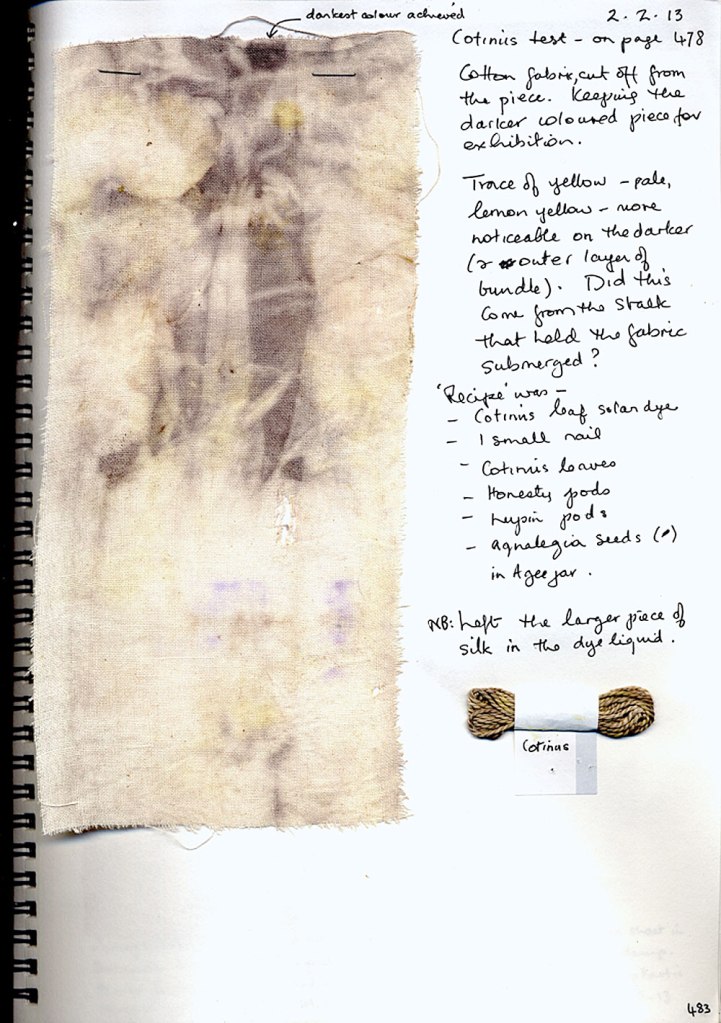
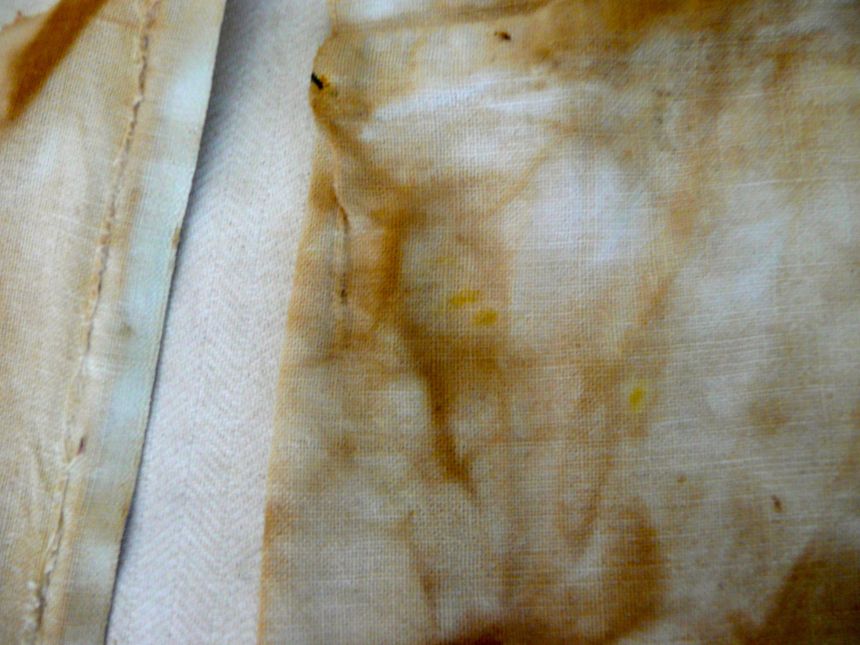
Bundles removed, inspected, and the silk returned as very little dye taken up in the centre of the bundle.  To brighten the colour I added some hypericum and hydrangea sola dye to the cotinus/iron brew.  The opened cotton bundle is below:
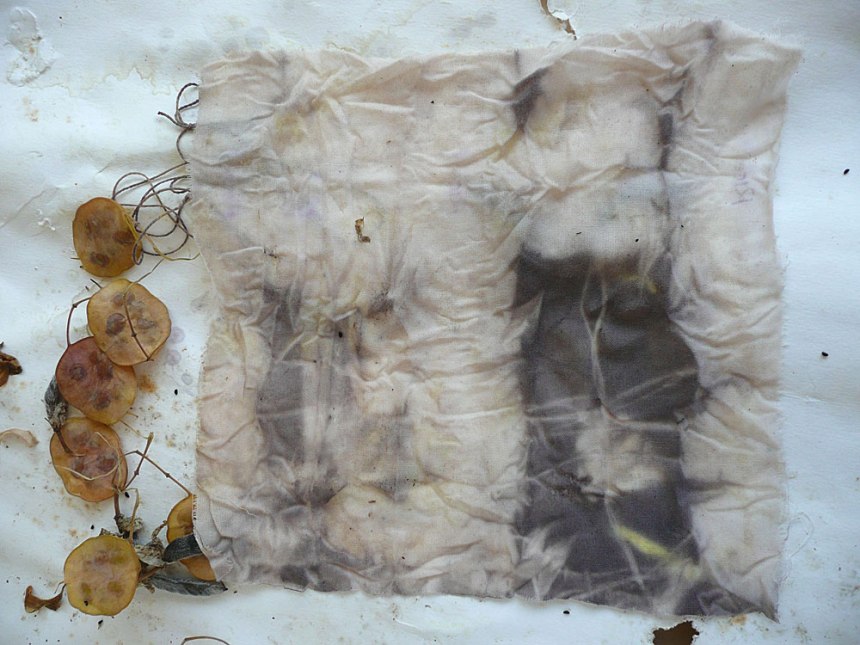
Cotinus-solar-cotton-bundle

ecoprint--cotton-continus

This is what happened to the silk bundle.
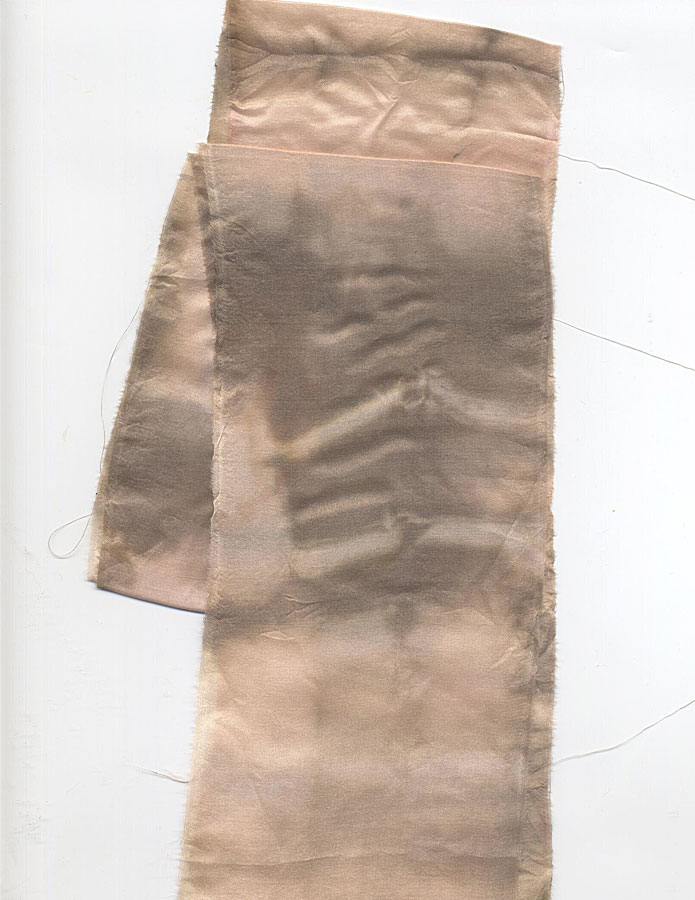
Cotinus-on-pink-silk-1

The ‘cotinus’ dye bath was not abandoned at this point but I put it in a larger jar to accommodate a linen bundle.

28 February 2013

Linen added.
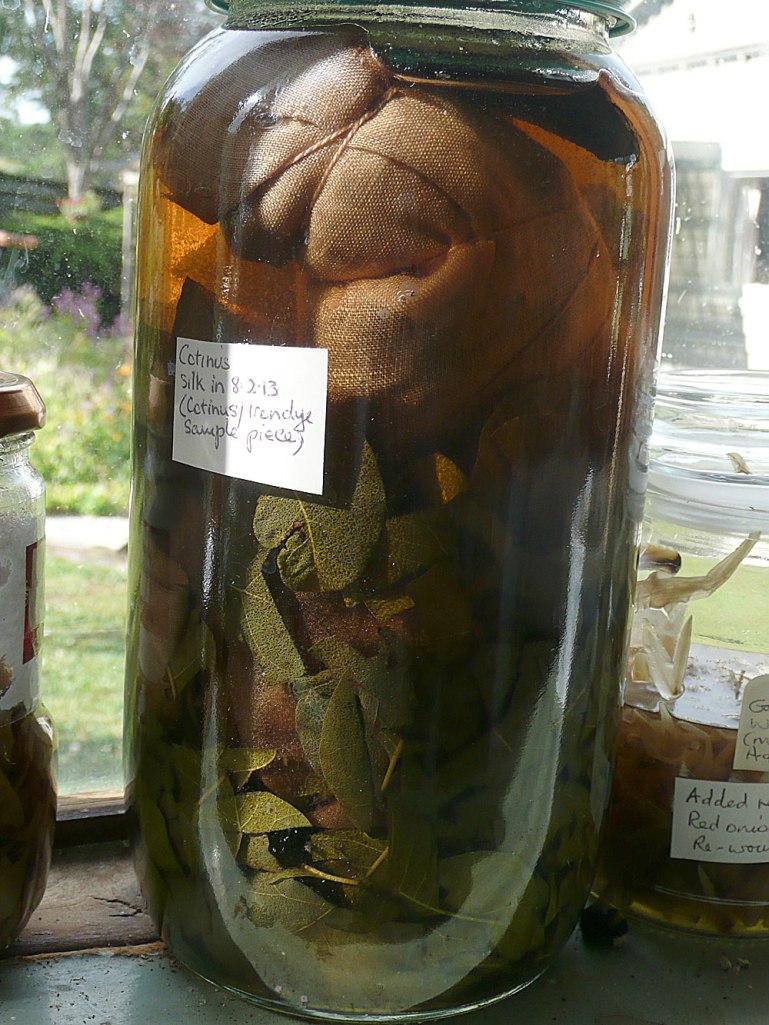
Linen-cotinus-sequoia

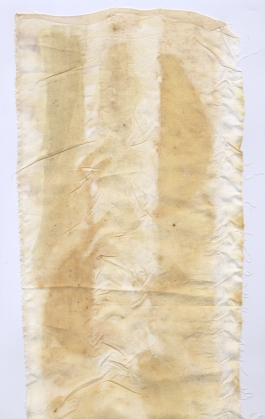
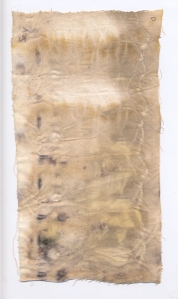
Sequoiadendron giganteum cones, dark red prunus leaves and sequoia bark in a scarf length of white linen (mordanted previously in alum) and bound with linen and cotton thread, was next placed in the Cotinus leaf solar dye, but this left little colour, even after the linen and dye bath were simmered for one hour.  Even though the colour of the dye was dark perhaps I had exhausted the dye content.  I think it was worth the effort, the gentle colours – blue grey, pink and palest brown.

Cotinusdye-sequoiabundle

Steam and Solar Dyes – New Zealand Plants

In this post I collect together the New Zealand plants I have recently used in steam and solar dyeing.

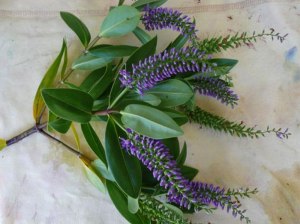
Hebe species.  Steamed bundles

Hebe-plant

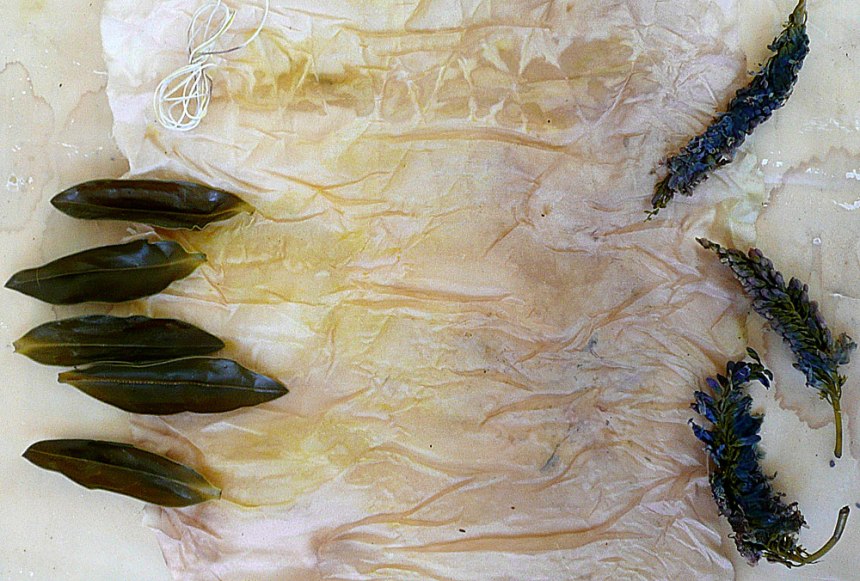
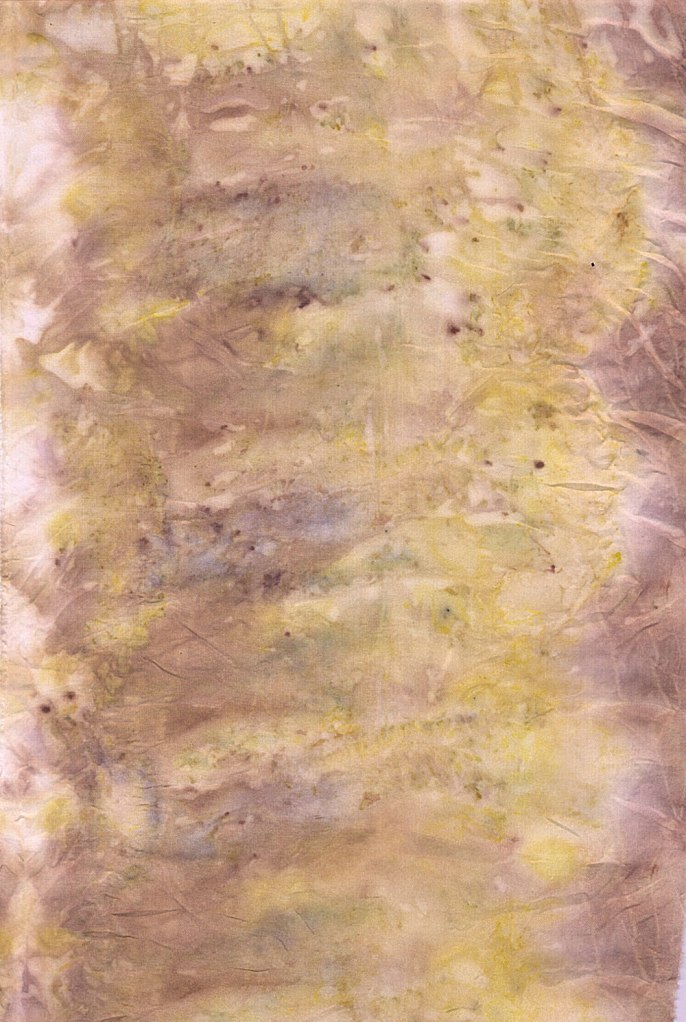
Hebe flowers and leaves were laid out on opposite sides of two silk bundles, with hebe twigs for the core. After steaming the leaves produced yellow and the flowers a mix of blue and a grey-pink-brown as is shown in the smaller bundle below.  Although as the silk used was already dyed a pale ‘salmon pink’, this background colour does not look very pink in the photograph…

Hebe small silk

Good colours, but not much definition of leaf or flower shape, and I still had the heat too high causing damage to the silk as you can see at the top the image above.  The photograph below shows part of the larger piece of dyed white silk.

Hebe-large-silk

Beech Leaves – Nothofagus species.  Solar dye

Nothofagus

I placed the leaves in water in a large jar.  No colour emerged, so  I decided to simmer the leaves, but unfortunately damaged them by letting the water in the pot dry out…

In 1849, when the British settlement of Canterbury started in earnest, the area named Oxford  by the early surveyors was covered by a large forest – Harewood Forest, which has been described as ‘the most magnificent stand of virgin bush in Canterbury and unique because of its variety.  It originally covered 56,000 acres [22,662.40  ha] and was the magnet which attracted the sawmilling community from which the present town grew’  (Oliver A Gillespie, Oxford, the first hundred years).  The forest  was logged for timber for the growing settlement around Christchurch and was nearly destroyed in 1898 by a fire which swept through the area, fanned by the strong winds that occur in Canterbury.  The last sawmill closed in 1912.

I will repeat the solar dye at some point, as I am lucky enough to have these trees growing in the garden.  There are still clumps of the forest remaining close by – and we find seeds from these oases arrive via the birds and grow well in the undisturbed parts of the garden.

Kapuka – Griselinia littoralis.  Solar dye

Griselinea

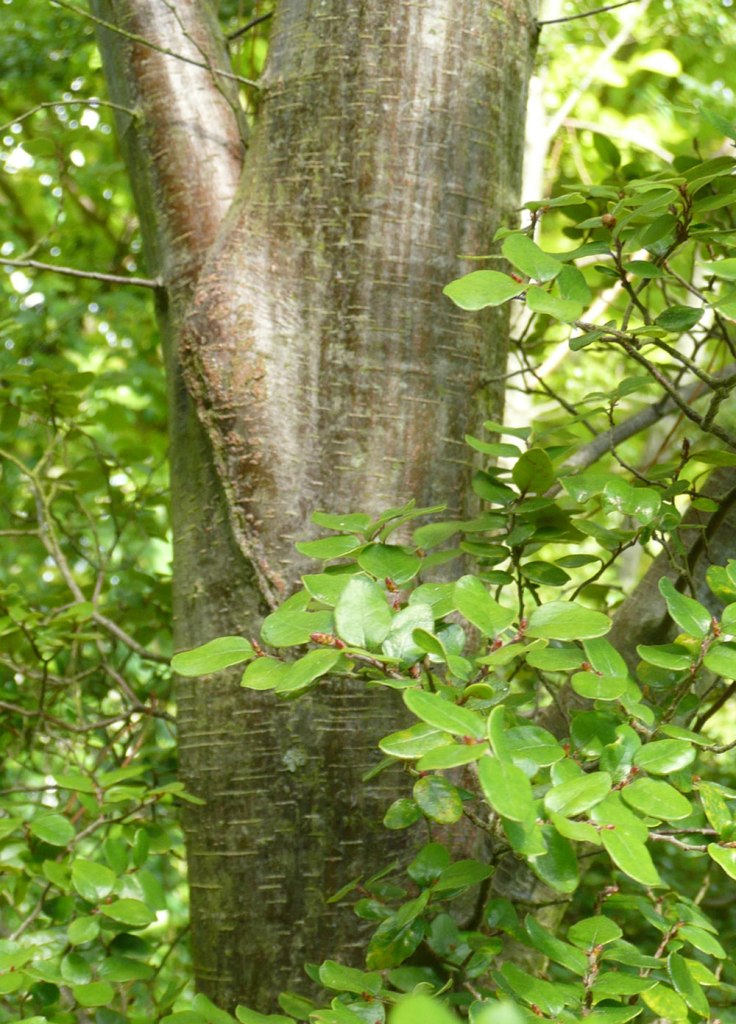
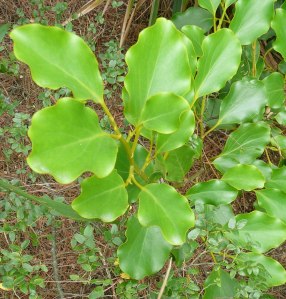
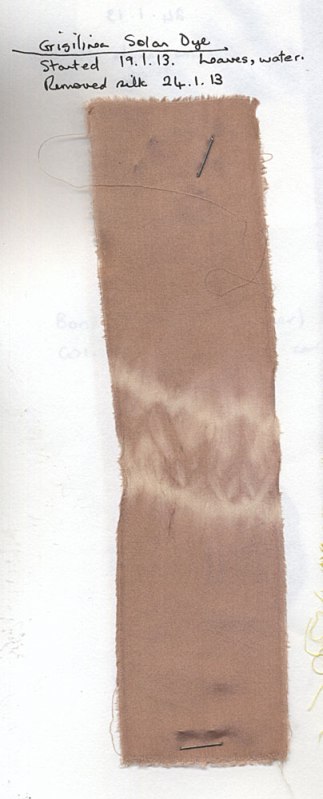
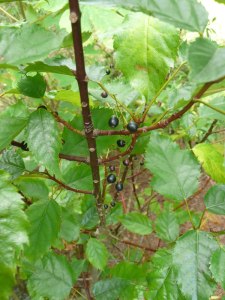
This tree is found in lowland and subalpine forest throughout New Zealand.  Griselinea has small flowers, which are green in the female and yellow in the male plants, and the berries are black when ripe.  For my test I used the green leaves which I cut up, and tied a knot in the alum pre-mordanted silk.  The berries are now on the trees, and ripen from March to June.

Griseliniesilksample

Wharariki, New Zealand Mountain or Coastal Flax Plant – Phormium cookianum.  

Steamed bundle and solar dye.

I think the flax plants in my garden are cultivars of P. cookianum.  The leaves have distinct colours – either green, yellow, pink and orange, or in combination, each plant being different.  The flowers are small and, characteristically for this plant, the seed pods hang downwards and are more or less twisted.  Our flax plants have not flowered yet this year so I wonder if they flower every year.  (See more details here :  <http://www.landcareresearch.co.nz/science/plants-animals-fungi/plants/ethnobotany/weaving-plants/information-sheets/harakeke-and-wharariki> )

This piece of silk started life as a steamed bundle containing a fallen Magnolia bud, but very little colour came from this (here the silk is still wet).  Taking this silk I  rolled up a new bundle containing just yellow flax leaf pieces and put it on to steam with the Hebe bundles mentioned above.  The vein down the centre of the flax leaf left a good red mark on the silk.

P1170291

P-cookianum-silk

Makomako or Wineberry – Aristotelia serrata.  Steamed bundle and solar dye

 The plant is found throughout New Zealand in lowland and subalpine forest, especially in clearings.  The solar dye liquid has a sweet, wine-like smell.

Aristotelia-serrata

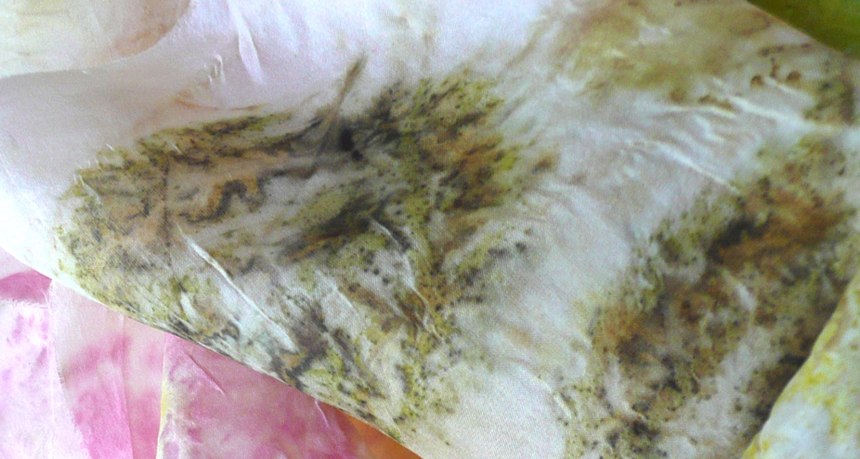
Incorporated into a steam bundle of mixed flowers and leaves, were some Flax, Wineberry and Griselinea leaves, and Hebe flowers.  The Wineberry leaves gave a good imprint.  This is seen in the two images below.  The purple-grey marks are from the leaves which are thin and translucent.  (The pink in the background of the second  image below is from hollyhock flowers.)

wineberrybundle

Wineberry

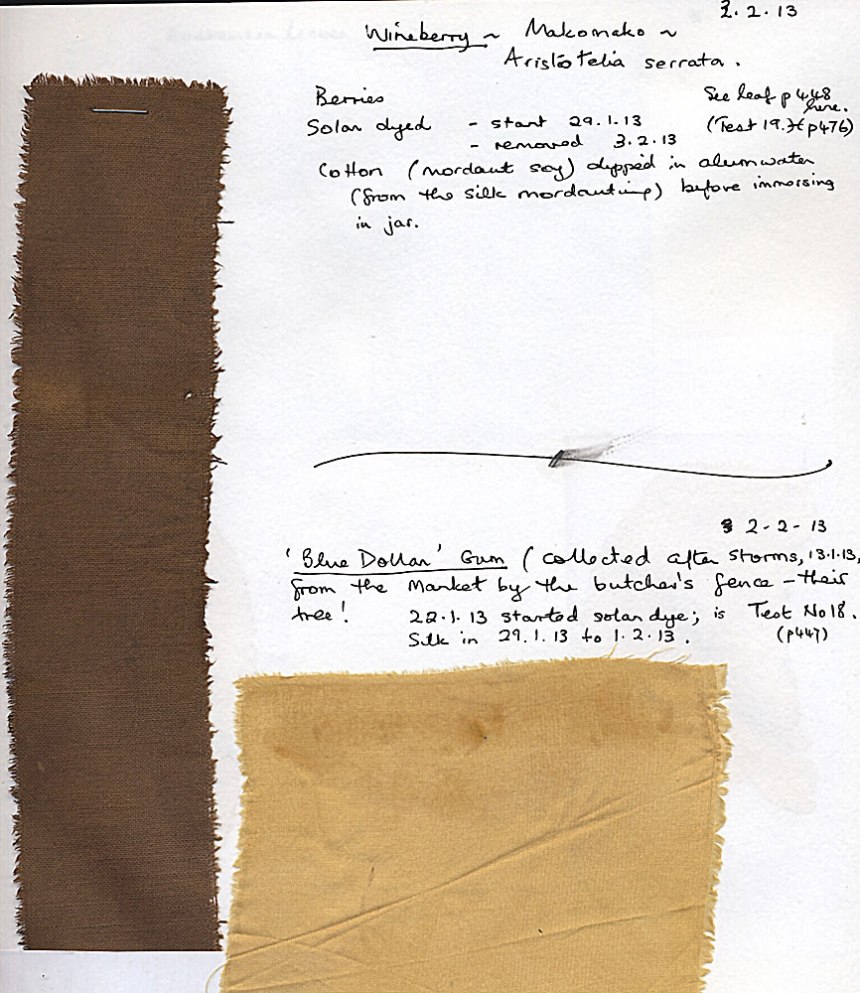
The berries, which are edible, are red when mature and black when ripe.  I picked black berries and solar dyed the cotton shown below.  The colour of the dye is very strong.  This entry in my workbook is shared with a eucalyptus solar dye.

Wineberry-solar

The Eucalyptus (I think it is blue dollar gum) shown above, leads nicely into my next post which I intend to be about my other solar dyes.

For information on the plants I referred to NZ Flowers and Plants in Colour by J. T. Salmon, edition published in 1986.  Some of the plant nomenclature has changed since then, but I have used the current plant names.  All plants come from the garden.

Solar dyeing – Hypericum

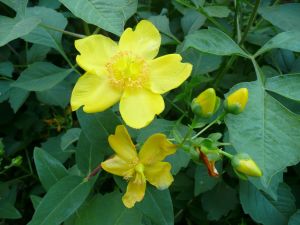
For one of my first solar dyeing experiments, I used St Johns Wort, Hypericum, from the garden. My plant is one of the many varieties of Hypericum.

St Johns Wort flower

On 6 January I placed the buds, leaves and flowers separately in three glass jars, filled with tap water (Oxford bore) and placed a weight on the top to keep the unmordanted cotton cloths submerged.

The following image is the dyed, scrunched up cotton from the jar that contained buds and two stones, one of which must have had a generous amount of iron in it as it introduced a black colour.

Hypericum buds

The resulting green, blue and black was very nice to see.  The cotton from this and the next jar was removed on 17 January.

The jar with the chopped up hypericum leaves contained a Waimakariri river stone to weigh down the leaves and three folded and tied cotton bundles with different contents.  In the photograph below, the top scrap of cotton was folded on its own.  The lower scrap enclosed more hypericum leaves and some Acacia melanoxylon bark.  The leaves in this bundle came through as a pale green-yellow, just visible in the image.  The thin strip on the right is 300 gsm Fabriano paper, folded and placed in the jar with the bundles.

Hypericum leaves

The third bundle containing flower buds is below.  The yellow buds did not seem to change the colour; I do not know where the grey marks came from!  Interesting that the iron caused such a different colour to appear in the first jar.

Hypericum

The third jar containing hypericum flowers and a piece of wire that I thought was copper was left until 28 January when I removed the cotton.  Some brighter traces of yellow appear, perhaps through contact with the wire.

Hypericum copper

On 19 January I started to record my solar dyeing tests and to date I have 35 of them.  No wonder I have not had a chance  to sit down at the computer.  The weather has been hot and mostly dry for about three weeks,  even now at 5.51 pm it is 27 degrees C in the studio (built as a greenhouse).  I recorded 47 degrees C one day on the shelf by the windows were I place my solar dye jars.  The garden is full of flowers and I could certainly never need to go out further afield in search of material for dyeing. I hardly know where to start.  I would prefer to concentrate on New Zealand native plants and have solar dyed with Harakeke the New Zealand flax plant – Phormium cookianum; Griselinea littorals; Hebe; and Wineberry – Aristotelia serrata.

I have been reading Richard Mabey’s book Weeds; How Vagabond Plants Gatecrashed Civilisation and Changed the Way We Think About Nature, published in 2010.  Chance and serendipity are rife here at the moment – I found this book in the library by chance – and I was also concurrently very curious about a weed that was new to me.  I eventually found this plant on the internet by using the search terms ‘tiny white flower weed’.  The plant is called Galinsoga parviflora and has the common names of Gallant Soldier or Potato Weed.  Well, it is growing in the vegie patch and appeared last season – near the potatoes.  Then I discover from the Contents that Mabey’s book  has a chapter entitled Gallant-soldier!   It so happens that this plant, a member of the daisy family, arrived at Kew Gardens in 1793 from Peru and was named after the ‘splendidly ennobled’ Spanish botanist Don Mariano Martinez de Galinsoga.  This plant has the tiny-est flower I have ever seen.  It escaped Kew Gardens in the 1860s and eventually found its way to my garden.

Another serendipitous moment arrived when I read in this book that in 1748 ‘a celebrated [British agricultural] improver,  William Ellis, who farmed at Little Gaddesden in the Chilterns […] was experimenting with different methods of weed control and pasture management’.  Ellis used clover as an effective way of controlling weeds. This nitrogenous crop could be ploughed in so was also a great cost saver as hand weeding would not be required.  I expect my ancestors from Little Gaddesden took to straw-plaiting to supplement their incomes, no longer being required to weed the Corn (wheat) fields.  Actually, we have also used clover as a weed suppressant – we have a bricked area that we despaired of – after two years hand weeding between the  bricks we once tried the chemical way but not really wanting to do this gave that idea up pretty fast (and it didn’t work really for the weeds came back quickly).  We finally decided to just mow it!  It works wonderfully, and is a haven for the bees as the clover is taking over.

Much to my comfort, Mabey also talks about Hypericum perforatum.  “Each leaf is covered in tiny transparent dots (the perforations of the Latin name…) and held up against the sky the sun’s rays prick through, like dapple in a springtime wood.”  A good connection with embroidery there…

This is miles away from eco-print and solar dyeing… and the dye from Galinsoga is a pale straw colour.

(Mis)Adventures in Eucalyptus Eco Printing (2)

Testing eucalyptus on silk and cotton again.

Eucalyptus leaves

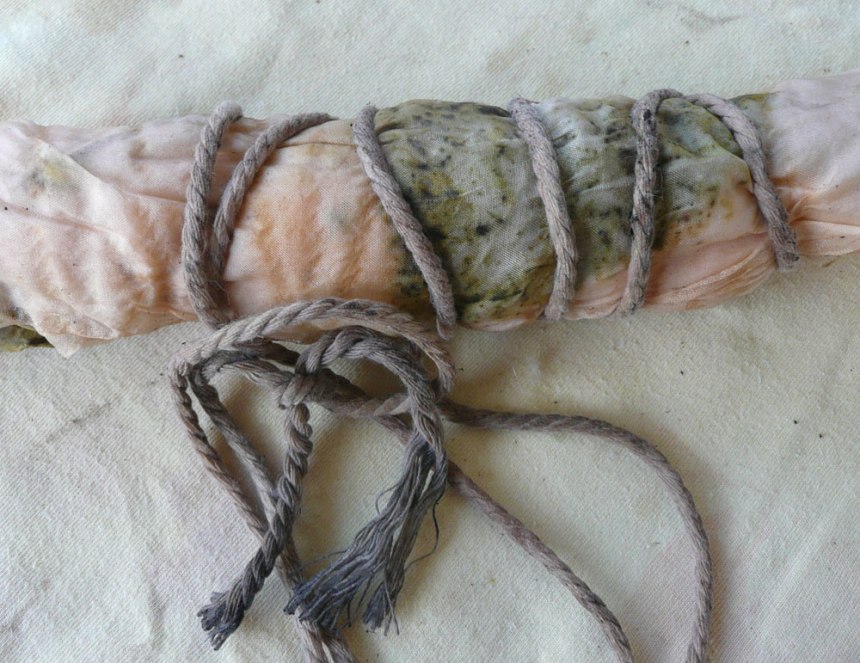
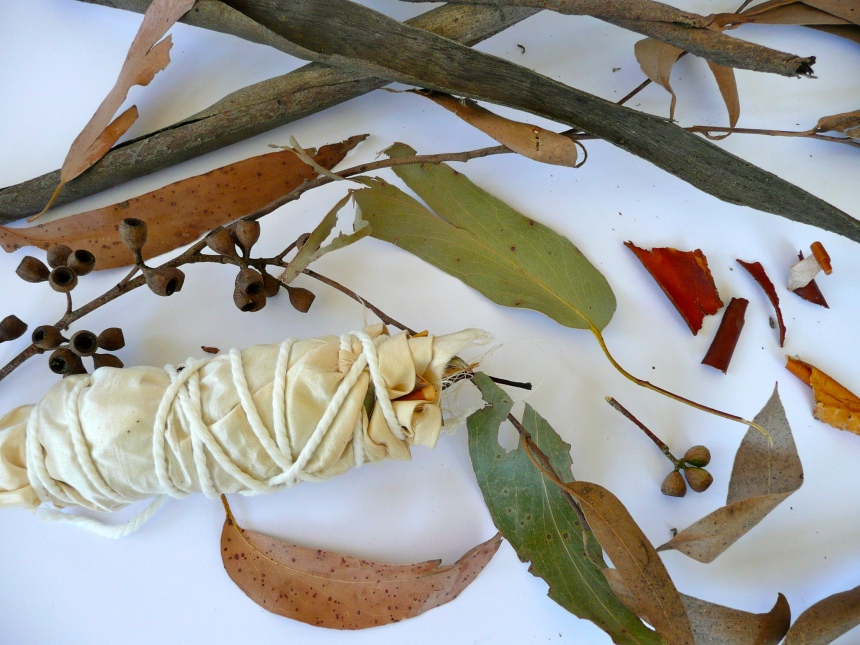
Last week I collected some more dried, fallen, eucalyptus leaves from the same tree as before.  You can see what beautiful colours these dried leaves have.  The green leaf on the left by the twig was a fresh leaf blown down by the recent north-west gales.  These leaves were placed on dampened, un-mordanted silk and rolled up in close contact with the cloth.  The eucalyptus twig formed the core of the bundle which was bound with cotton knitting yarn.

I made three more silk bundles with eucalyptus leaves, the smallest one was rolled up on itself with no eucalyptus twig in the centre. Two cotton bundles were also steamed.  I used some more of the cotton fabric as in the first tests, but this time it was mordanted with soy milk.  One of these cotton bundles contained only a small stem of daphne leaves and pink-red flower buds.

eco  bundles

I used the colander as a steamer basket with the pot lid to cover.  I steamed the bundles for one hour as this basket arrangement was not very air tight.  At one point the water nearly dried up, and I think the temperature in the pot became too hot as the silk fabric on the outer layer along one side of the largest bundle is stiff and ‘fused’ together.  One cotton bundle also showed signs of heat damage as well.

I finally managed to get more colour on the fabric pieces!  Still not what I would have expected, as is shown by the large silk bundle pictured below (left).

Lge silk bundle

This is the small silk bundle. Colour from the leaves and bark has been taken up by the silk quite well.

Silk e eucalyptus

This is the soy mordanted cotton fabric.  The bundle contents were daphne leaves and flower buds, and an eucalyptus twig core.  The cotton has absorbed quite a lot of colour.

Daphne on cotton

The following day I had another go… A post to come soon.

(Mis)Adventures with Eucalyptus eco prints

Plunging in with eucalyptus and silk.

In early December 2012, I started to try using eucaplytus leaves on silk and cotton fabric.  I went down the road to where a gum tree planted by Mrs White in the late 19th century towers above all other trees.  I collected dried, fallen leaves and fresh-when-cut leaves; see pods; bark; twigs from the prunings by the tree frog machine that took place a fortnight earlier.  Using India Flint’s method on page 264 of her book Second Skin, I rolled up in the silk the leaves etc around a bark covered twig for the core of the bundle of fabric.

First silk bundle

In a stainless steel pot I simmered the following for 30 minutes:

One bundle of leaves, bark twig, seed pods all tied up with a polyester piping cord.  An extra piece of eucalyptus bark; extra eucalyptus leaves; coil of aluminium wire 1 mm dia x 170 mm long; a piece of aluminium foil 80 mm x 200 mm; a used tea bag; tap water from kitchen, with a top up from laundry tap as necessary (untreated Oxford town bore water, no chlorine).

I was a bit nervous nothing would happen.  I was correct!  Well, something did happen, but not what I desired.  This is typical art progress!

After 30 minutes I turned off the heat and left it until the next day.  Without  removing all the cord, I had a peek to see what was happening when the bundle was cool.

First silk bundle

Apart from the resist created by the cord and plant material, very little colour came through from the eucalyptus, the whole piece being dominated by the dye water, as far as I understand.  I also wondered if this material was, in fact, silk.  I have had it for about twenty years and it was an old piece when I was given it.

Undaunted, you might say, and buoyed up by India Flint’s Eco Colour, I researched and read the internet – more very useful information from Alice Fox in the UK,  Wendy Feldberg in Canada and Cassandra Tondro in the USA  – thanks SO much for this.  I re-read the information to sort it all out in my mind into an ordered format so that I could at least intend experimenting in a reasoned fashion and record the tests in my workbook.  I made ash water from the wood burning stove ash, and then got jars of copper, alum, rhubarb and iron water underway.

The ash water had been strained through an old cotton pillow case, so I thought I would put this mordanted fabric in a hot dye and used the left-over silk bundle eucalyptus brew.  This still contained the leaves, aluminium foil and bark, and I also put in some Sequoiadendron giganteum bark from the garden as well (another tree planted early on in Oxford’s history) and a small dash of the rust & vinegar water I had used in my earlier paper experiments (just for good measure).

The cotton bundle contained an old rusty nail as core, lemon balm leaves and  one eucalyptus leaf at the end – all tied up with the cord previously used.

Eucalyptus cotton iron

I also put in a sheet of paper, concertina folded, enclosing another eucalyptus leaf, and held together with two rusting bulldog clips. Later I added another folded sheet of ordinary printing paper.

Euc thread Bond

Euc fold

As the experts will know, the water got very black!  I did not record how long I left the contents heating, but must have been about under an hour.

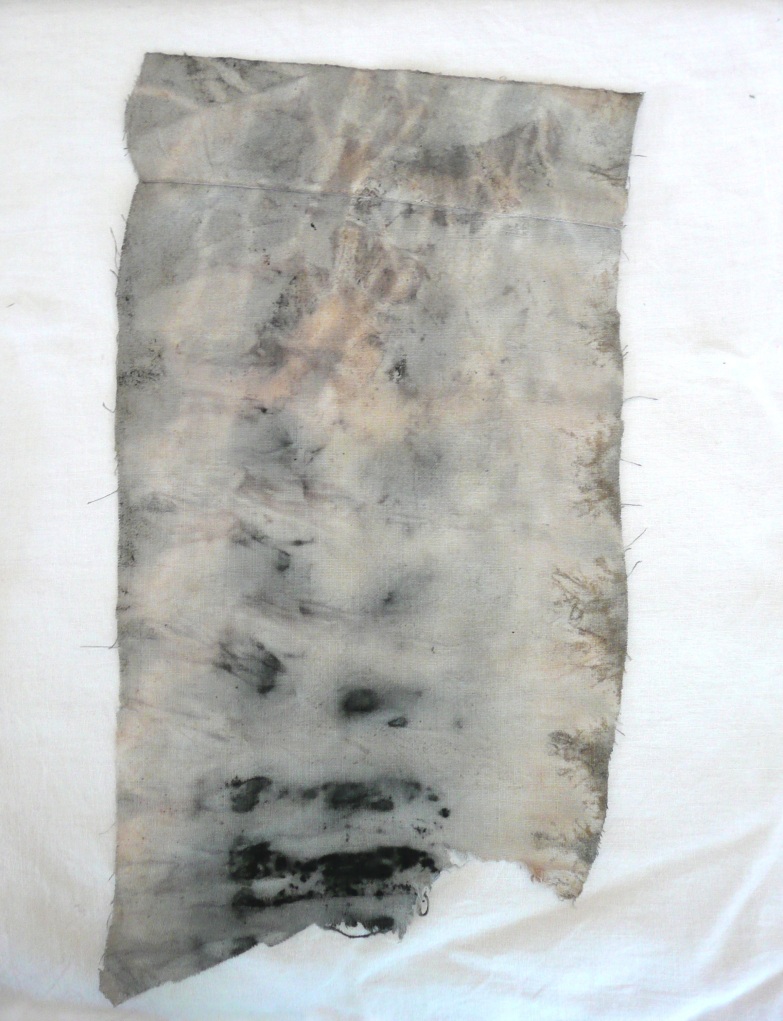
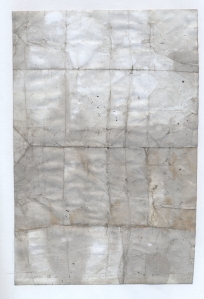
The results:  the cotton dyed fabric is above showing the black marks from the nail, and I think the eucalyptus leaf is showing at the top where I laid it across the hemmed fabric.  The two paper experiments are the smaller images – the bulldog clip marks are seen in the left hand image.