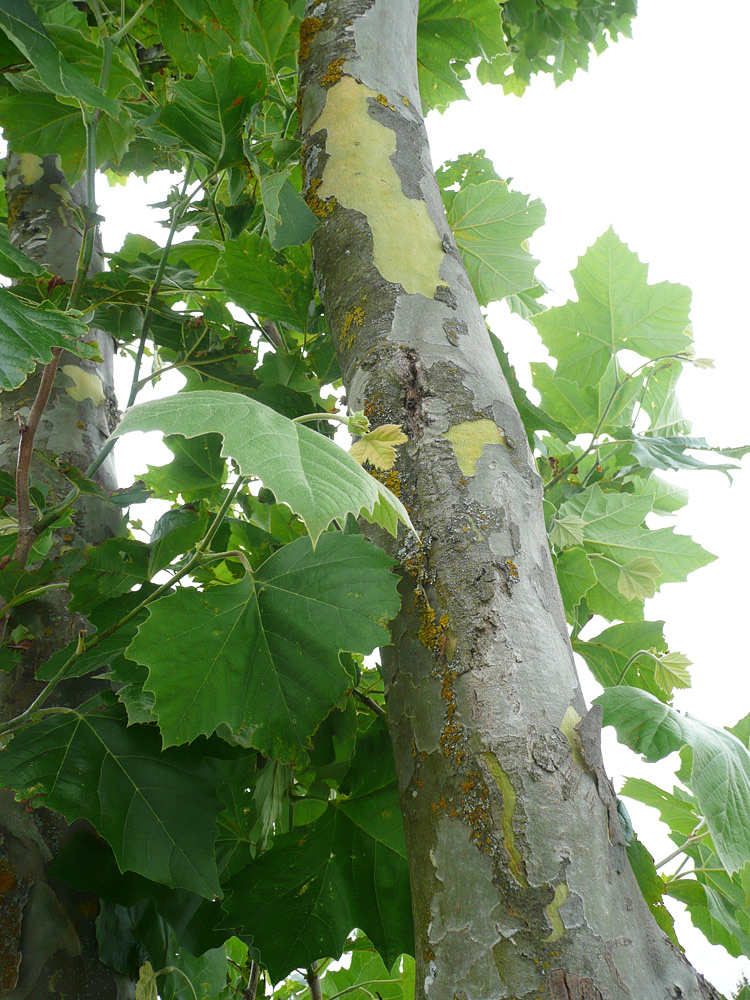
I went out to find the tree – it is what I know as a London Plane tree – and it seems to be known under various botanical names and I won’t bother to list them. Glad that little problem sorted… See previous post.
Earth pigments, paint, painting, printmaking, eco colour and visual arts; Canterbury, South Island, New Zealand
I went out to find the tree – it is what I know as a London Plane tree – and it seems to be known under various botanical names and I won’t bother to list them. Glad that little problem sorted… See previous post.
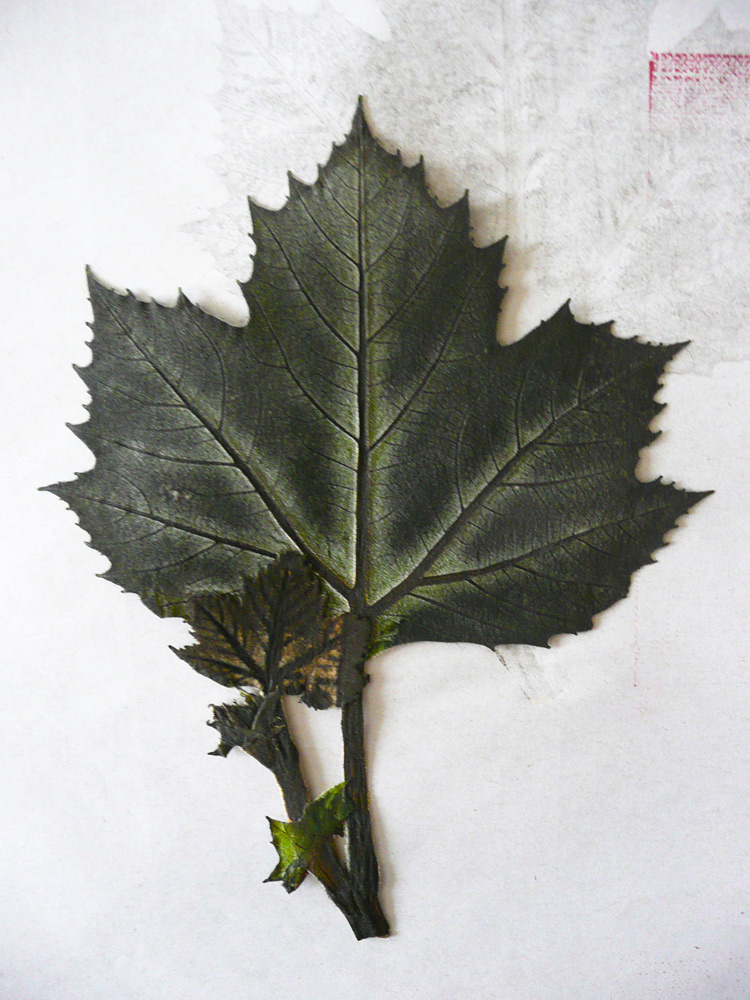
On a walk yesterday I found a windblown leaf, and later picked some leaves and flowers from the garden. I am not sure at all what species of tree the leaf is from. It is difficult to define, mainly because it is immature. However, I think it may be a Platanus (plane, sycamore) as suggested by the stem and leaf vein structure. To memorialise this arrested development I made prints from the leaves.
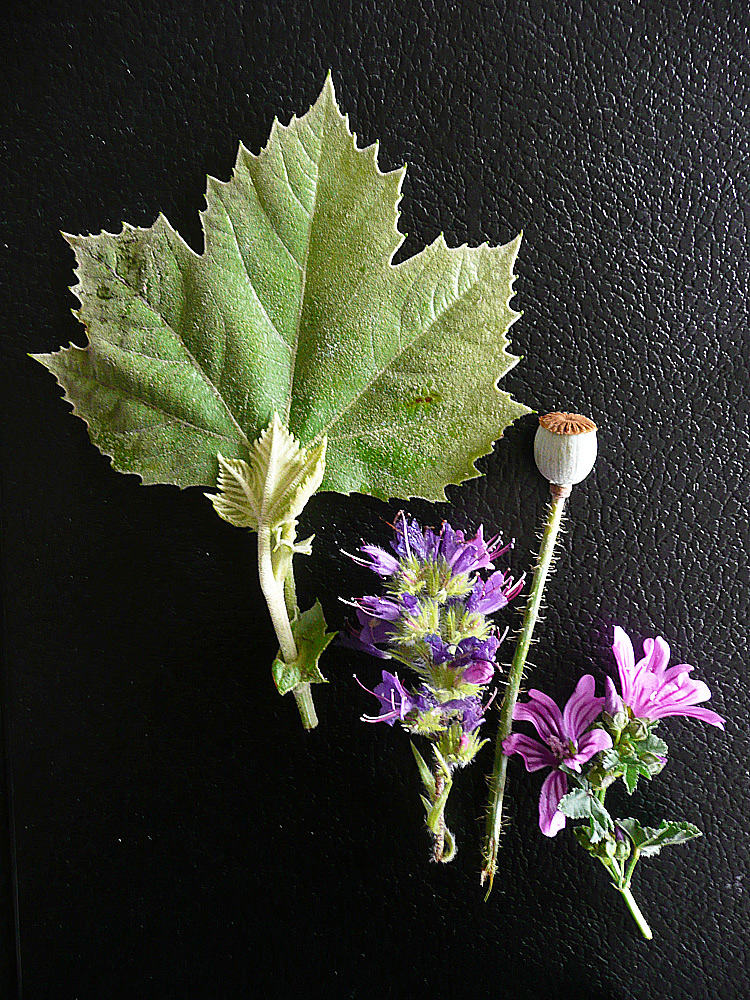
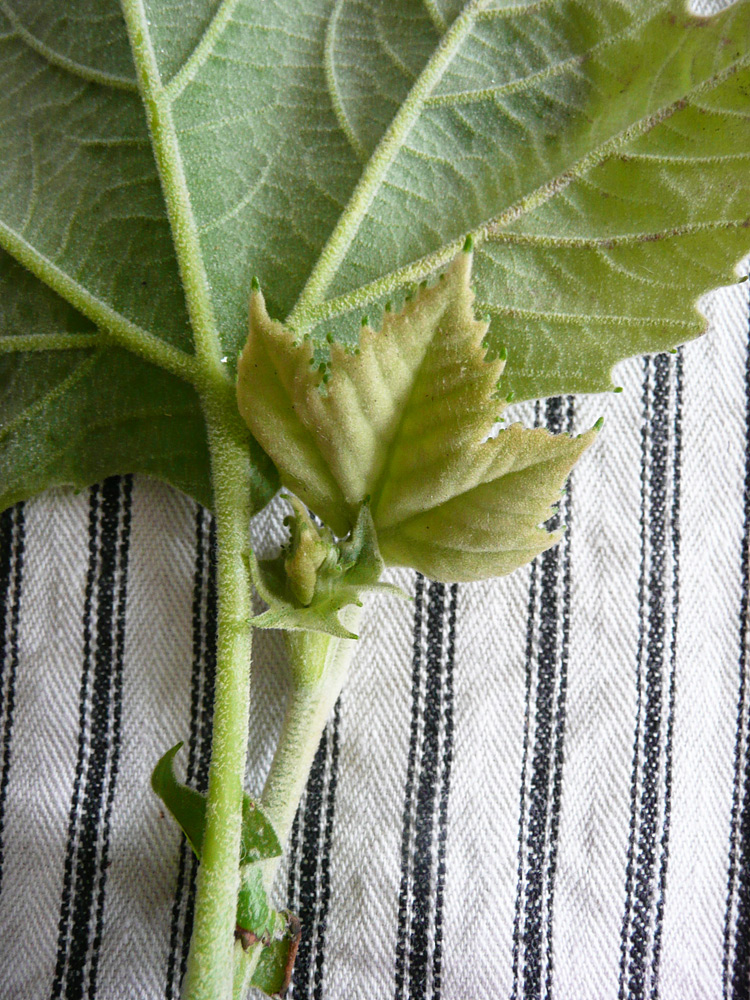
I made a few nature prints, on paper and cloth. The first print is from the inked plate (with the leaf removed after passing the two through the press). I dropped the inked plate on the floor which accounts for the wiggly marks and scratches. Liked the effect!
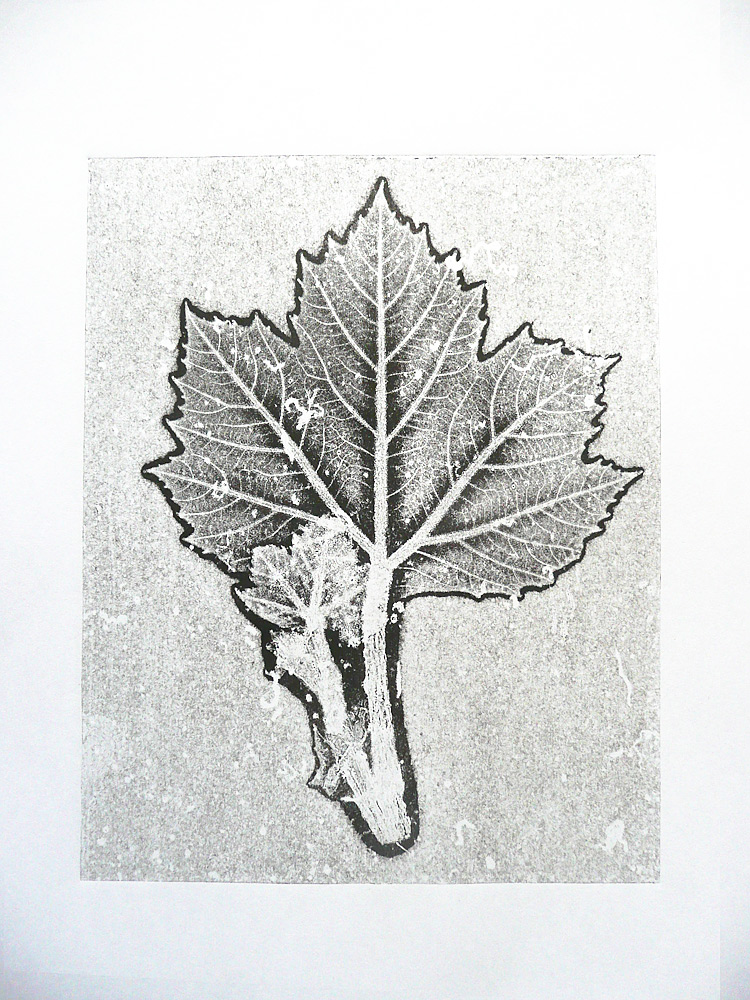
This print below, taken directly off the leaf alone, is particularly interesting, delicate.
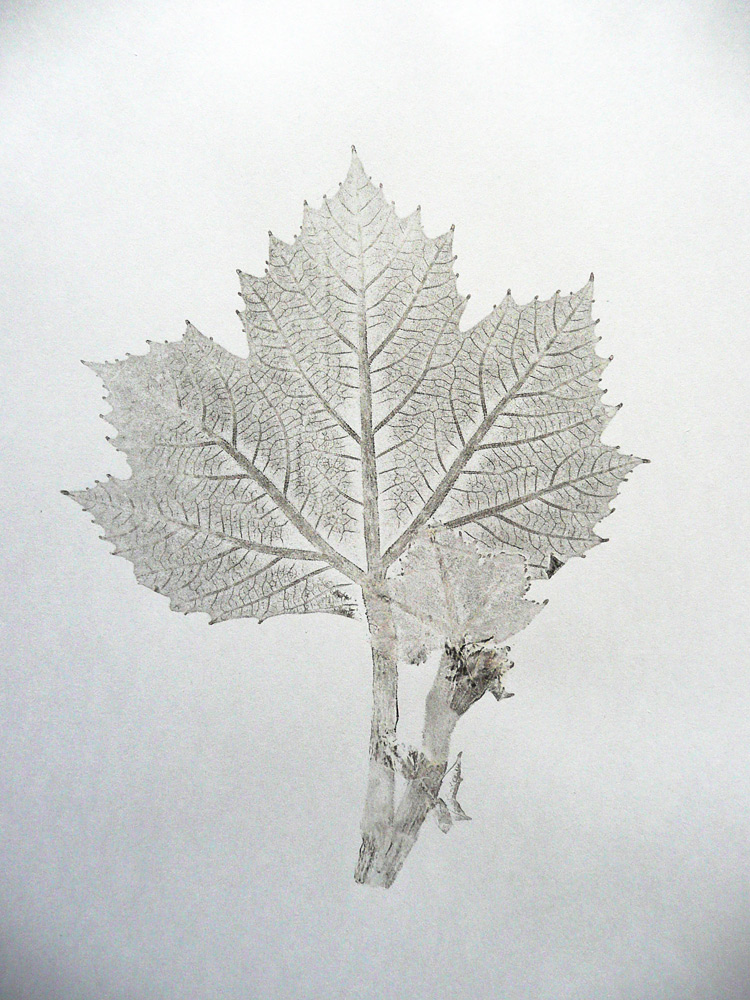
This print is made on damp 300 gsm paper 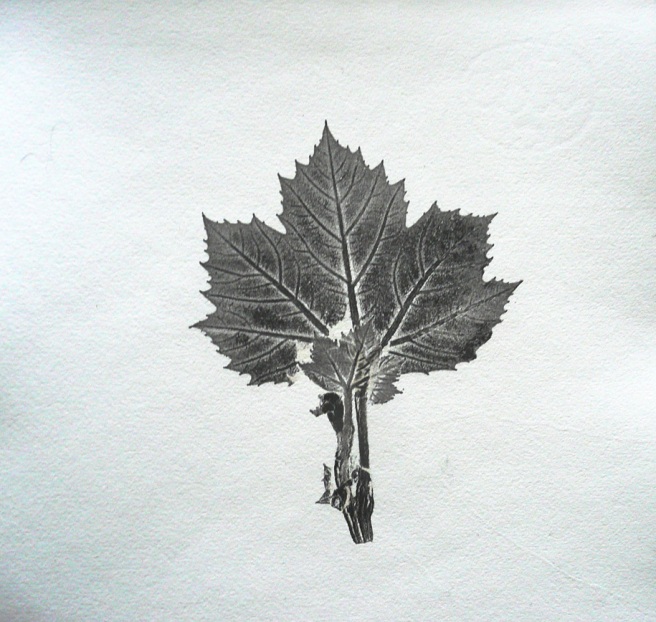
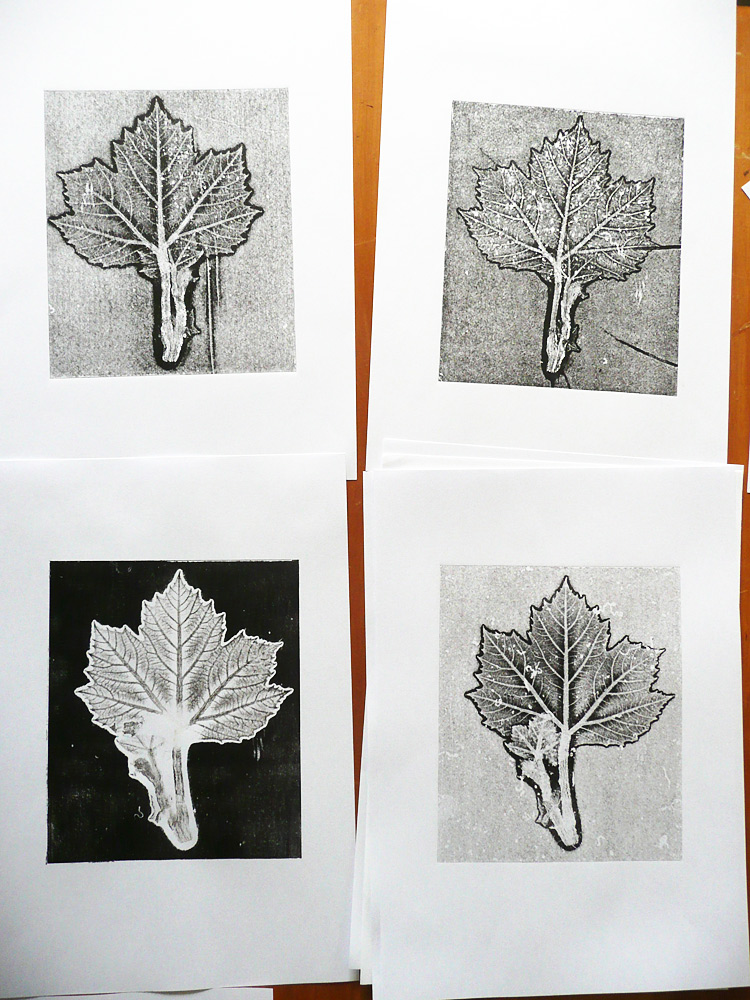
Here is a small selection of the process – when the leaf was thick it caused creases in the paper and some areas did not print so well.
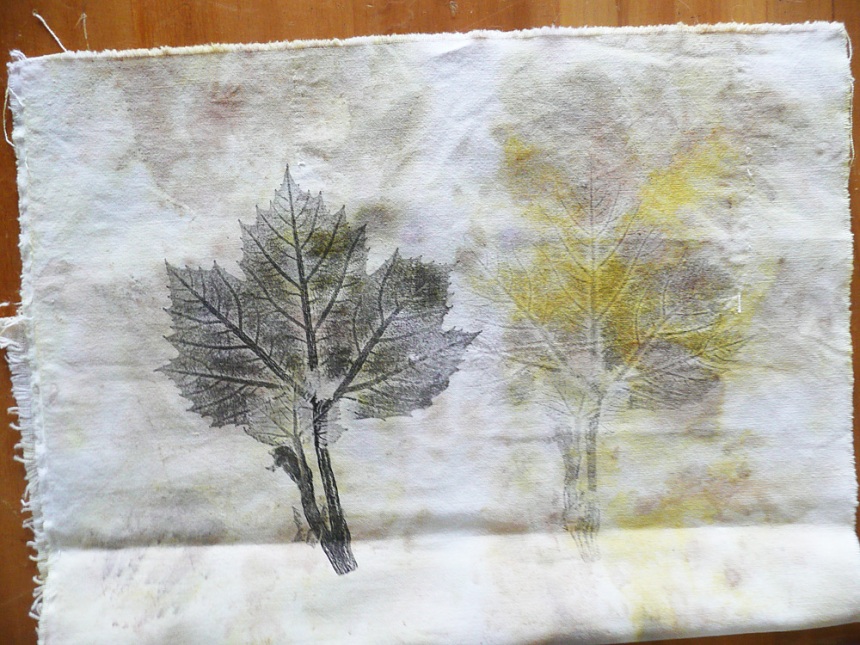
I have been busy… Here I have printed on cloth; works very well. The impression on the right was hand done with the roller and not put through the press, unlike the other one on the left. I am getting confident with using the etching press.
Finally, the most beautiful object of all, the actual leaves, with a trace of the ink still on them. It shows the underside of the leaves. I used Akua black ink, and many of the prints were printed on dry digital/inkjet A4 paper.
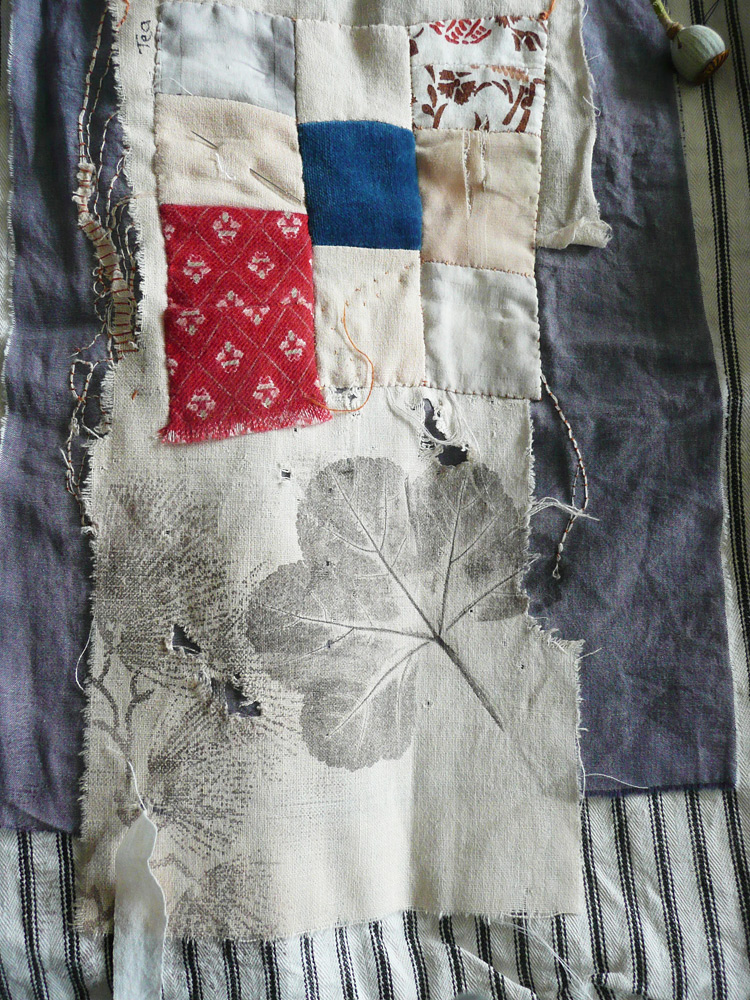
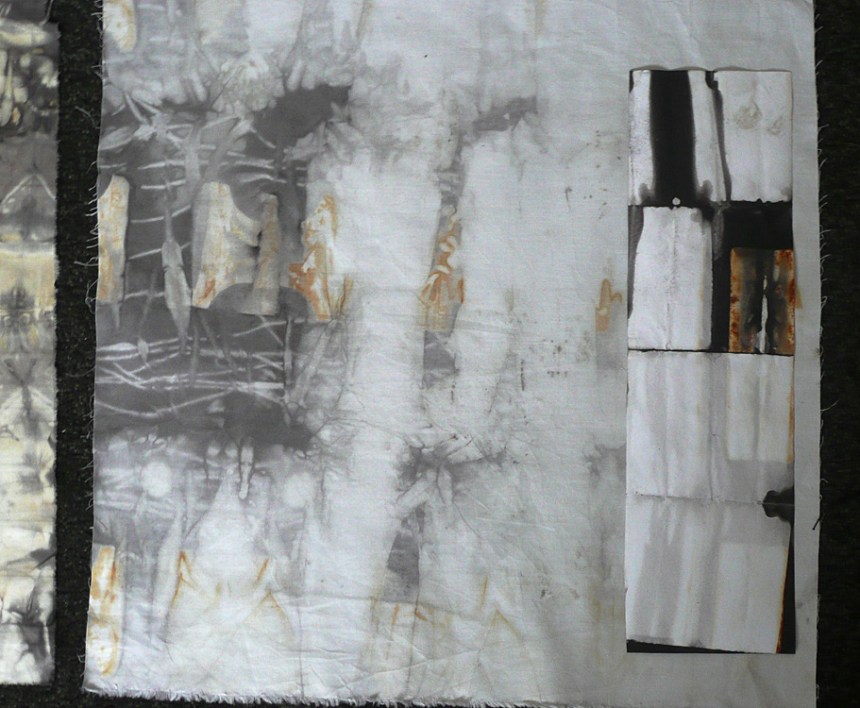
To end, here is a textile work I have started in response to following Spirit Cloth. I have printed on to cloth a mallow leaf and an image off a piece of old wallpaper.
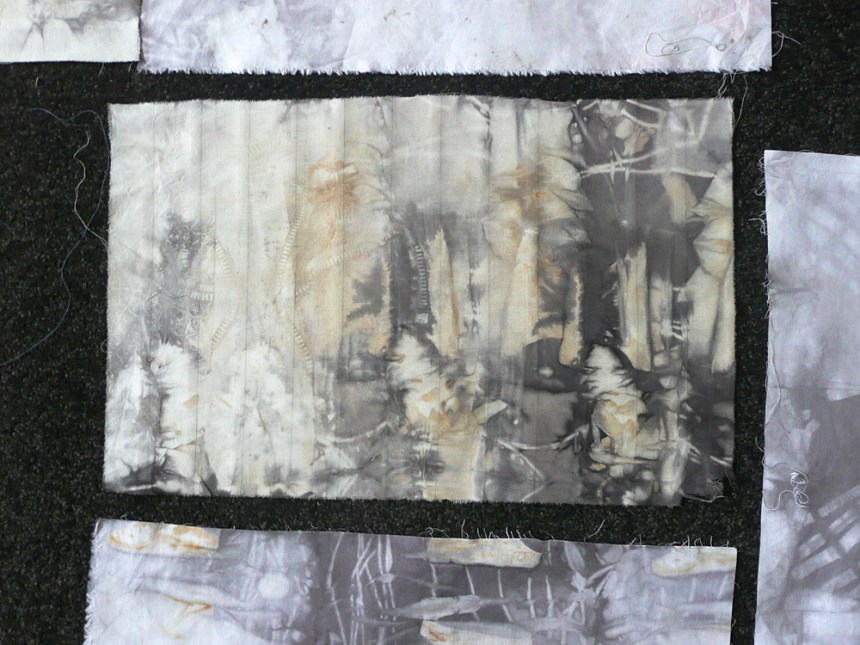
Being a Jill of all trades, I was prompted to have another go with metal and tannin by an article in Wendy Feldberg’s blog Threadborne. I am switching from researching, to seed collecting, to sewing up clothes and soft furnishings, to printing, to photography, to collecting more rocks for pigments, to drawing and back again with great rapidity at the moment. So this dip into dyeing is yet another experiment. Making the invisible visible through chance.
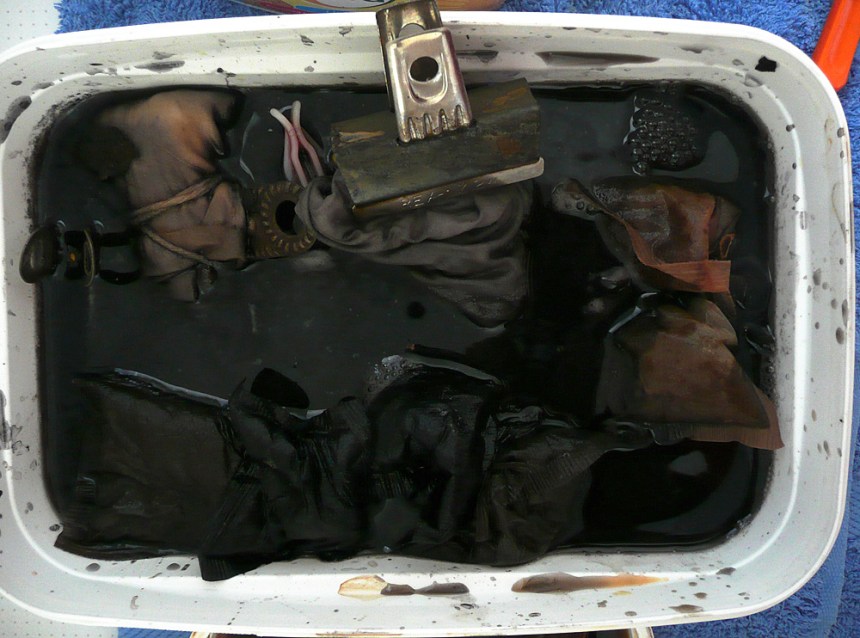
My intention for this project was to get some pieces of cloth that I could use in my art work. I had one bath with just the tea and tea bags, and the other with the metal and tannin. I tried to combine the two dyes, moving some bundles from the tea to the metal bath and leaving part of the bundle above the dye so it was just dipped into the liquid.
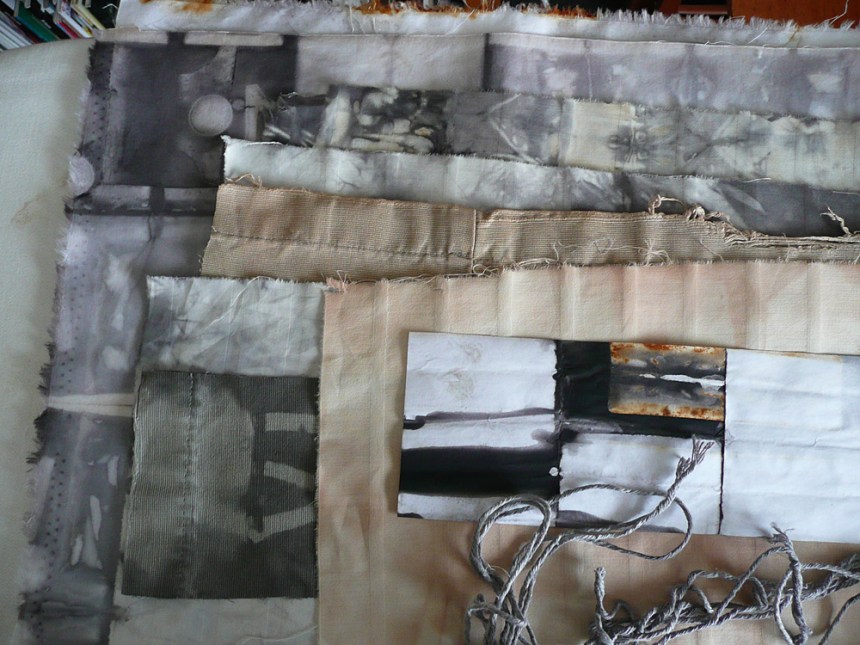
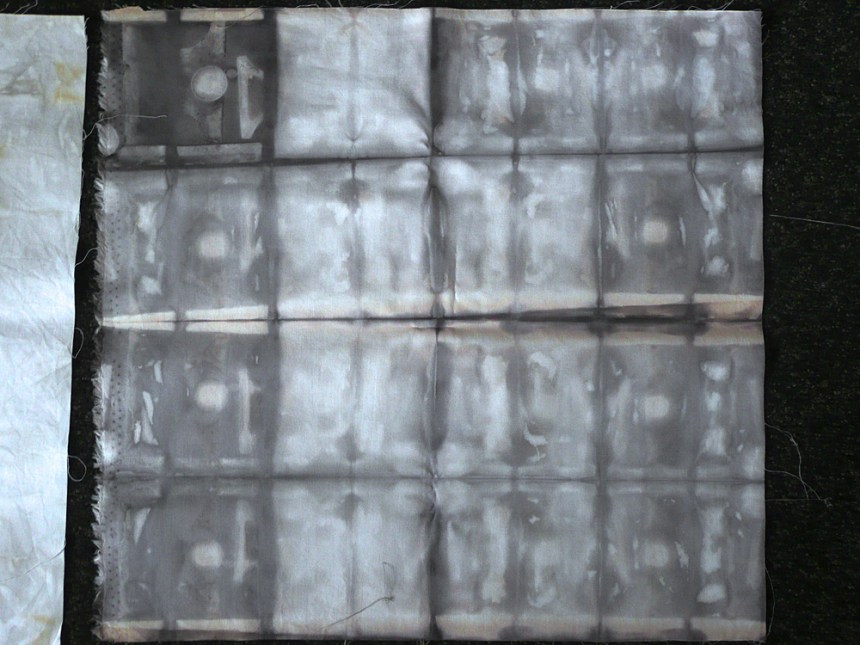
The results from the dye session were good, better than expected. It was a simple process compared to other dye sessions I have done that took much more of my time – or I should say – my presence, watching and checking. I used some new squares of light weight cotton with a glazed surface on one side, together with some old sheeting and clothing. The glazed side accepted the ‘dye’ the same as the unglazed side. I am thinking I might try printing on this fabric…
Cloths were rolled or folded, then bundled, clipped and tied. I actually had two dyeing sessions, refreshing the initial brew with more tea, tea bags and vinegar. The metal was rusty scraps, coins, bulldog clips, an old metal zip, and some aluminium foil (don’t think that did anything) all in a plastic ice cream 1 litre tub. Once out of these cold dye baths – one was overnight, the second one day – the cloths were rinsed, then left for a short while in salty water, then washed with Ecostore hand wash liquid soap that sits in the laundry. I was very lazy, but really I only had machine washing powder as the other option. And I felt the hand wash liquid would be softer on the dye. Anyway, it worked fine.
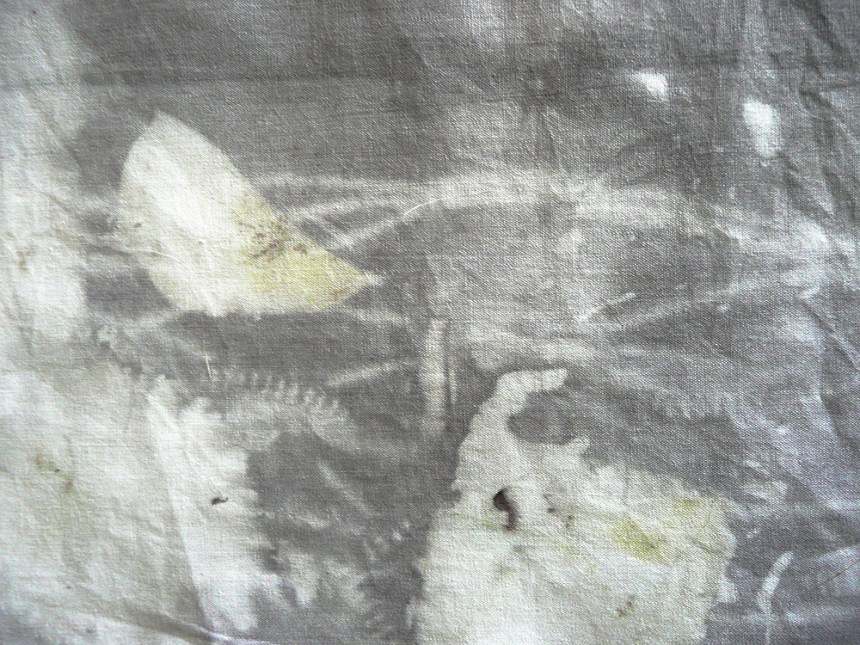
After drying, the cloths were ironed – once flattened the magic really became apparent. I included some pink rose petals and leaves in one bundle. The petals left a pale green colour, and there is a mysterious very pale pink – cannot image where that came from, but it may have been a label that was attached to the plastic mesh bag as it was not from the rose petals. I included the bag hoping to get an impression of the grid, but that didn’t happen. I also folded a piece of acid free office computer paper and put that in the second dye bath.
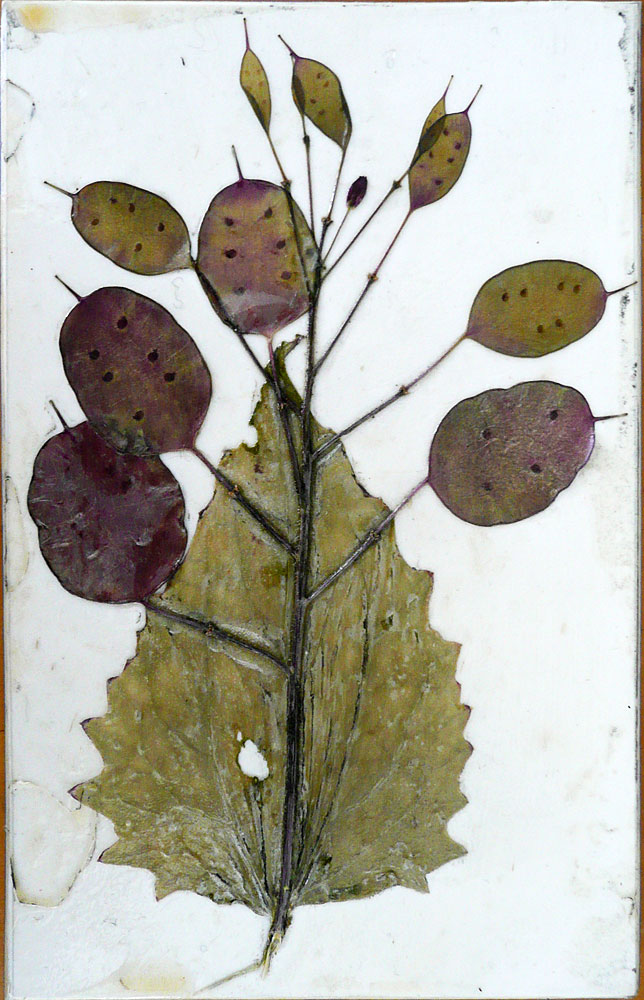
Seeds and seed pods are really quite beautiful, make good subjects for art and design. This is a collagraph plate that I made ‘last year!’ in December from dried seed pods of the Honesty plant (Lunaria annua, aka Money Plant) and one of the plant’s leaves. I had kept the dried specimen from 2012, so it has lasted well. I glued the dried plant material onto a piece of mat board and coated front and back of the board in two layers of polyurethane varnish – but it still had a little warp. This did not make any difference when the plate was printed. (Or so it seemed to me…) A small piece of the leaf had already broken away in the past, but apart from an interesting phenomenon that appeared when I inked the plate (the layers of varnish came away from three of the seed pods) the plate has held up well through its various inkings and cleanings. The photo here is what it looks like, cleaned, after an afternoon’s printing with Akua water based ink.
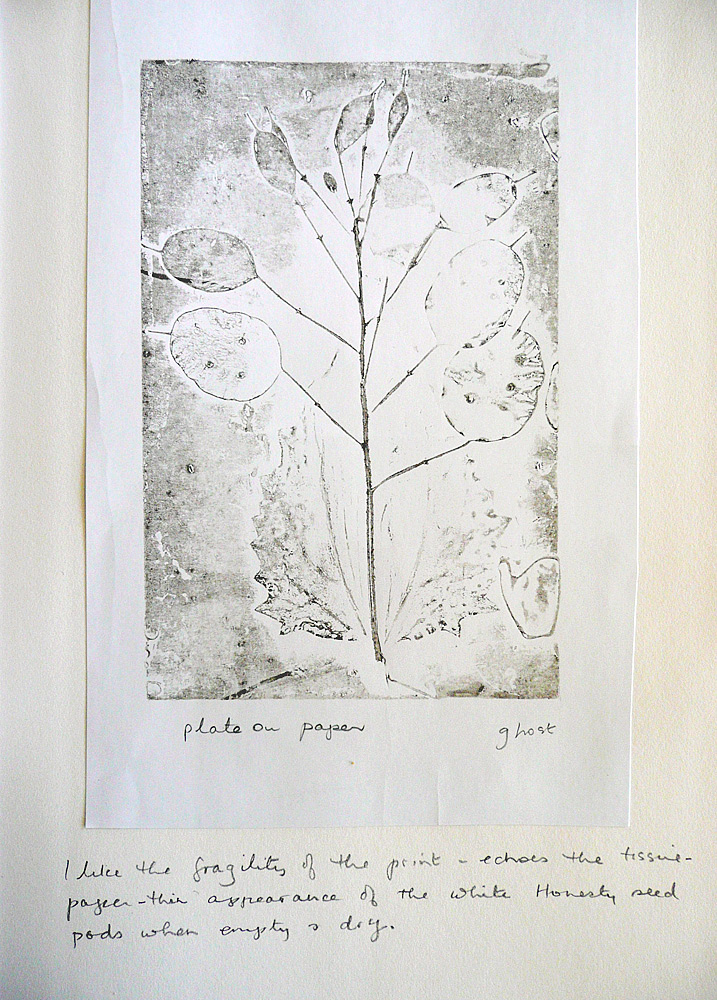
This is a ghost print (i.e. second print from an inked plate) from one of the initial printings.
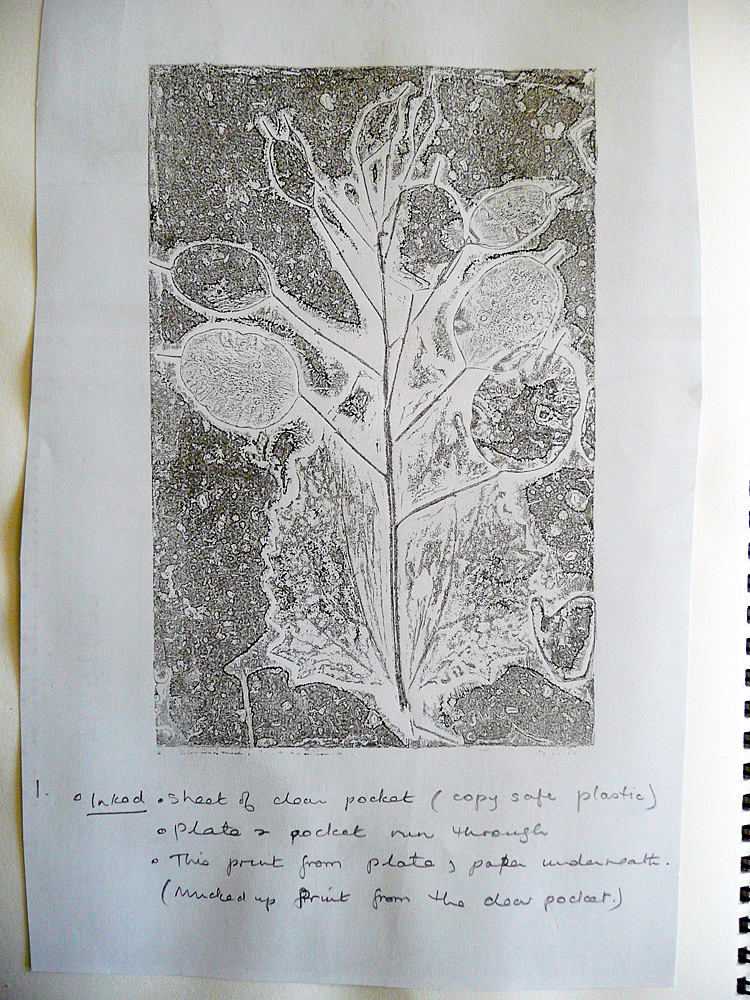
The next two images are of a print made by inking up a piece of plastic, sending the plate and the plastic through the press, and then taking a print off the plate. The plastic creates an interesting background with plenty of unexpected results which is one of the reasons I enjoy printing.
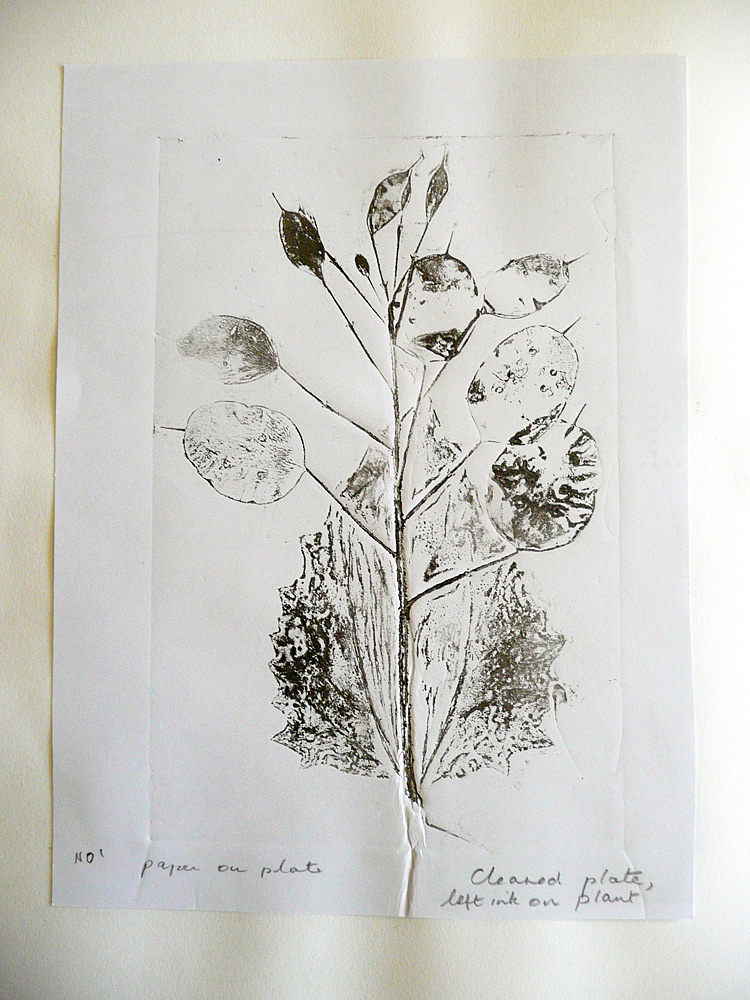
Finally, here is a the result of selectively cleaning the inked plate, so that only the raised parts of the collagraph will print. Still have a lot to learn! At least I now know that placing the paper on top of the plate creates an embossed image. The digital ink jet paper is dry and probably causes the creasing. I really enjoy using Akua ink as it is easier to clean up and I do not like using turps! The ‘black’ ink (actually a combination of colours, more a dark grey) creates an image that almost could be a photocopy.
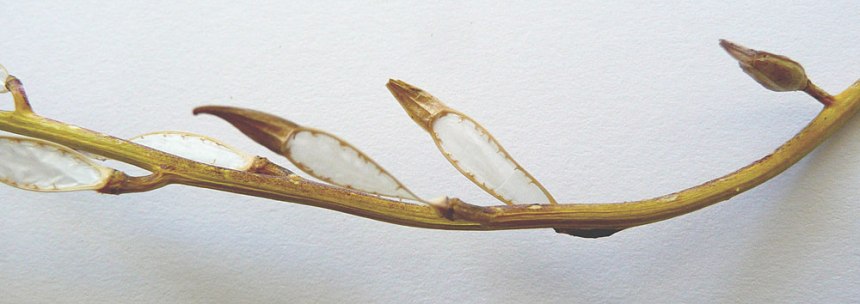
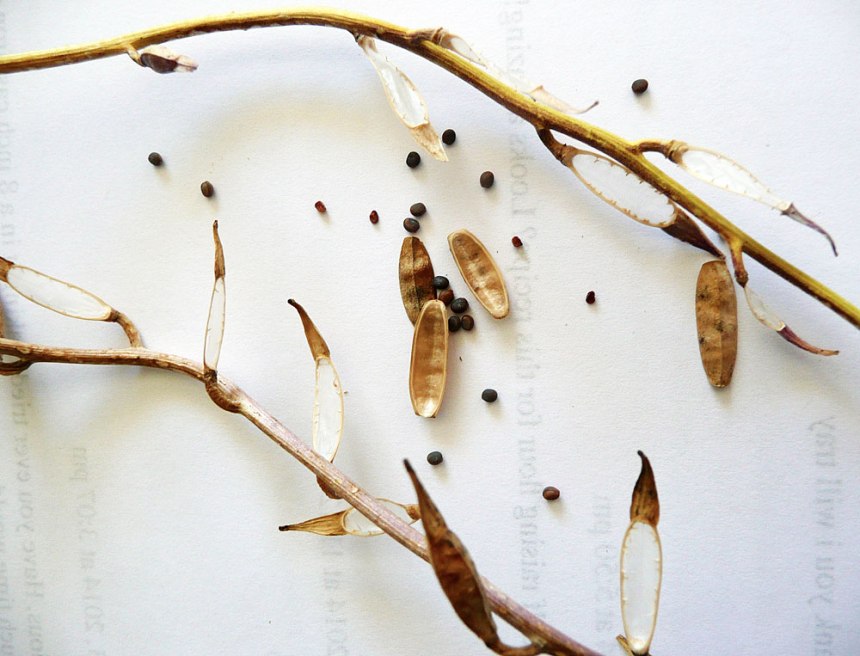
I have been collecting Rocket (Eruca sativa) seeds from the veggie bed. Really quite fascinating, and I notice that the membrane between the two halves of the seed pod is similar to that found in dried Honesty plants. I would like to find Lunaria rediviva a perennial ‘cousin’ of Honesty which has yet another variation on this form with more elongated pods. [Just found out that they are all members of the Mustard family (Brassicaceae)!]
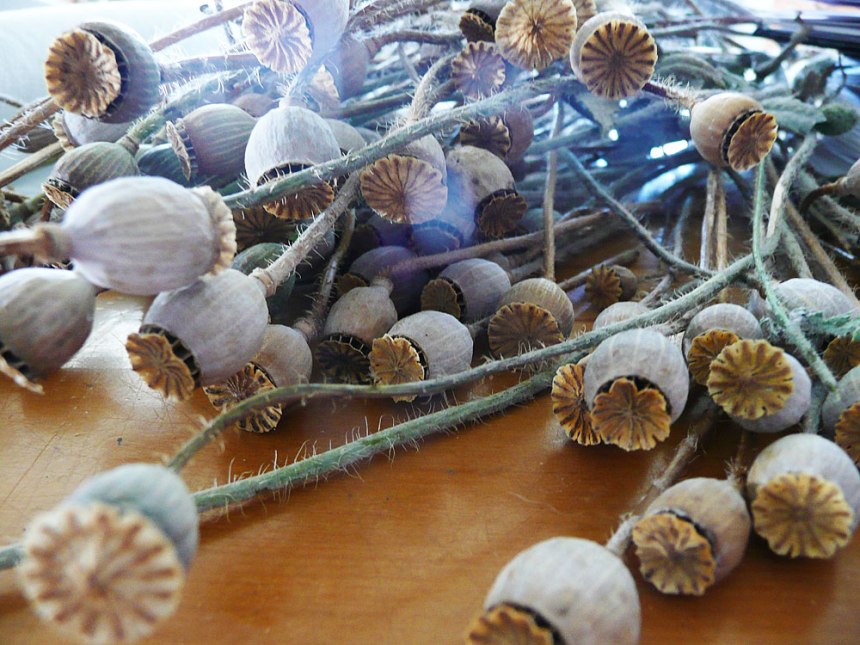
Finally, poppy seed pods from the garden.
A few prints, one produced at home, and the others at printing group.
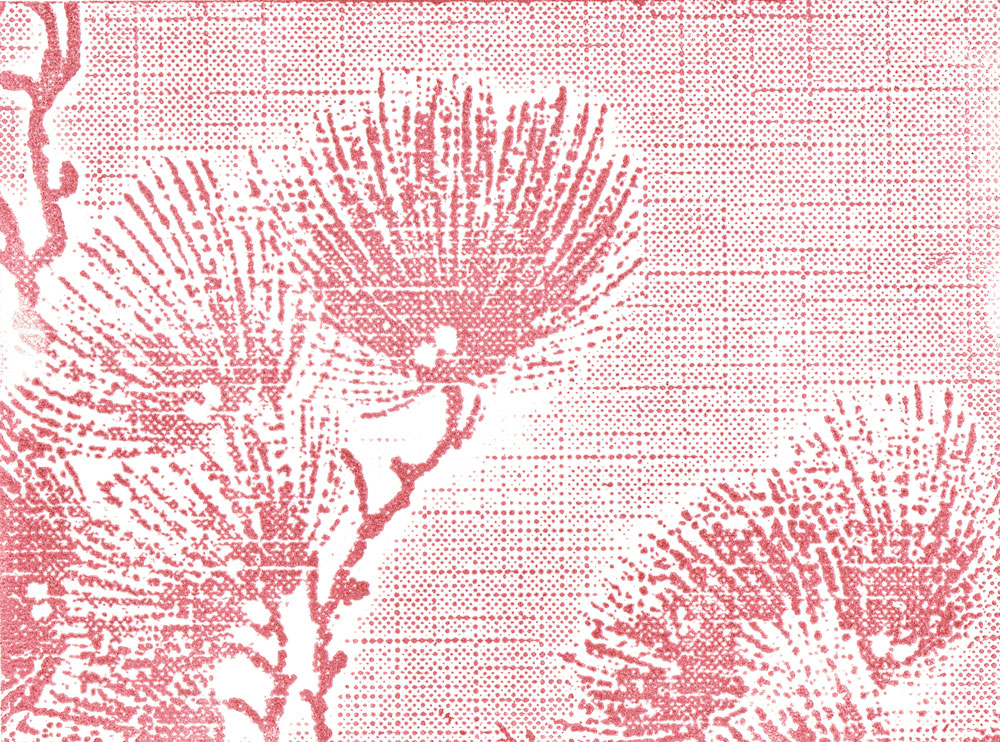
This print is produced with Akua inks, on a smooth card, and I used my printer at home. The print is taken directly off some old wallpaper that came from my parents house. The original illustration of what I think may be a conifer is pale green, but here I used red and it suggests the NZ Christmas tree – Pohutukawa! I used this print to make Christmas cards for family and friends.
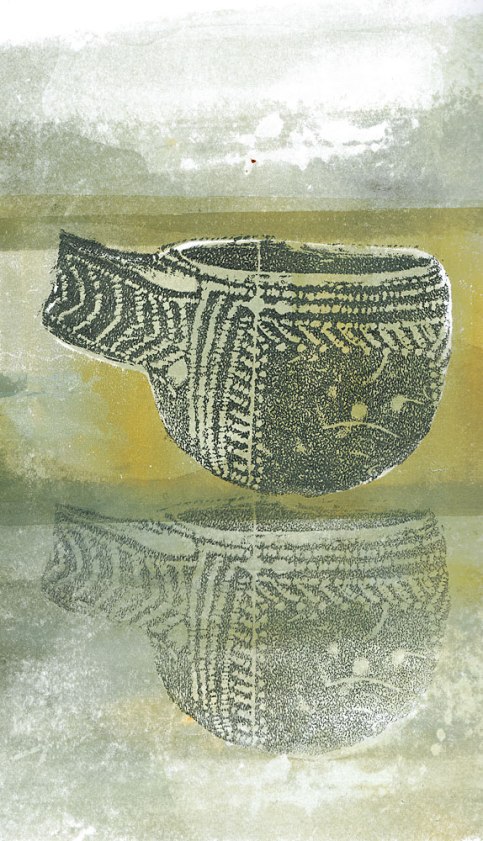
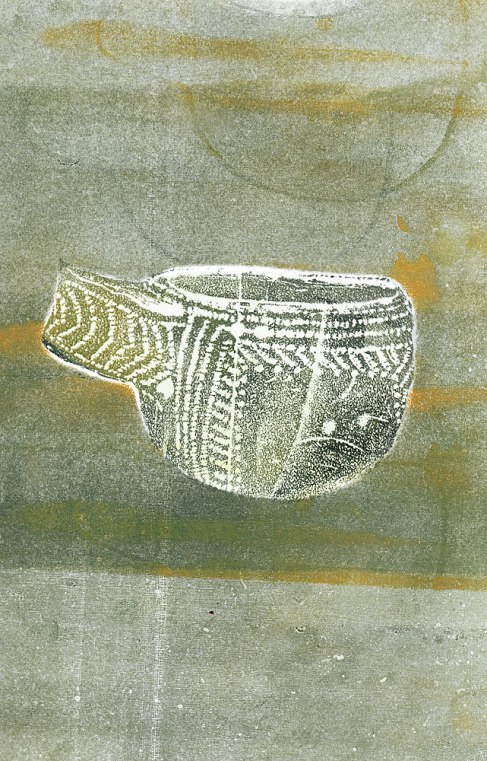
I’ve always had an interest in pottery, probably because of the glazes, but I really like the shapes of vessels and I am also presently researching cardial ware pottery. The next two images are of prints I made using a piece of flat, smooth polystyrene packaging that came with food from the supermarket (nice to recycle!). I traced the outline, cut the shape out and used a pointed etching tool to impress the marks. I am still learning, so it is helpful to have an image I can work up on a block quickly, then be able to concentrate on the printing process itself. I used two small pieces of polystyrene joined with masking tape at the back, and the marks and pits on the surface of the polystyrene helped to suggest the surface of clay pottery ware – as you can see below. I really think these printing block are artworks in their own right.

I found the cardial ware pottery image by Joanbanjo on Wikimedia Commons. The neolithic pot is described as decorated impressed ware, from the Cova de l’Or de Beniarrés, (5000 – 4200 BC) in the Museu de Prehistòria de València. I used water based printing ink and dry paper for these works.
By Joanbanjo (Own work) [CC BY-SA 3.0 (http://creativecommons.org/licenses/by-sa/3.0)%5D, via Wikimedia Commons from Wikimedia Commons
Finally from the garden, a photo of poppies for 2014 – red for love and tinged with white for peace.
I wish everybody a safe and bountiful 2015!

 Celia Wilson
