I completed a Skillshare course on botanical sketching by Laura Ashton, and was really pleased to get a few tips that really helped! So pleased to find a use for some of my dried plant material.

Earth pigments, paint, painting, printmaking, eco colour and visual arts; Canterbury, South Island, New Zealand
visual art
I completed a Skillshare course on botanical sketching by Laura Ashton, and was really pleased to get a few tips that really helped! So pleased to find a use for some of my dried plant material.
Catching the spring before it fades…
A low of -1 degrees Celsius overnight, but a clear blue sky this morning means now I can get the washing dried on the line! Snow on the mountains arrived as well. I could not resist taking the camera out to record the plants in the garden.
I always fight between clearing or not clearing the ‘weeds’ as clearing them disturbs everything in the flower beds. Then when the dry, hot days arrive I think the weeds would help to keep the soil moist. But I know that the strong weeds would overtake the cultivated plants. The vegetable and fruit trees and bushes are looking at their best just now. Lots of Ladybirds – hope they and the birds do a good job controlling the aphids. It is a balancing act between taking action and just observing. A new location brings a new set of conditions. I am intrigued at the different biodiversity existing in two locations 2 kilometres apart from each other. We have fewer birds and habitats for them here than at the last place. I’ve started reading my permaculture book again. Need a jungle.
There are some lovely black blue iris flowers just opening – will they make some dye?
My painting, the last image, now looks just like Spring!


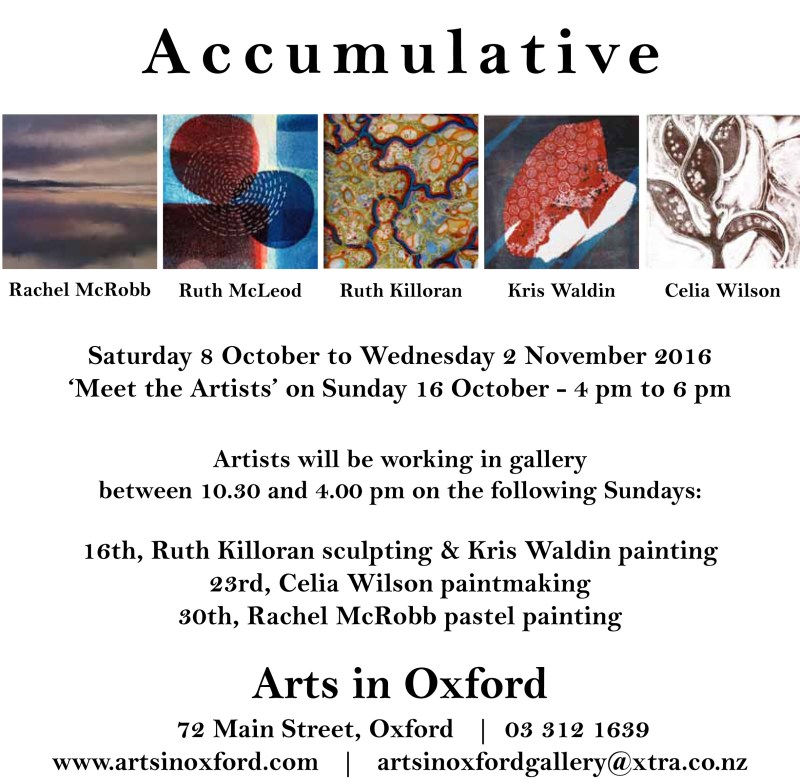
As part of our group exhibition, Accumulative, I will be in the Arts in Oxford Gallery this Sunday 23 October from 10.30 am until 4 pm making paint from rock from the Canterbury area and further afield.
Hope to see you there!
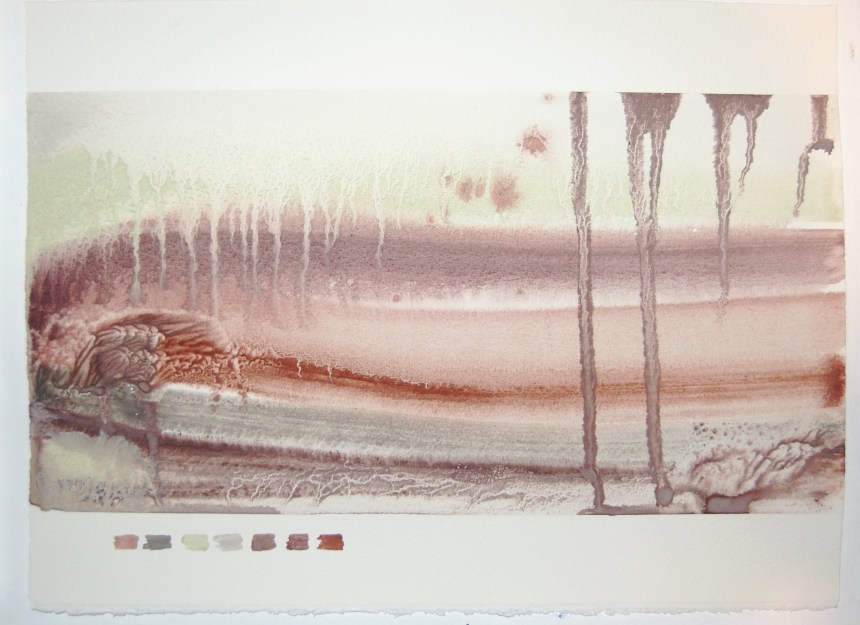

We’re all in the joke mood at the moment, that is if you are doing an assignment for Art of the MOOC. It has been a real battle for me to think of a joke related to a social issue or a social movement. My attempts just sounded so silly, but after going on line to find some, I thought mine were not that bad after all…
So how about:
When is a thinking person’s coal mine empty? When it’s mindful.
When can coal see? When it’s fossilised.
Then I thought, if I am making paint from coal (which was my intention), to sequester it, for example, I need a link to paint and pigment. Luckily, my brain caught on, and I came up with using charcoal (which is also carbon). Now, as there is a good possibility that prehistoric man also used charcoal to paint or draw with, aka cave paintings, I could somehow make a joke that linked carbon, pigment and paint. I do have some coal left over from when we had a coal fire (oops, but we only used it once and we had to travel 100 k to buy the coal)… but the charcoal came from the woodturning stove and the tree came from the garden and it did seem a little more environmentally appropriate.
So my joke for Art of the MOOC was: Was there a prehistoric carbon footprint? No, they used their hands…
I made a video of the paint making process which can be found on my Facebook page. www.facebook.com/celia.wilson.56 It is also on Vimeo https://vimeo.com/147520835, and I have a link to Twitter…

In my spare time… I’ve been doing some printing; actually it is becoming a little obsessive which surprises me as it has taken a while for the process to become second nature. I no longer approach the press with trepidation. Anyway, there is a lot to learn which is good, and the block or plate making part of the process is great – full of possibilities.
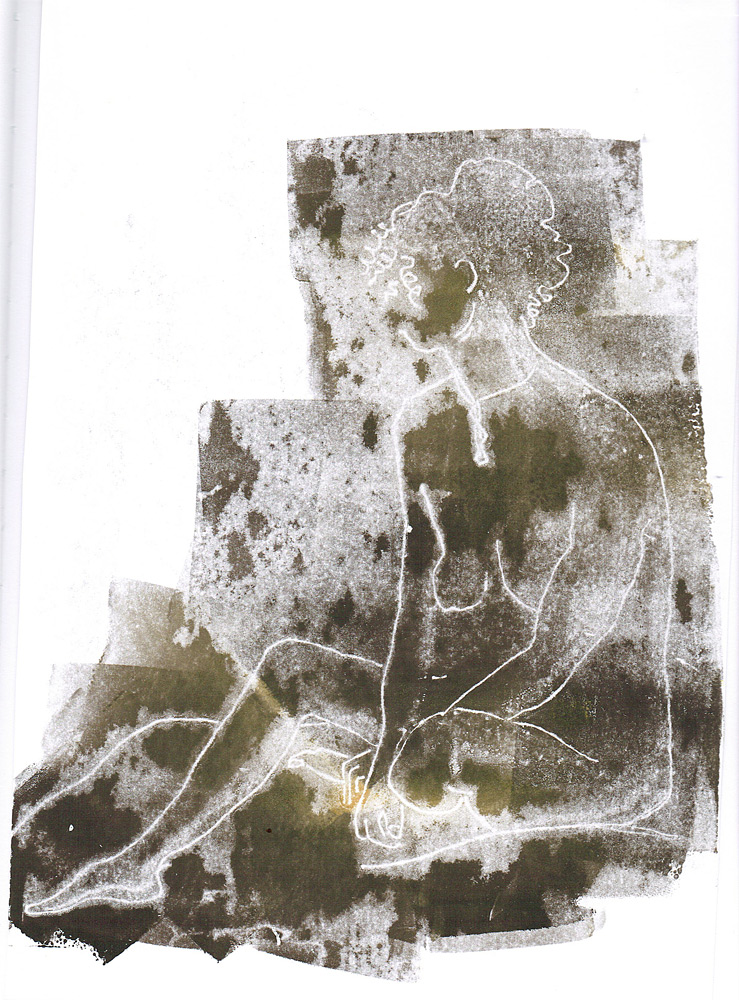
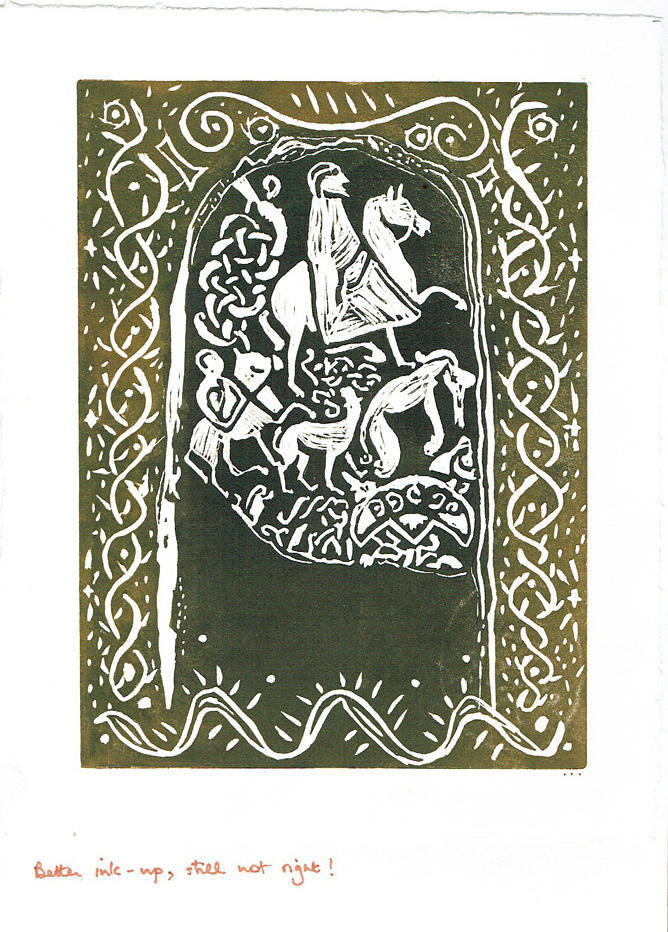
I have been organising a life drawing group and the first print shown below started life as a transfer print from a photocopy of one of my drawings. The inked plate was run through the press after making the transfer print, so that the drawing appeared on this second printing as a white line. The mossy, stone-like inky background has possibly a good connection to the second image which is a lino block print – and my second attempt at carving lino. The print shows the reverse of ‘Meigle No 4’ which is a Pictish cross slab. The decoration surrounding it is what I can only call an exercise in ‘control of the carving tool’.
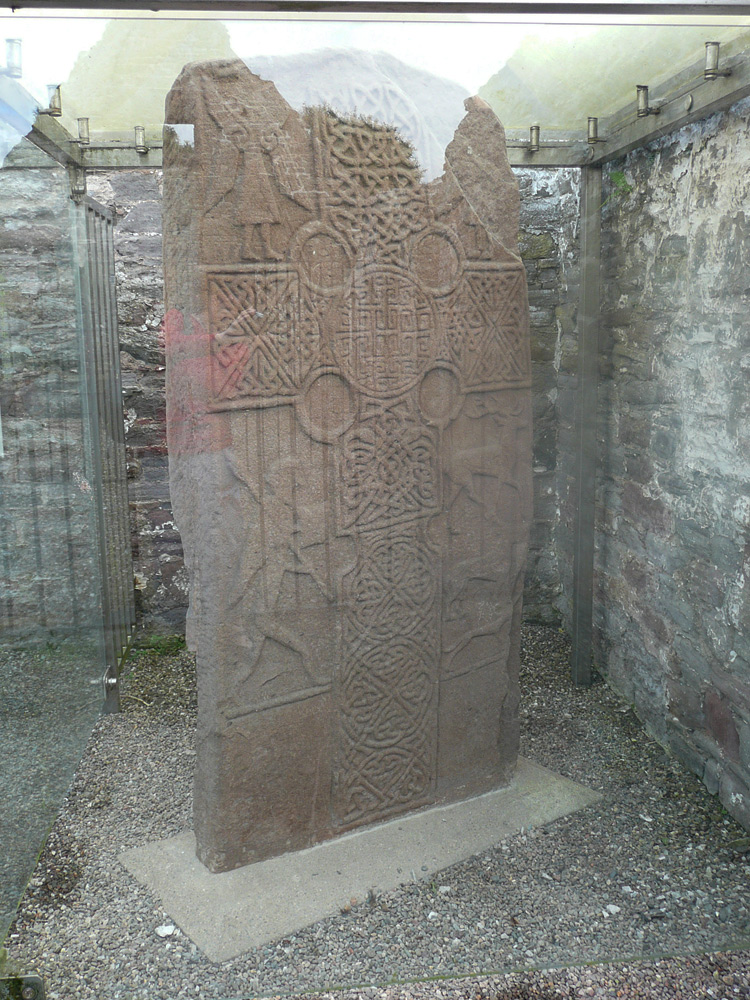
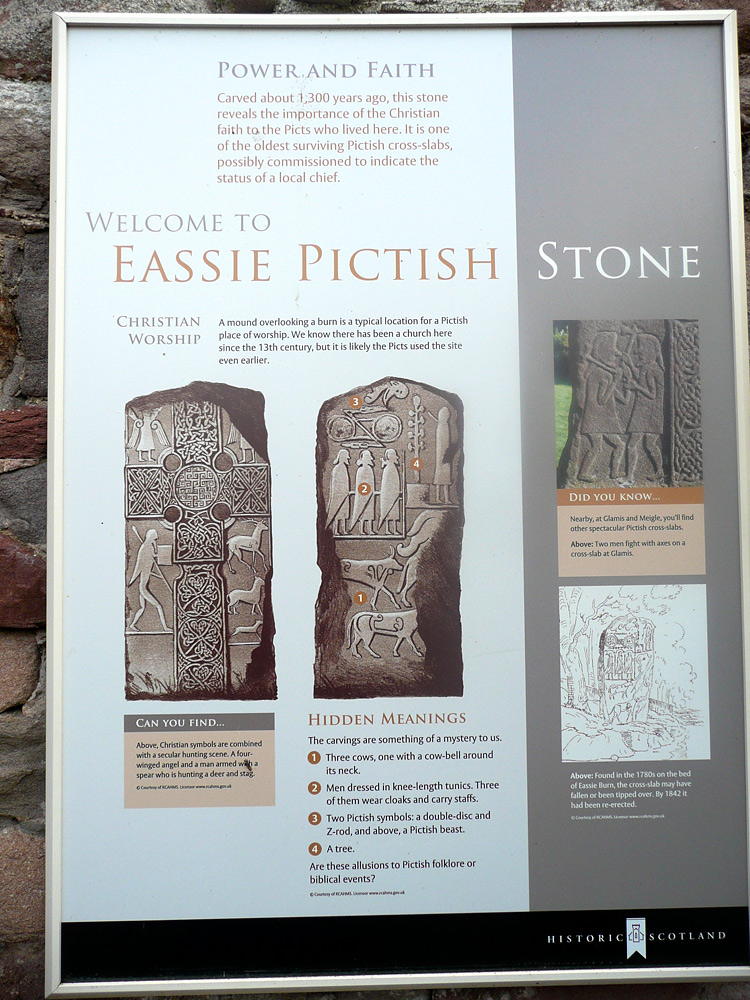
We visited the Meigle Sculptured Stone Museum in Perthshire, Scotland, in 2012 when staying near Alyth which was home to the generations of Barclays and Colvilles in my family tree. The cross slab image was copied from the photograph in George and Isabel Henderson’s book, The Art of the Picts. This is part of my cultural heritage that I feel I can use in my art – by association with place if not by genetic inheritance which, if you go back far enough, will be unknown. We also saw the Pictish stones at the Eassie churchyard in Angus, and my two photos taken there follow the print images.
This Eassie cross slab is enclosed in thick glass for protection, accounting for the reflections seen in the photo. Very impressive object. The Historic Scotland information panel explains what is known about the iconography and history of these stones.
Progressing with my little piece of fanciful endeavour. The weather is too hot to do much but I am enjoying this evening pastime. Trying to contextualise this piece, I found it lends itself to ‘something old, something new, something borrowed and something blue’. The ‘borrowing’ comes from Spirit Cloth, so thanks to Jude for her inspiration and putting me on yet another path.
It is quite difficult to find suitable, old, worn cloth, but I realise I have to collect all my textiles and yarns in one spot – I seem to be endlessly looking for where I have stashed them – and since we moved they could be anywhere! I am using fabric dyed last year, snippets of my mother’s dressmaking, her box of embroidery threads, my threads from those I collected decades ago and even some old silk velvet from my sister’s mother in law. The cloth (dyed in tea) with the holes was an old pillowcase into which we used to put horse riding gear when it was being machine washed. The ‘something new’ is the print of the mallow plant growing in the new garden.
I really like the feel of the layers of cloth and the abstract forms created by the stitching on the reverse of the piece. The space created by the circle (top left) seems to suggest landscape, or a vista. It is the only part that has visual depth. What to do next…

A few prints, one produced at home, and the others at printing group.
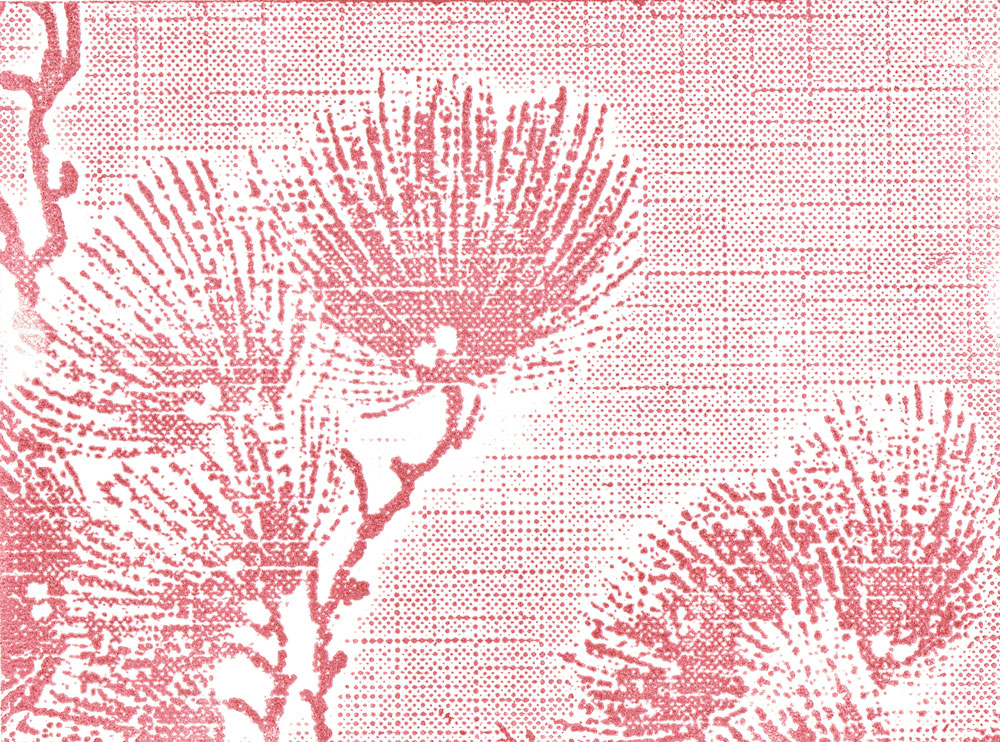
This print is produced with Akua inks, on a smooth card, and I used my printer at home. The print is taken directly off some old wallpaper that came from my parents house. The original illustration of what I think may be a conifer is pale green, but here I used red and it suggests the NZ Christmas tree – Pohutukawa! I used this print to make Christmas cards for family and friends.
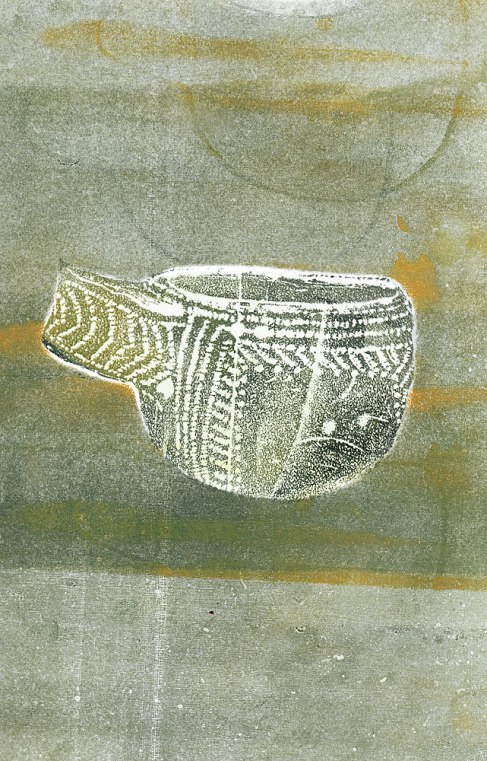
I’ve always had an interest in pottery, probably because of the glazes, but I really like the shapes of vessels and I am also presently researching cardial ware pottery. The next two images are of prints I made using a piece of flat, smooth polystyrene packaging that came with food from the supermarket (nice to recycle!). I traced the outline, cut the shape out and used a pointed etching tool to impress the marks. I am still learning, so it is helpful to have an image I can work up on a block quickly, then be able to concentrate on the printing process itself. I used two small pieces of polystyrene joined with masking tape at the back, and the marks and pits on the surface of the polystyrene helped to suggest the surface of clay pottery ware – as you can see below. I really think these printing block are artworks in their own right.

I found the cardial ware pottery image by Joanbanjo on Wikimedia Commons. The neolithic pot is described as decorated impressed ware, from the Cova de l’Or de Beniarrés, (5000 – 4200 BC) in the Museu de Prehistòria de València. I used water based printing ink and dry paper for these works.
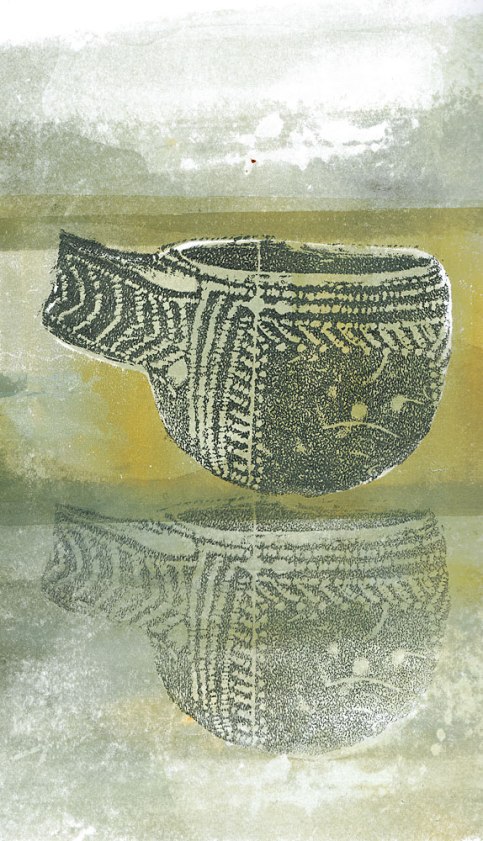
By Joanbanjo (Own work) [CC BY-SA 3.0 (http://creativecommons.org/licenses/by-sa/3.0)%5D, via Wikimedia Commons from Wikimedia Commons
Finally from the garden, a photo of poppies for 2014 – red for love and tinged with white for peace.
I wish everybody a safe and bountiful 2015!

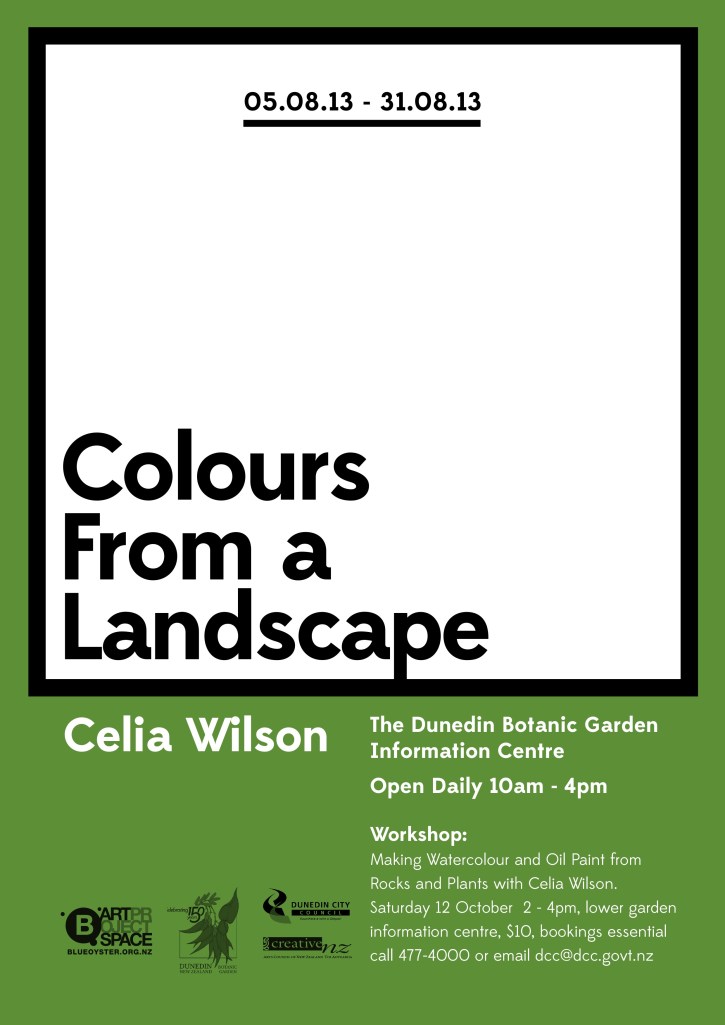
I am currently showing some pigment colour swatches at the Dunedin Botanic Gardens, and in October I am doing a workshop on making paint. This exhibition was facilitated through the Blue Oyster Gallery in Dunedin. Also included in the show are some natural pigments on paper – eco prints – and some raw pigment. The two artworks on paper show colours from Waikari (green) and Ashley Gorge (pink and green) in North Canterbury. Many thanks to Clare Fraser from the Dunedin Botanic Gardens who is in charge of the venue. I think the colours look fantastic presented on black paper against the lovely red walls of the Information Centre!
The pigment swatches each show a colour found at a specific location which is named on the swatch.
Appearing below are some of the photos I received from Jaime Hanton, Blue Oyster Gallery, Dunedin, who kindly photographed the show and installed the work for me :
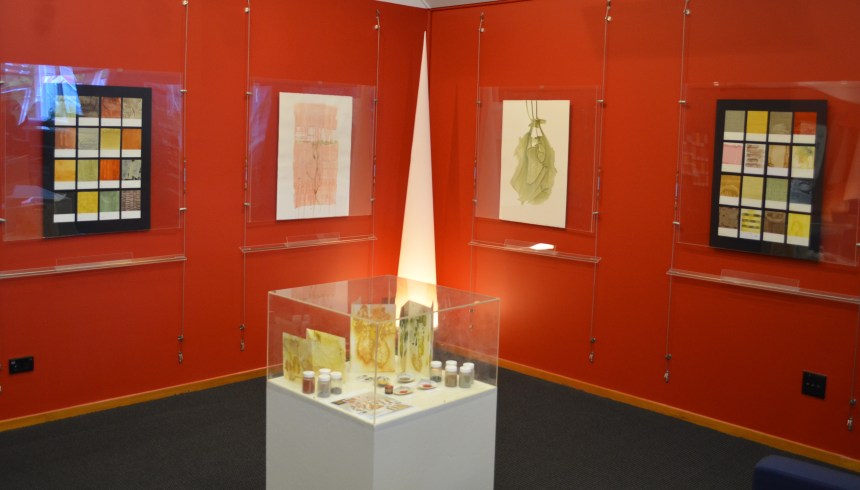
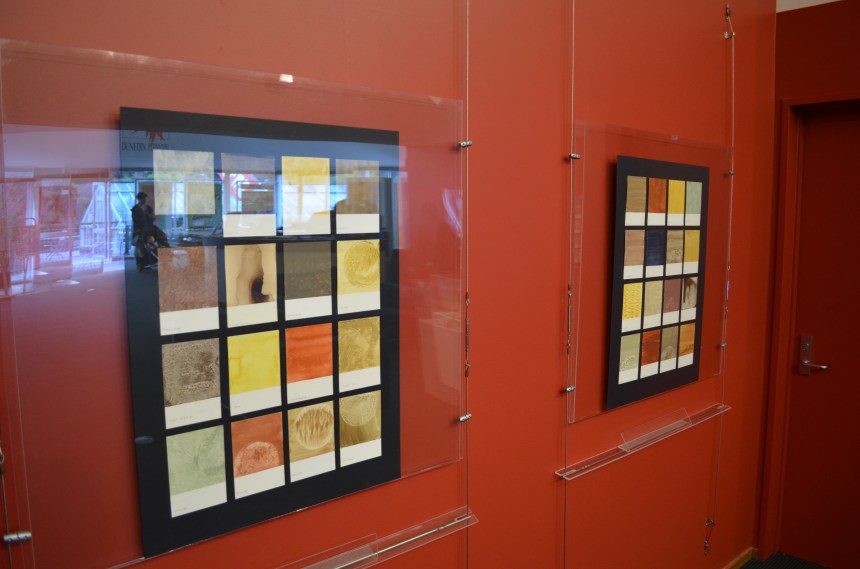
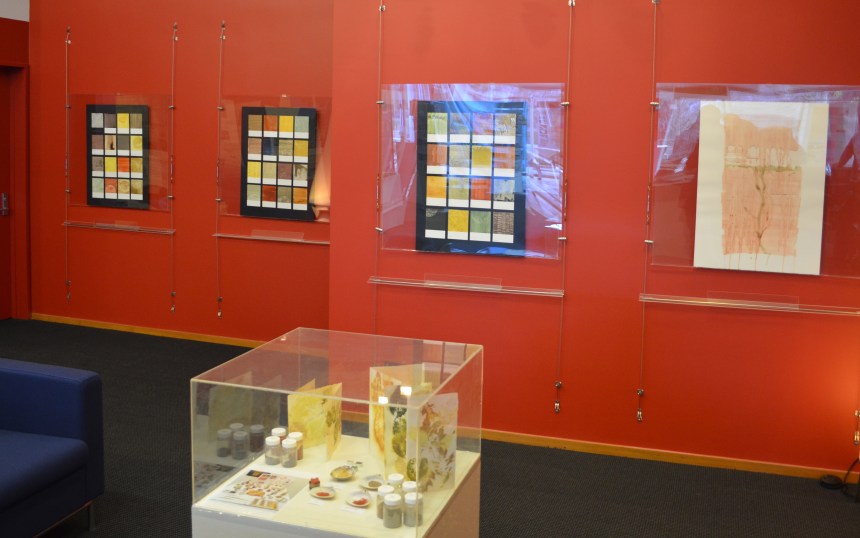
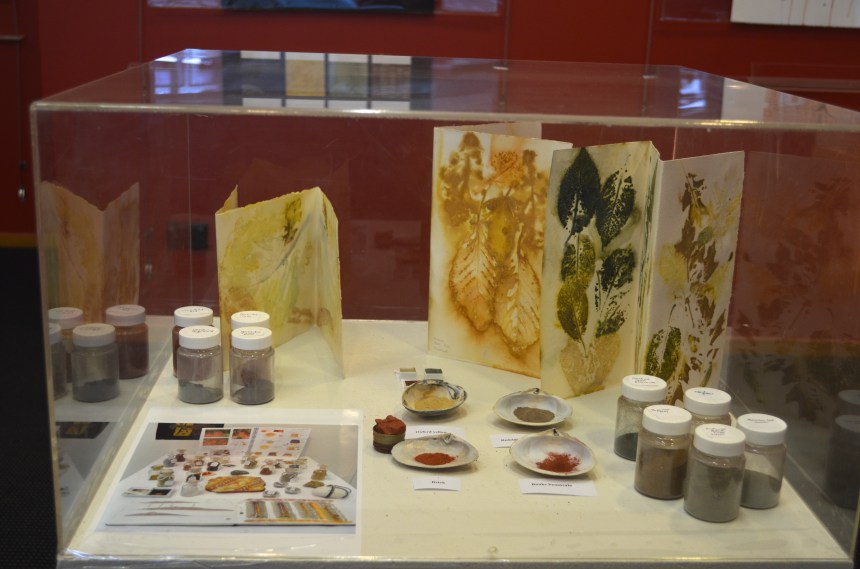
This is not my anticipated installation for this show as the initial selection was stolen. My box was left on the pavement by the courier company and disappeared overnight. The items in this box were some of those in the photograph shown in the display case, bottom left corner. If, by any chance, they turn up, I would just love to have them back. They represent five years research, experiment and recording. I have given up hope of ever seeing them again, however, and will re-build as much of the information as I can… Worse things happen, and I ‘count my blessings’.
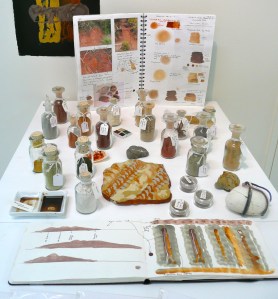
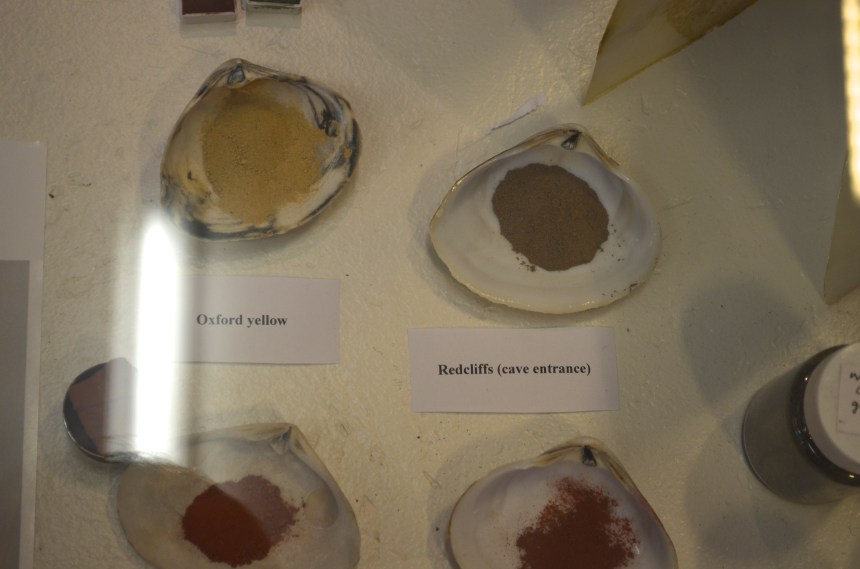
Shells were traditionally used for paint containers!
Plunging in with eucalyptus and silk.
In early December 2012, I started to try using eucaplytus leaves on silk and cotton fabric. I went down the road to where a gum tree planted by Mrs White in the late 19th century towers above all other trees. I collected dried, fallen leaves and fresh-when-cut leaves; see pods; bark; twigs from the prunings by the tree frog machine that took place a fortnight earlier. Using India Flint’s method on page 264 of her book Second Skin, I rolled up in the silk the leaves etc around a bark covered twig for the core of the bundle of fabric.
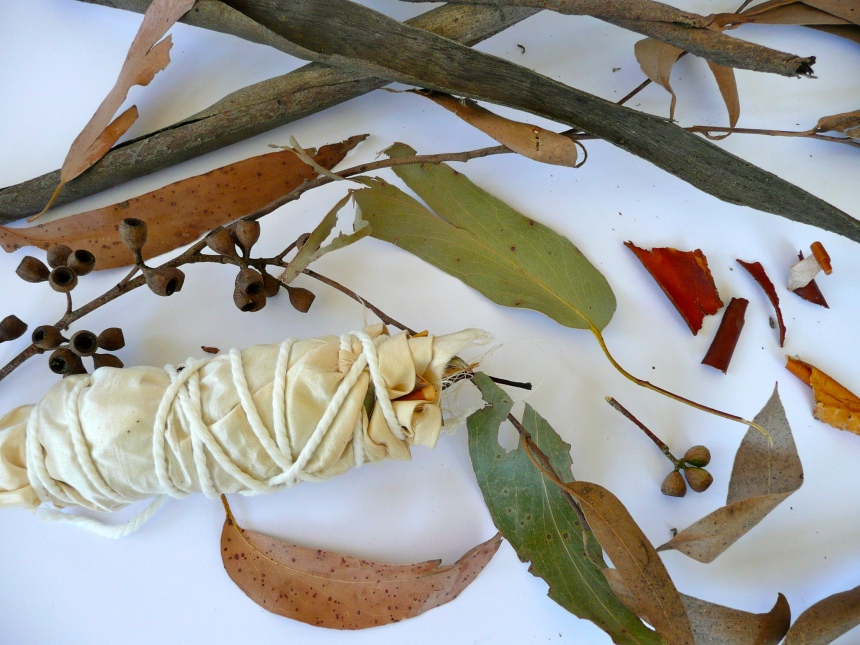
In a stainless steel pot I simmered the following for 30 minutes:
One bundle of leaves, bark twig, seed pods all tied up with a polyester piping cord. An extra piece of eucalyptus bark; extra eucalyptus leaves; coil of aluminium wire 1 mm dia x 170 mm long; a piece of aluminium foil 80 mm x 200 mm; a used tea bag; tap water from kitchen, with a top up from laundry tap as necessary (untreated Oxford town bore water, no chlorine).
I was a bit nervous nothing would happen. I was correct! Well, something did happen, but not what I desired. This is typical art progress!
After 30 minutes I turned off the heat and left it until the next day. Without removing all the cord, I had a peek to see what was happening when the bundle was cool.

Apart from the resist created by the cord and plant material, very little colour came through from the eucalyptus, the whole piece being dominated by the dye water, as far as I understand. I also wondered if this material was, in fact, silk. I have had it for about twenty years and it was an old piece when I was given it.
Undaunted, you might say, and buoyed up by India Flint’s Eco Colour, I researched and read the internet – more very useful information from Alice Fox in the UK, Wendy Feldberg in Canada and Cassandra Tondro in the USA – thanks SO much for this. I re-read the information to sort it all out in my mind into an ordered format so that I could at least intend experimenting in a reasoned fashion and record the tests in my workbook. I made ash water from the wood burning stove ash, and then got jars of copper, alum, rhubarb and iron water underway.
The ash water had been strained through an old cotton pillow case, so I thought I would put this mordanted fabric in a hot dye and used the left-over silk bundle eucalyptus brew. This still contained the leaves, aluminium foil and bark, and I also put in some Sequoiadendron giganteum bark from the garden as well (another tree planted early on in Oxford’s history) and a small dash of the rust & vinegar water I had used in my earlier paper experiments (just for good measure).
The cotton bundle contained an old rusty nail as core, lemon balm leaves and one eucalyptus leaf at the end – all tied up with the cord previously used.
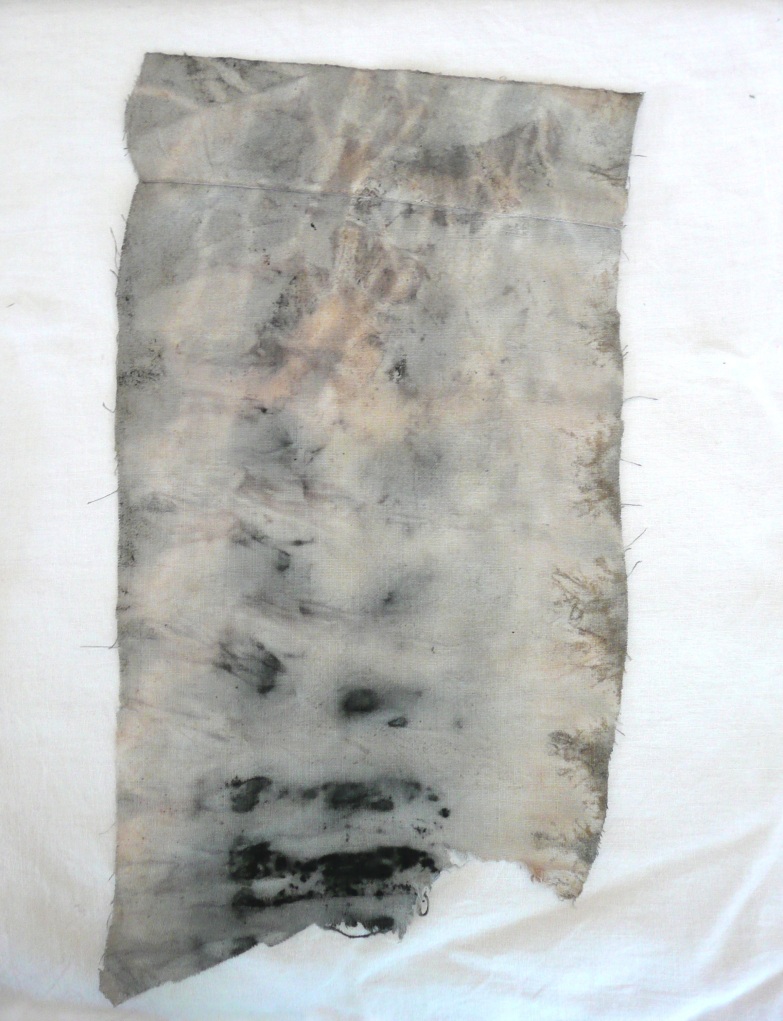
I also put in a sheet of paper, concertina folded, enclosing another eucalyptus leaf, and held together with two rusting bulldog clips. Later I added another folded sheet of ordinary printing paper.

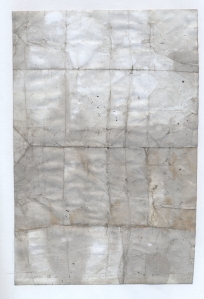
As the experts will know, the water got very black! I did not record how long I left the contents heating, but must have been about under an hour.
The results: the cotton dyed fabric is above showing the black marks from the nail, and I think the eucalyptus leaf is showing at the top where I laid it across the hemmed fabric. The two paper experiments are the smaller images – the bulldog clip marks are seen in the left hand image.
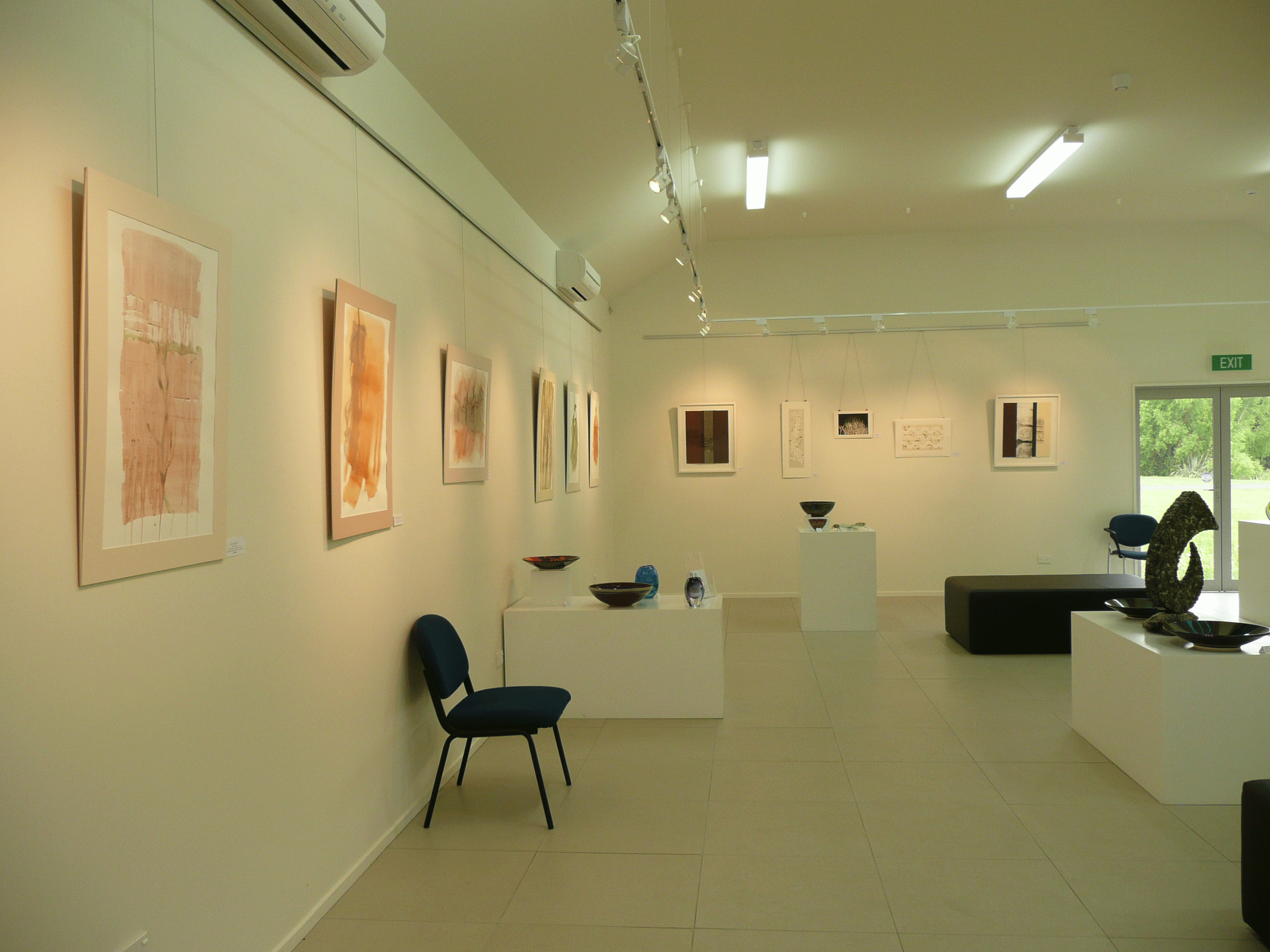
Gallery views of the Forms of Attention group exhibition by Helga Goran, Kim Lowe, Cristina Silaghi and Celia Wilson, at the Arts in Oxford Gallery, Oxford, North Canterbury, held during 24 October to 21 November 2010. Click on the link above to see the Forms of Attention catalogue.
 .
.

 Celia Wilson
