Hot Off the Press

Tomorrow's Beginning

Tomorrow’s Beginning

Bro

Boro

Image in Search of a Title

An Image in Search of a Title

Hot Off the Press;  four printmakers showing at Arts in Oxford Gallery, Oxford, North Canterbury

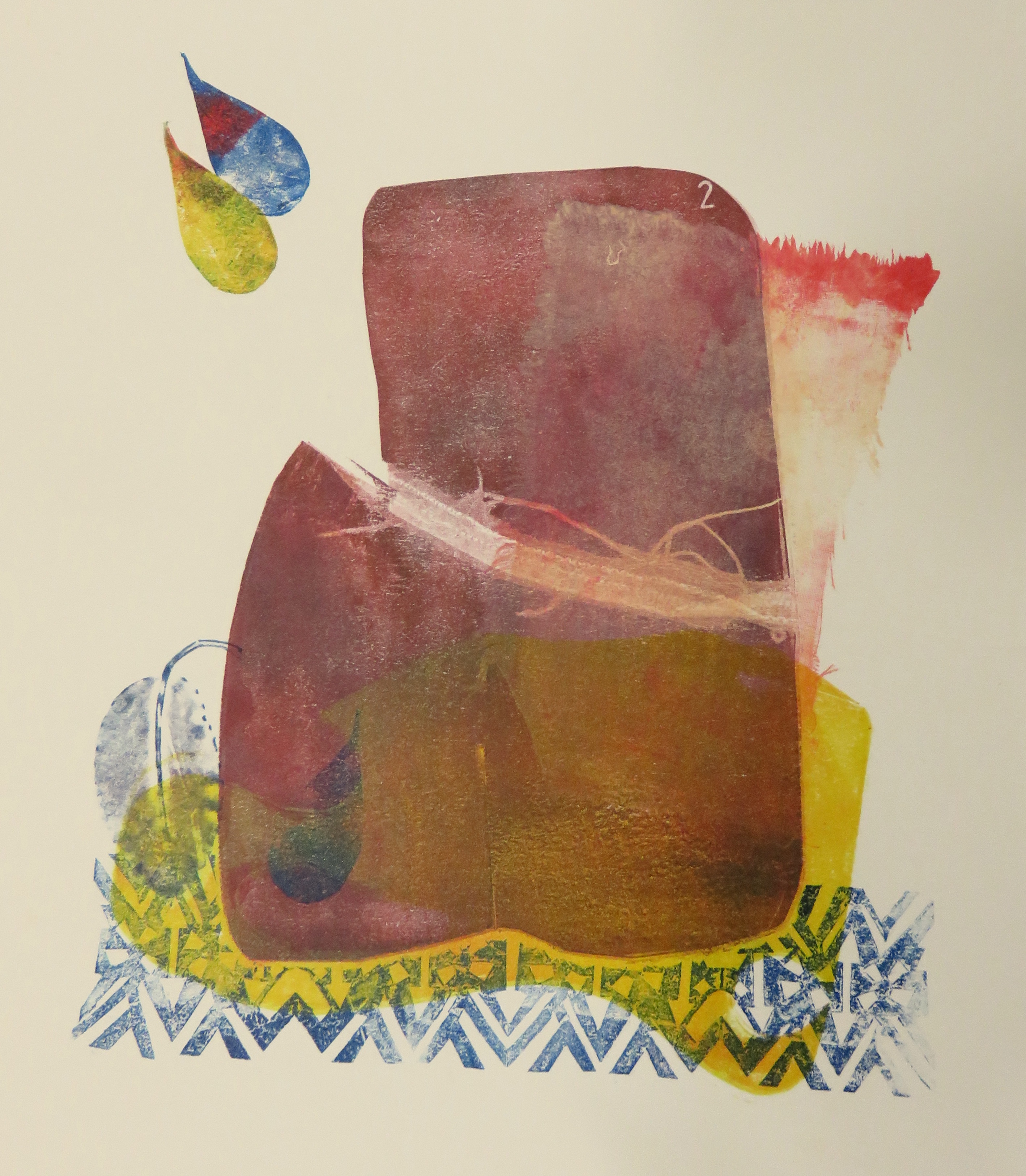
This selection of monoprints is my first venture into exhibiting prints.  I hope I’m keeping true to my art practice of using process and chance to make the image.  I like to use recycled items, such as scraps of paper, cloth and plastic to print with. The scraps are either used as found or cut into shapes or patterns.

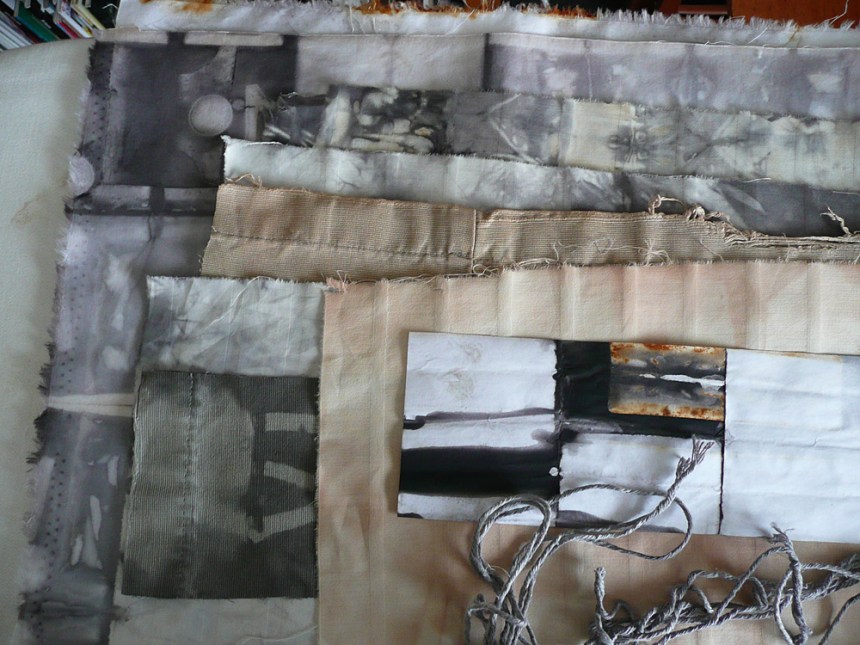
Through an interest in Japanese prints and making textile works I discovered the term ‘boro’. Boro is a Japanese word that translates as ‘rags or scraps of cloth, and the term boro is also used to describe clothes and household items which have been patched-up and repaired many times’[i]. The textiles could be passed down the generations and so also become holders of memory, in much same way as in old patchwork quilts.

In this set of prints I have interpreted this textile construction method by reusing the plastic, paper and cloth as the printing ‘plates’, integrating the shapes one on another to create an image that formed itself piece by piece. Would this go here? – What colour contrast will I do next? – the image in effect prompting a response from me.  Memories (for me) are contained in many of the ‘scraps’ used.

The base of all the works is a found shape that reminded me of a kimono, and from this emerged the idea of boro as a process to create these images.

[i] https://furugistarjapan.wordpress.com/2011/02/18/boro-japanese-folk-fabric/


Object or Thing

Cannot add more to this piece of work.  It sat there for a while, rolled up in the old bible box that my Grandmother used as a hat box (she had wonderful hats).  Then the other night I finished off the bottom right hand corner.  A little piece of family genealogy there, to me anyway…

IMG_0313


Lying flat on the table, it is a thing.  Nothing wrong with being ‘a thing’ – it seems things in our lives are interconnected with our brains and consciousness and make us what we are, allowing us to make new connections.  Is it more interesting as a thing or an object now that I have fastened to the wall?  Does it take on a new identity?  Or has it lost its becoming and is now static – I won’t say dead.   Its new persona invites new becomings, however.


Object


hatbox


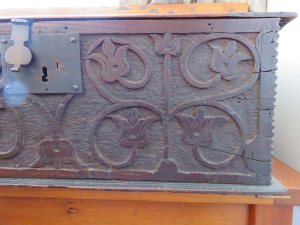
Lovely design on the ‘hat box’.

Green dye from Black Turtle Bean

Following on from the previous post about black bean dye –

The next day, bicarbonate of soda was added to the Black Turtle Bean solar dye.  Colour changed to green and this colour transferred to the un-mordanted silk and cotton scraps.

This test needs to be redone; the bicarb was added to the original dye which was probably a bit tired – the beans were ‘going off’ at the time.


Black-turtle-bean-green-1


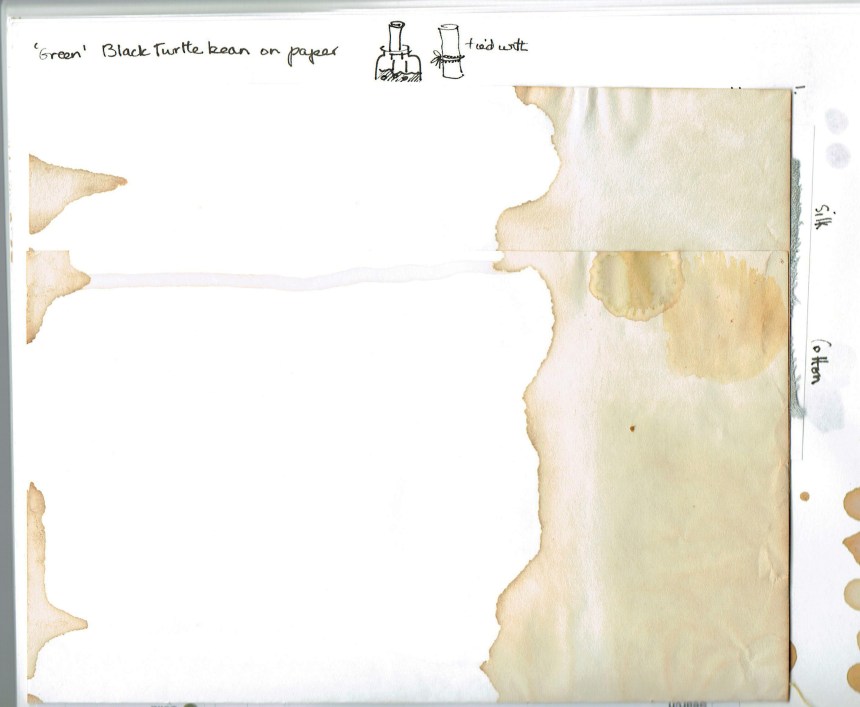
I also added to the solar dye pot some rolled-up paper, but the green disappeared into a brown-green when applied to paper.   Something in the paper which is photocopy paper reacting with this dye.  Where the pools of dye were deeper the green colour is just apparent.  This paper is stuck onto the test page and covered the swatches in the above image, hence the change of page direction!

Green-turtle-bean-on-paper


Black Turtle Bean, dye

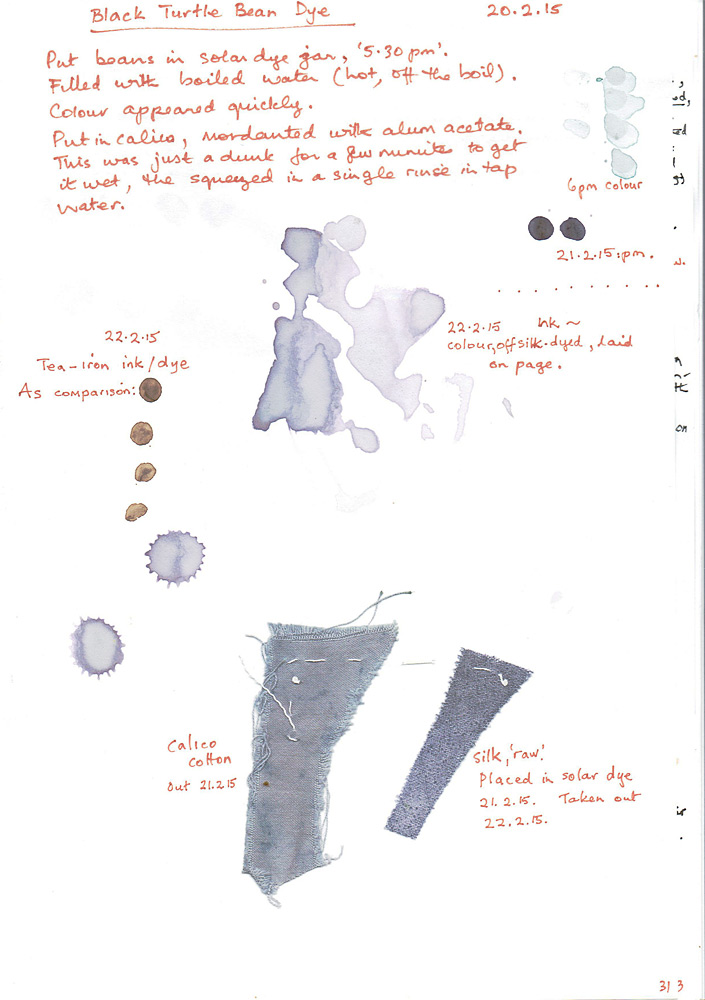
Saw Grackleandsun‘s blog on black bean dyeing, so I thought I would add this information on my recent test.  I used Black Turtle beans – not sure if these are the ones used in dyeing by Grackleandsun, but according to Wikipedia – “Black turtle bean is a small, shiny variety of common beans (Phaseolus vulgaris), especially popular in Latin American cuisine, though it can also be found in Cajun and Creole cuisines of south Louisiana. They are often called simply black beans.”

I coloured mordanted cotton and non-mordanted silk and also used the dye straight from the solar dye pot on the page.  it gave a lovely colour.  Eventually the jar did rather pong!

Anyway, here’s the page from my test book;

Turtle-Bean-dye-test-page

Summer printing

In my spare time… I’ve been doing some printing; actually it is becoming a little obsessive which surprises me as it has taken a while for the process to become second nature.  I no longer approach the press with trepidation.  Anyway, there is a lot to learn which is good, and the block or plate making part of the process is great – full of possibilities.

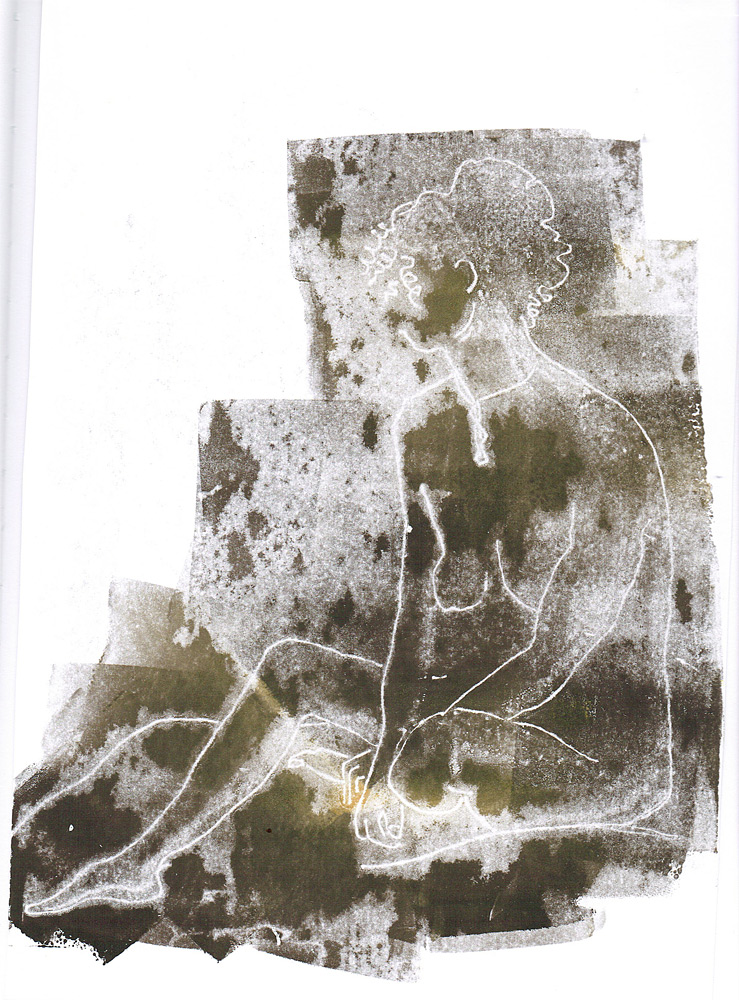
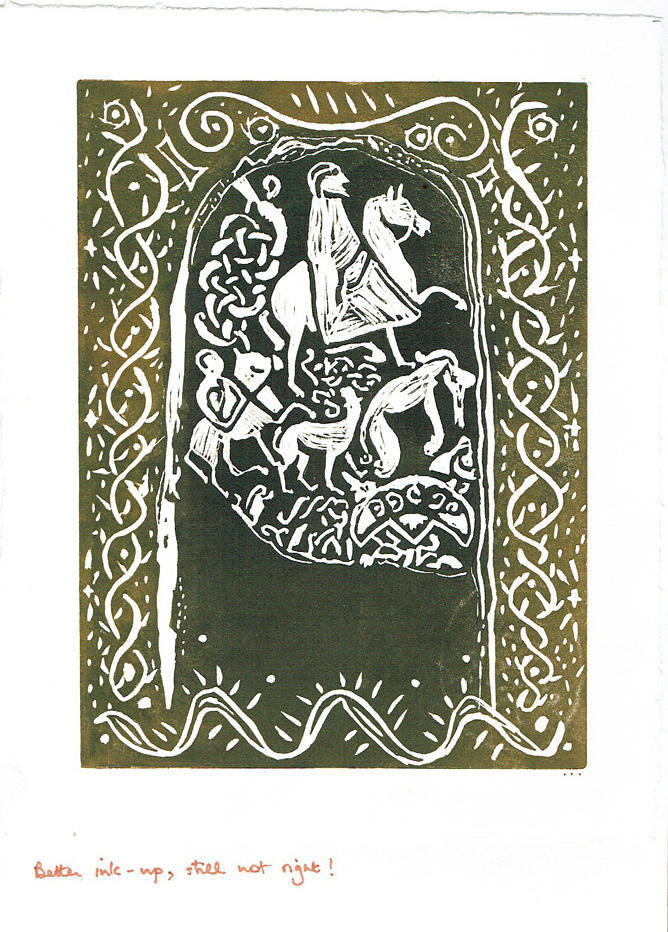
I have been organising a life drawing group and the first print shown below started life as a transfer print from a photocopy of one of my drawings. The inked plate was run through the press after making the transfer print, so that the drawing appeared on this second printing as a white line.  The mossy, stone-like inky background has possibly a good connection to the second image which is a lino block print – and my second attempt at carving lino.  The print shows the reverse of ‘Meigle No 4’ which is a Pictish cross slab.  The decoration surrounding it is what I can only call an exercise in ‘control of the carving tool’.

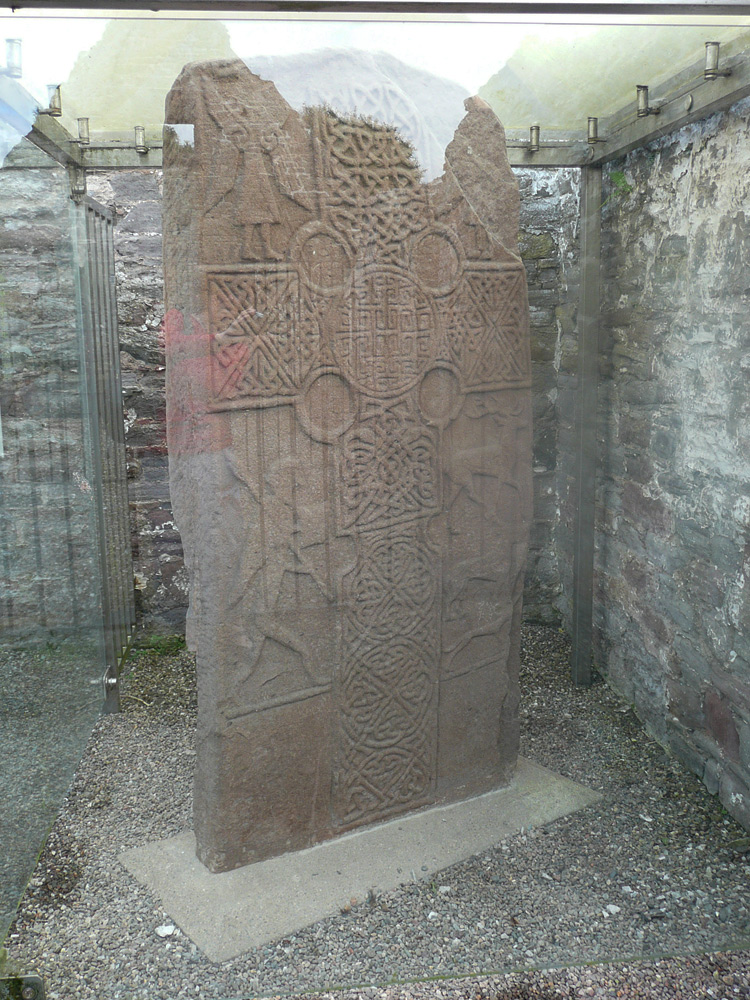
We visited the Meigle Sculptured Stone Museum in Perthshire, Scotland, in 2012 when staying near Alyth which was home to the generations of Barclays and Colvilles in my family tree.  The cross slab image was copied from the photograph in George and Isabel Henderson’s book, The Art of the Picts.  This is part of my cultural heritage that I feel I can use in my art – by association with place if not by genetic inheritance which, if you go back far enough, will be unknown.  We also saw the Pictish stones at the Eassie churchyard in Angus, and my two photos taken there follow the print images.

life-drawing-print

Meigle-standing-stone

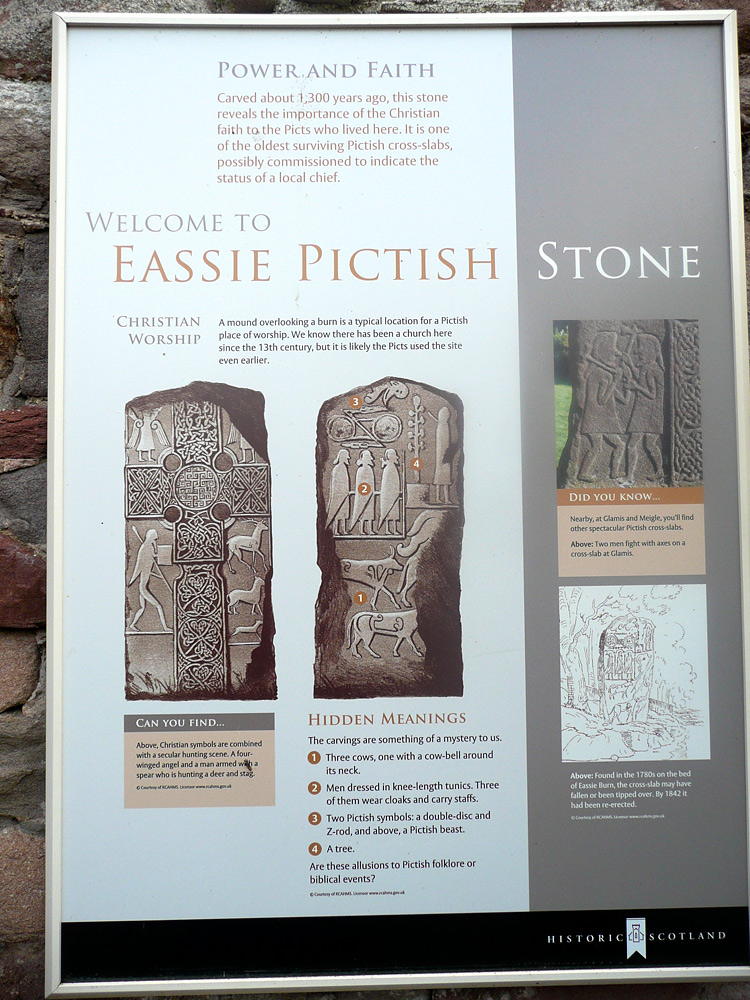
This Eassie cross slab is enclosed in thick glass for protection, accounting for the reflections seen in the photo. Very impressive object. The Historic Scotland information panel explains what is known about the iconography and history of these stones.

Eassie-cross-slab

Eassie-pictish-stone-info

Kozo Tea Iron

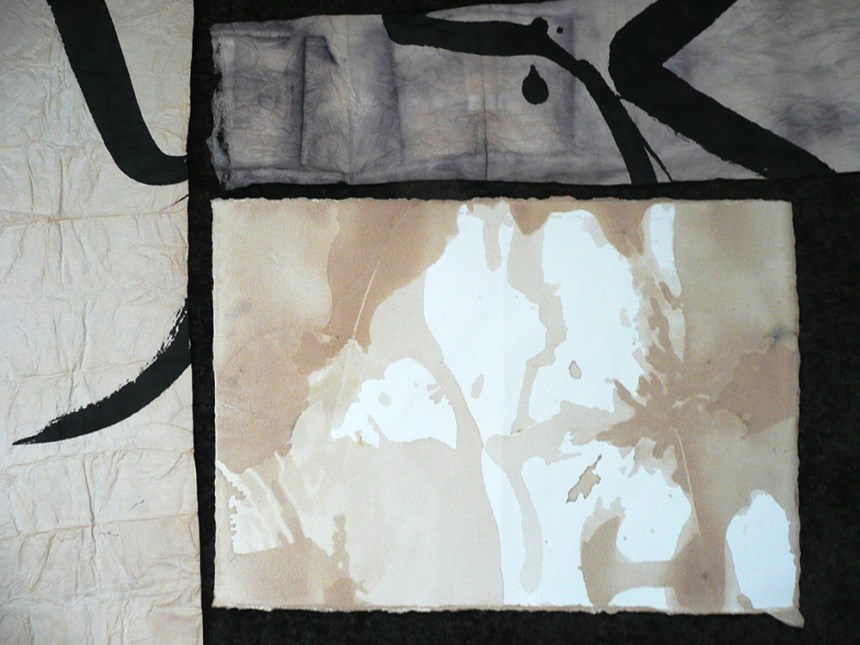
This latest experiment was about getting a contact print through an immersion in a cold dye, in this case tea. I used two strips of dry folded kozo paper that I had previously drawn on with sumi ink;  one piece was held together with a metal bull dog clip.  A stack of dry printmaking paper was interlaid with leaves and seeds,  then sandwiched between two sheets of perspex and clipped together with paper clips.  All three packages were immersed in the tea dye container for a few hours.  The darker dye (caused by the metal clip in the tea) remained in situ around the bundle while the liquid was motionless.  As I removed the papers I could see the reaction of the iron on the tea slowly take place over the rest of the dye and turn it completely black.

The kozo paper was squeezed in the hand when taken out of the tea dye to get the lovely ’embossing’ (the photo does not really do it justice).  I am very pleased with the abstract nature of the results, even though the plant material left little in the way of images on the printmaking paper, but there are some impressions – a trace of the leaves on some sheets.  There are also a few traces of other colours from the plant material.  Some of the seeds left a darker spot on the paper.

There is a tension here (freedom and control) between allowing enough moisture into the stack and the pressure required to achieve images of the plant material.  Perhaps the paper in the stack should have been damp which might have allowed more wicking of the dye.  Needs more investigation.

Some of the tonal variation occurred as the printmaking paper was removed from the stack.  I tried to restrict disturbing the remaining dye but some of this did happen of course!  The printmaking paper has much value as a base layer for further work.


Kozo-and-print-paper

Explore Find Collect Discover

Progressing with my little piece of fanciful endeavour. The weather is too hot to do much but I am enjoying this evening pastime.  Trying to contextualise this piece, I found it lends itself to ‘something old, something new, something borrowed and something blue’.  The ‘borrowing’ comes from Spirit Cloth, so thanks to Jude for her inspiration and putting me on yet another path.

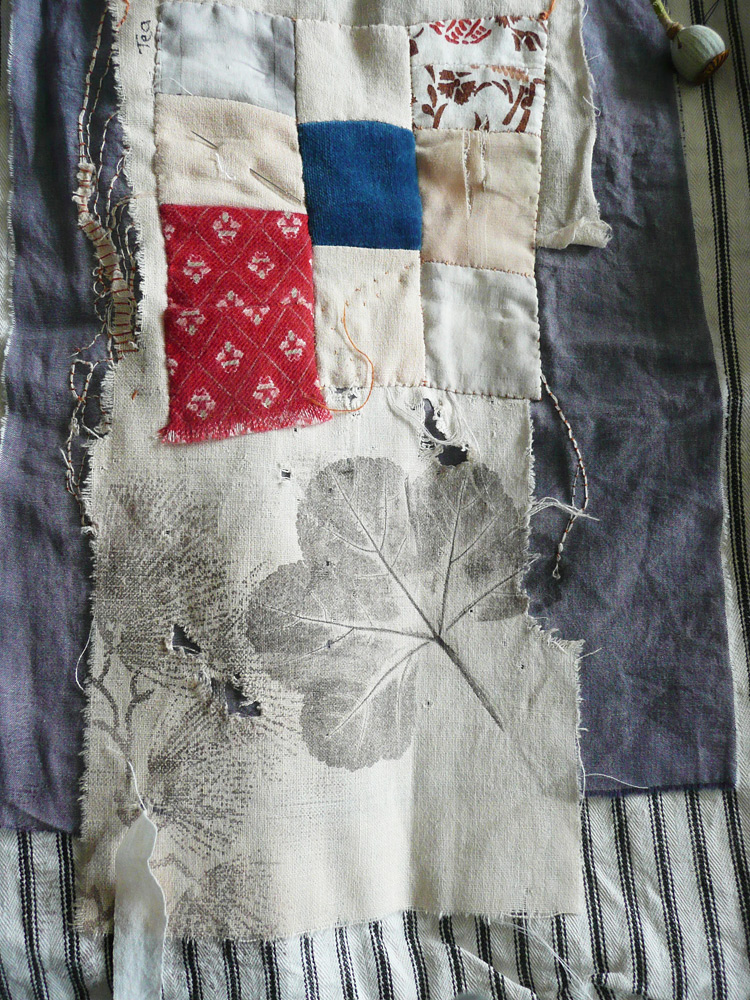
It is quite difficult to find suitable, old, worn cloth, but I realise I have to collect all my textiles and yarns in one spot – I seem to be endlessly looking for where I have stashed them – and since we moved they could be anywhere!  I am using fabric dyed last year, snippets of my mother’s dressmaking, her box of embroidery threads, my threads from those I collected decades ago and even some old silk velvet from my sister’s mother in law.  The cloth (dyed in tea) with the holes was an old pillowcase into which we used to put horse riding gear when it was being machine washed.  The ‘something new’ is the print of the mallow plant growing in the new garden.

I really like the feel of the layers of cloth and the abstract forms created by the stitching on the reverse of the piece.  The space created by the circle (top left) seems to suggest landscape, or a vista.  It is the only part that has visual depth.  What to do next…

Piece

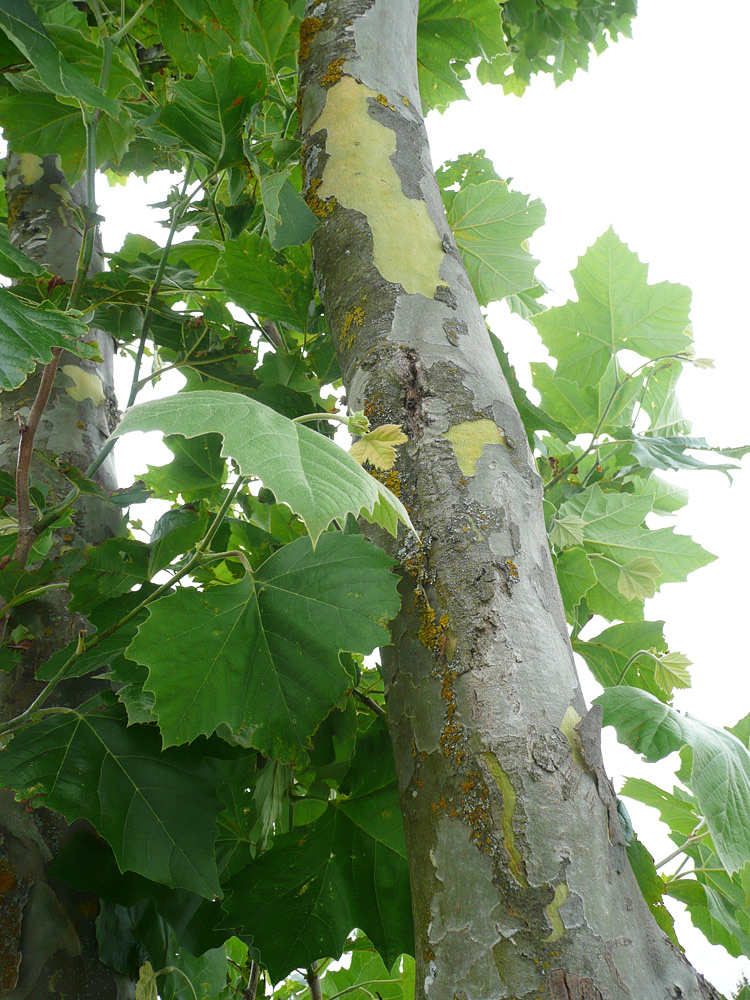
It’s a Plane tree

I went out to find the tree – it is what I know as a London Plane tree – and it seems to be known under various botanical names and I won’t bother to list them. Glad that little problem sorted…  See previous post.

Leafplane

Spring leaves, nature prints and patchwork

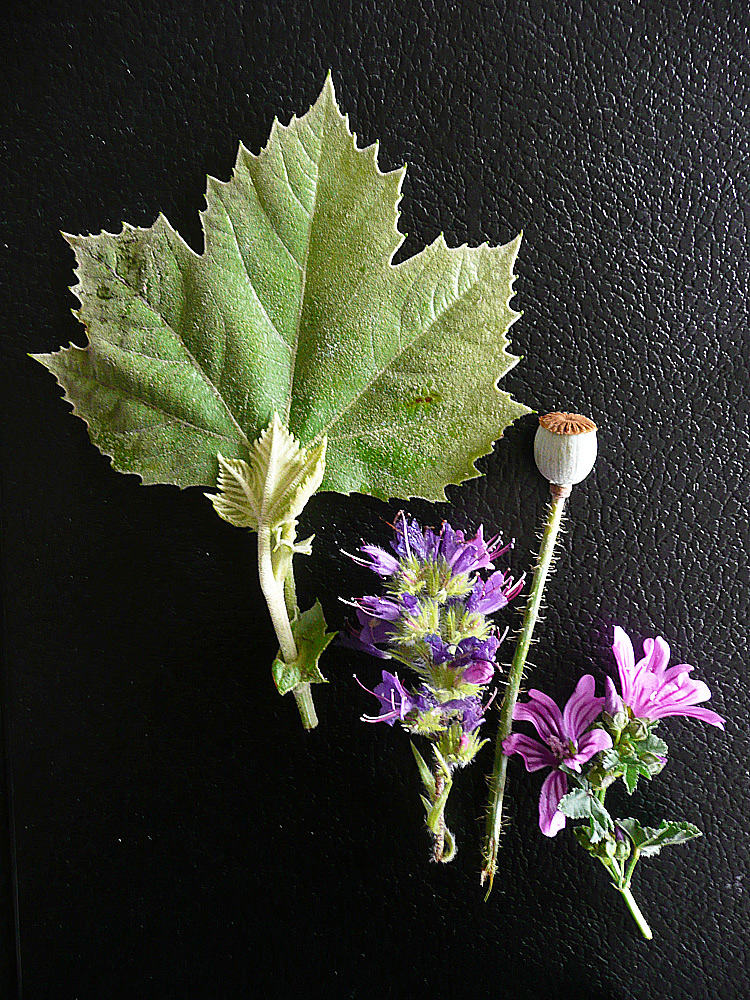
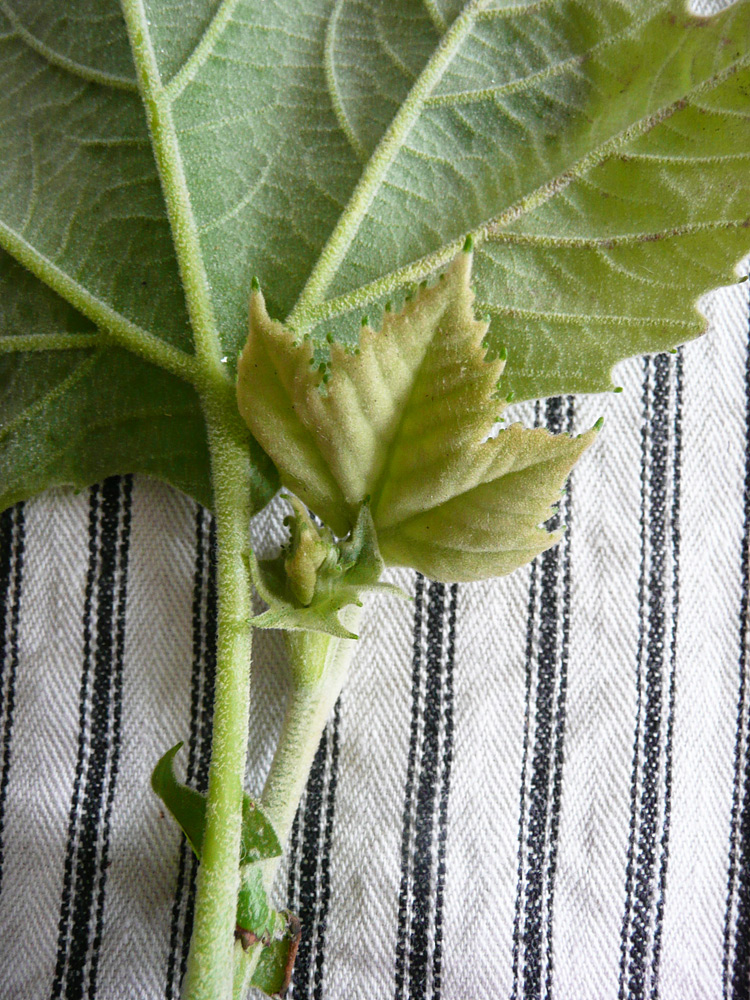
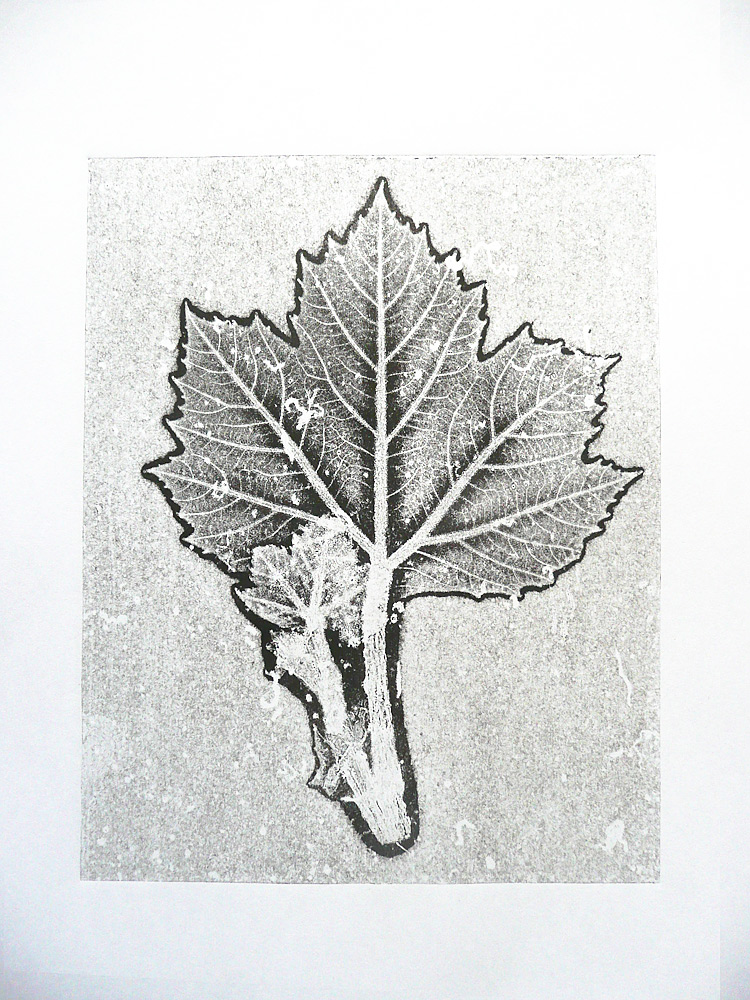
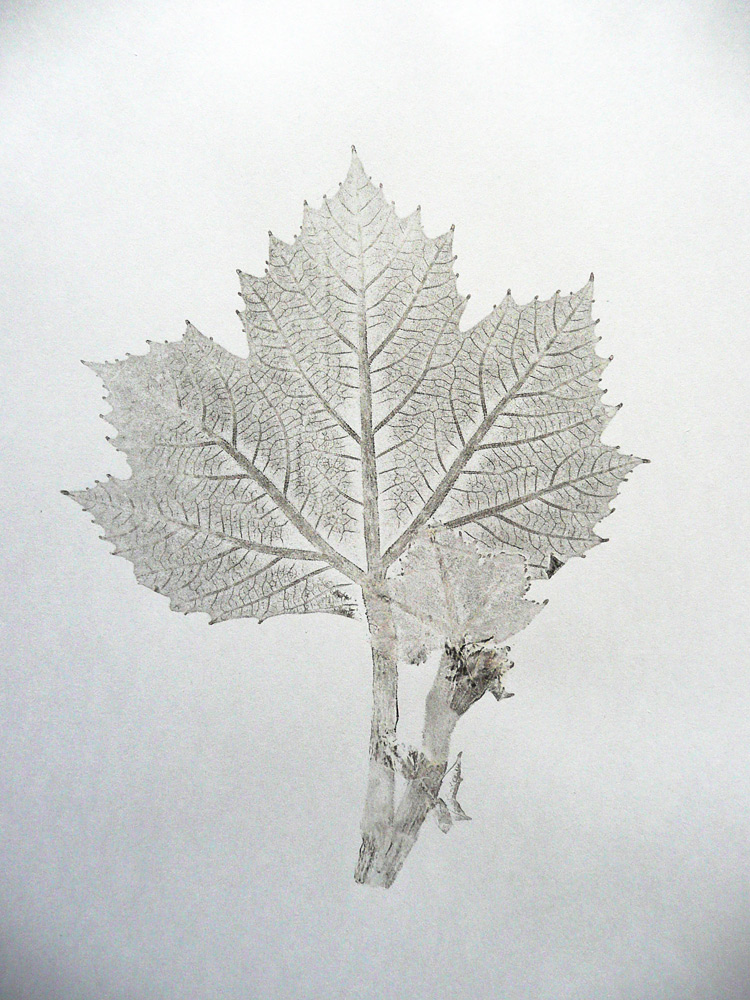
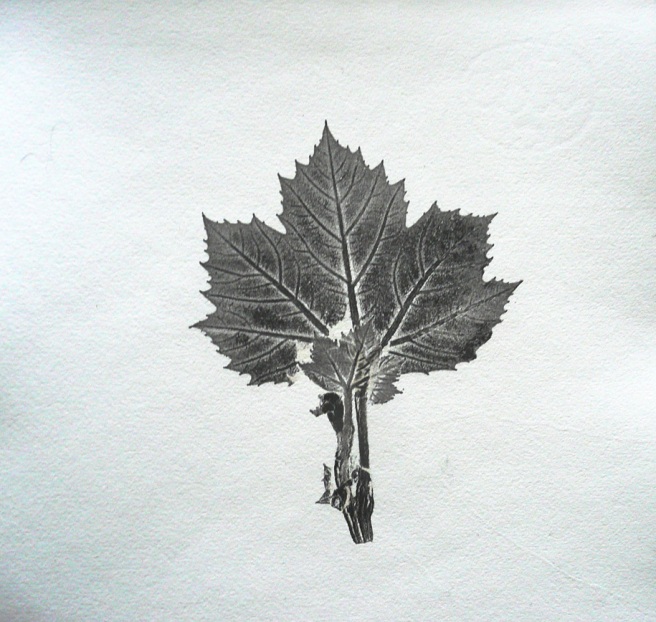
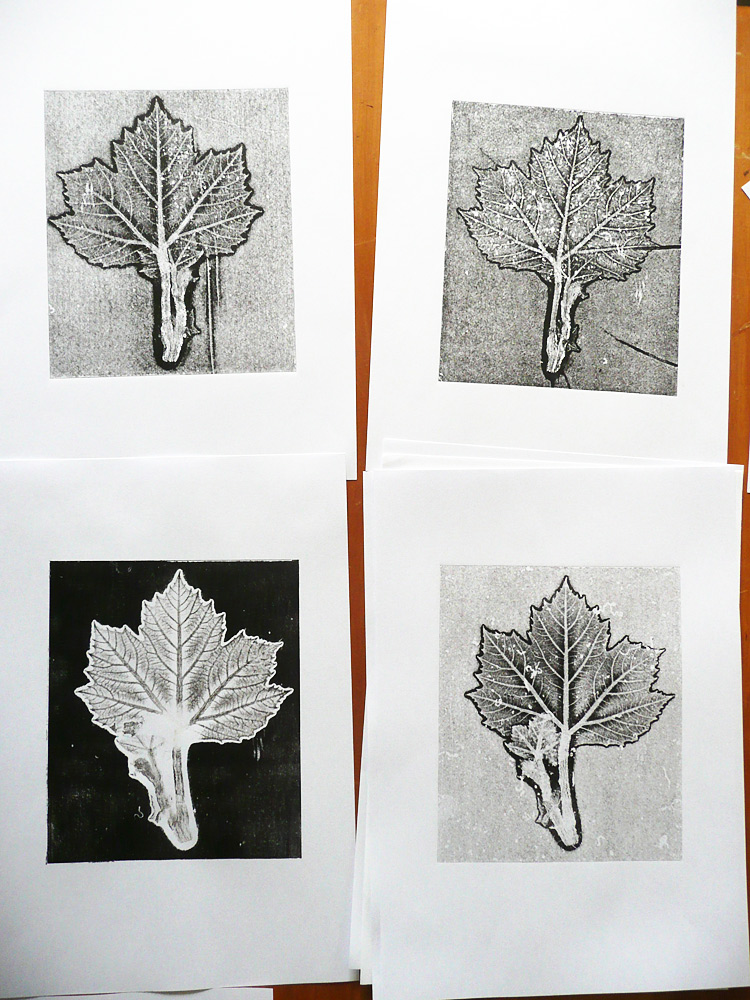
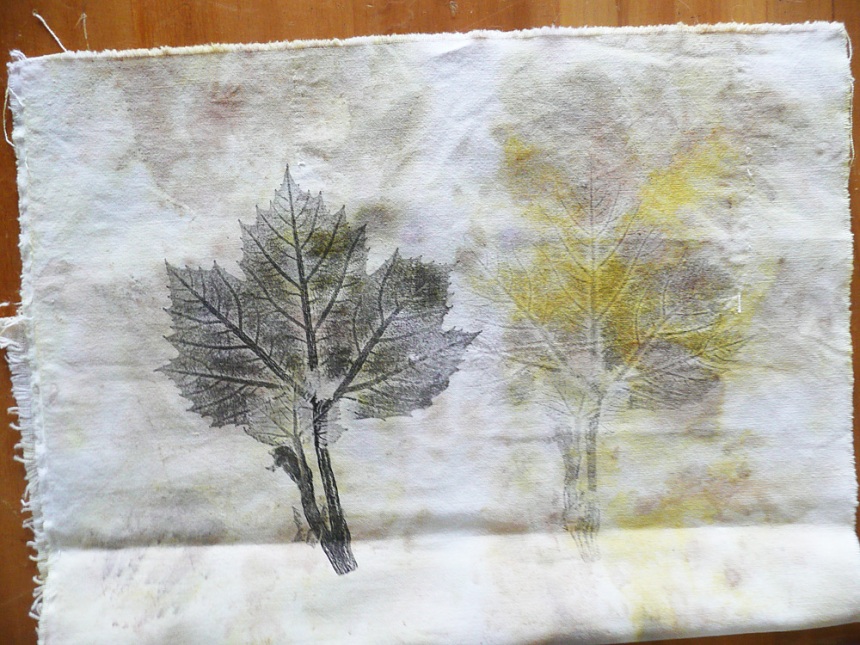
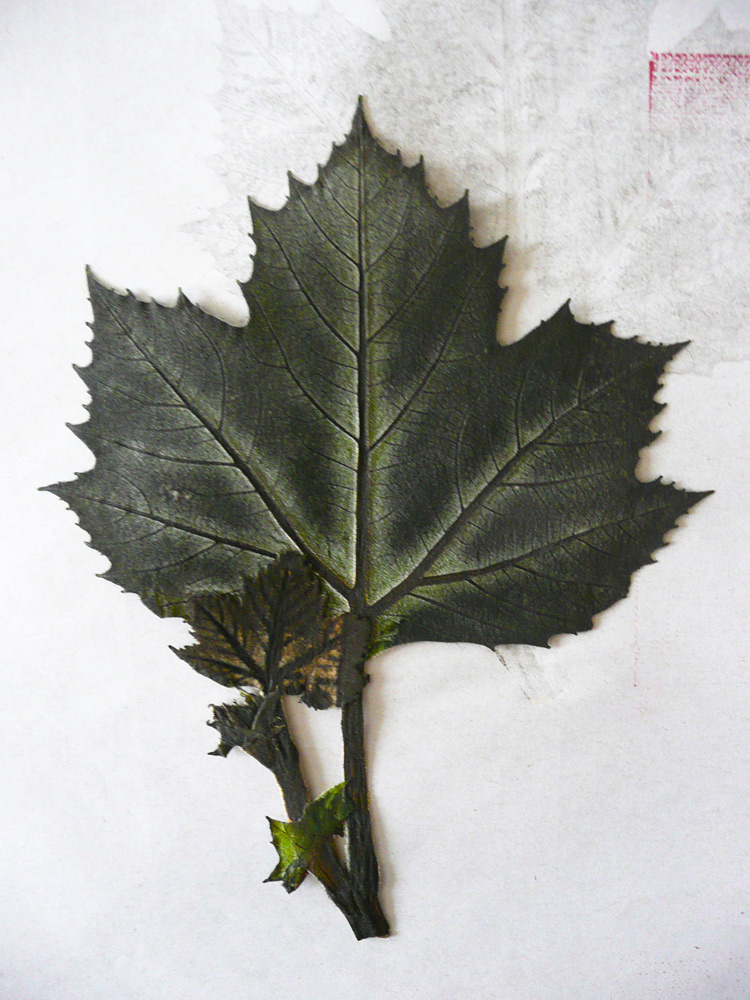
On a walk yesterday I found a windblown leaf, and later picked some leaves and flowers from the garden.  I am not sure at all what species of tree the leaf is from.  It is difficult to define, mainly because it is immature.  However, I think it may be a Platanus  (plane, sycamore) as suggested by the stem and leaf vein structure.  To memorialise this arrested development I made prints from the leaves.

Leaf1

Leaf2  

I made a few nature prints, on paper and cloth.  The first print is from the inked plate (with the leaf removed after passing the two through the press).  I dropped the inked plate on the floor which accounts for the wiggly marks and scratches.  Liked the effect!

Leaf5  

This print below, taken directly off the leaf alone, is particularly interesting, delicate.  

Leaf4  

This print is made on damp 300 gsm paper   Leaf3  

Here is a small selection of the process – when the leaf was thick it caused creases in the paper and some areas did not print so well.  

Leaf7  

I have been busy…  Here I have printed on cloth; works very well.  The impression on the right was hand done with the roller and not put through the press, unlike the other one on the left.  I am getting confident with using the etching press.  

Leaf8  

Finally, the most beautiful object of all, the actual leaves, with a trace of the ink still on them. It shows the underside of the leaves.  I used Akua black ink, and many of the prints were printed on dry digital/inkjet A4 paper.  

Leaf9  

To end, here is a textile work I have started in response to following Spirit Cloth. I have printed on to cloth a mallow leaf and an image off a piece of old wallpaper.

Leaf6

Dyeing Scraps with Tea and Rust

Being a Jill of all trades, I was prompted to have another go with metal and tannin by an article in Wendy Feldberg’s blog Threadborne.  I am switching from researching, to seed collecting, to sewing up clothes and soft furnishings, to printing, to photography, to collecting more rocks for pigments,  to drawing and back again with great rapidity at the moment.  So this dip into dyeing is yet another experiment.  Making the invisible visible through chance.

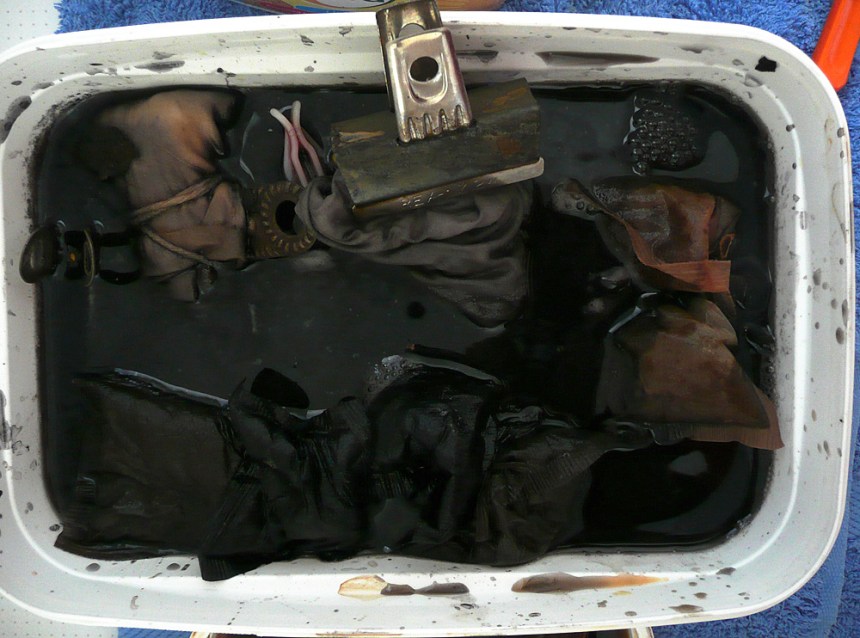
My intention for this project was to get some pieces of cloth that I could use in my art work.  I had one bath with just the tea and tea bags, and the other with the metal and tannin.  I tried to combine the two dyes, moving some bundles from the tea to the metal bath and leaving part of the bundle above the dye so it was just dipped into the liquid.

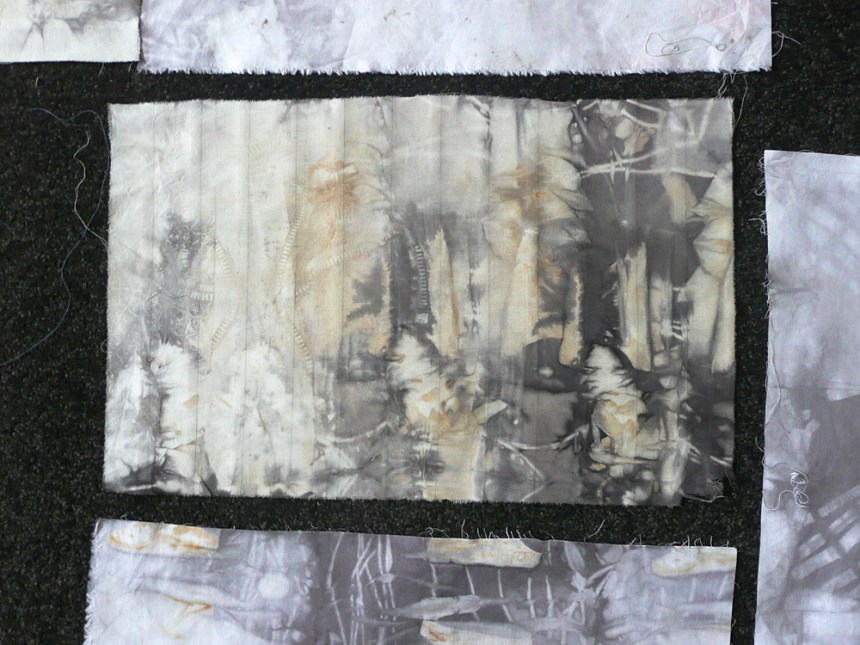
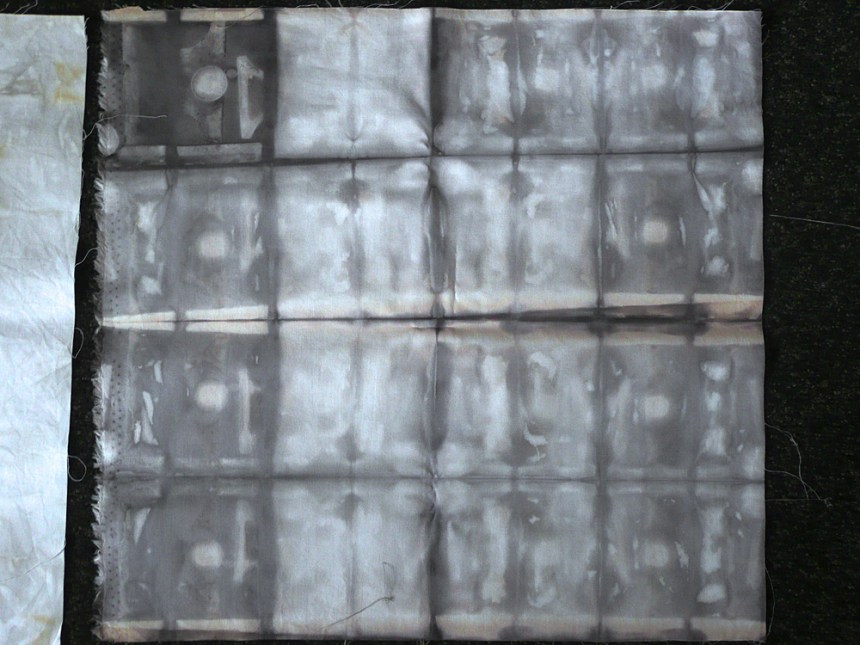
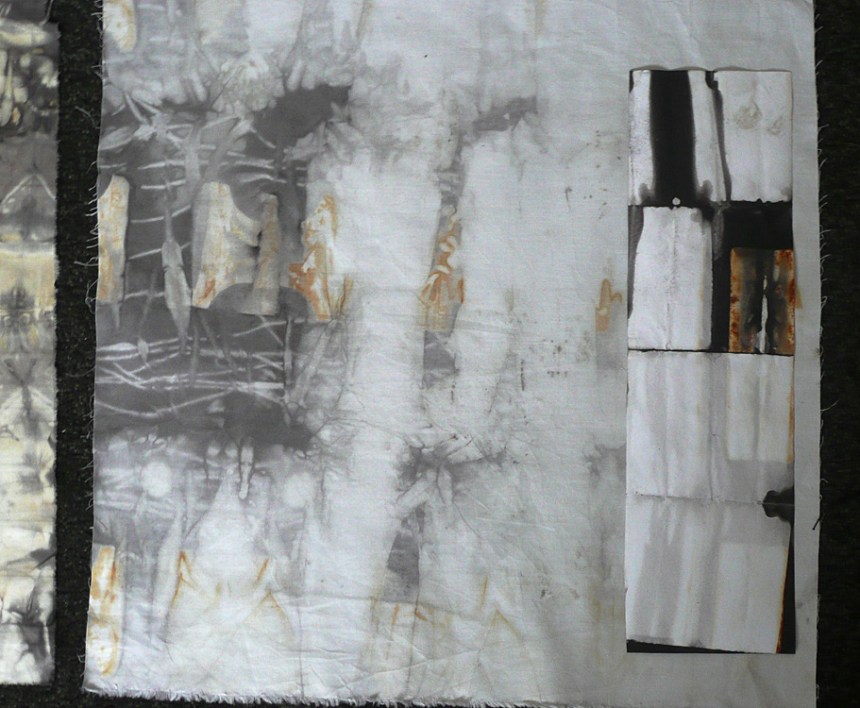
The results from the dye session were good, better than expected.  It was a simple process compared to other dye sessions I have done that took much more of my time – or I should say – my presence, watching and checking.  I used some new squares of light weight cotton with a glazed  surface on one side, together with some old sheeting and clothing.   The glazed side accepted the ‘dye’ the same as the unglazed side.  I am thinking I might try printing on this fabric…

Cloths were rolled or folded, then bundled, clipped and tied.  I actually had two dyeing sessions, refreshing the initial brew with more tea, tea bags and vinegar.  The metal was rusty scraps, coins, bulldog clips, an old metal zip, and some aluminium foil (don’t think that did anything) all in a plastic ice cream 1 litre tub. Once out of these cold dye baths – one was overnight, the second one day – the cloths were rinsed, then left for a short while in salty water, then washed with Ecostore hand wash liquid soap that sits in the laundry.  I was very lazy, but really I only had machine washing powder as the other option.  And I felt the hand wash liquid would be softer on the dye.  Anyway, it worked fine.

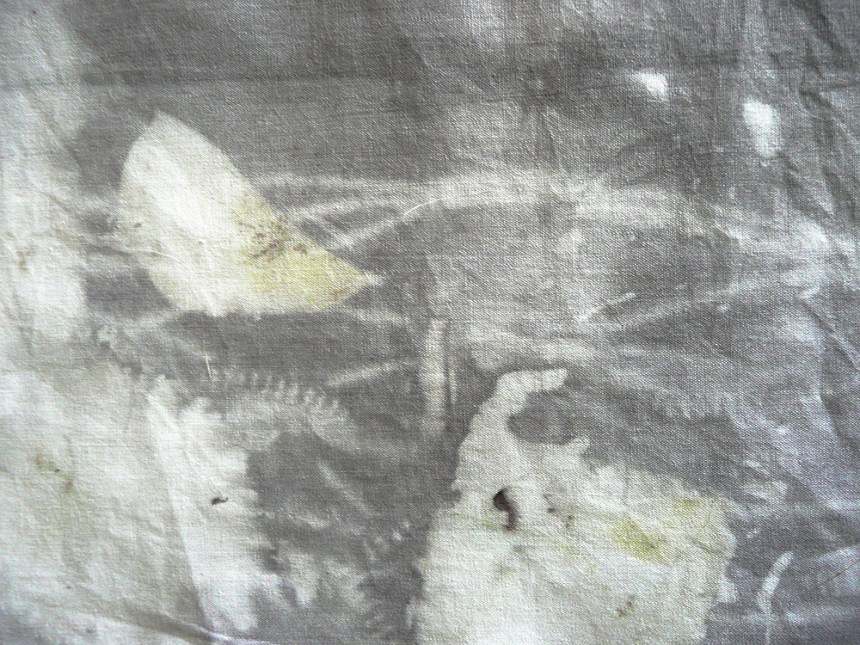
After drying, the cloths were ironed – once flattened the magic really became apparent.  I included some pink rose petals and leaves in one bundle.  The petals left a pale green colour, and there is a mysterious very pale pink – cannot image where that came from, but it may have been a label that was attached to the plastic mesh bag as it was not from the rose petals.  I included the bag hoping to get an impression of the grid, but that didn’t happen.  I also folded a piece of acid free office computer paper and put that in the second dye bath.


Dyed-brew

Dyed-scraps-overview

Dyed-multi

Dyed-repeat

Dyed-paper

Dyed-scraps-petals