Autumn Leaves on Paper and Cloth

I had the opportunity to collect leaves from a friend’s garden. She has the most wonderful collection of shrubs and trees, all good candidates for natural printing.  I made three separate bundles using paper from three different pre-steam soaks.

Pescia 300 gsm paper  was put in a brew of brown rain water and ivy branch and leaves which had collected in a rusty wheelbarrow. The paper was there for nearly three days. Secondly, and for the same amount of time, I placed Fabriano artistico 360 gsm paper, (synthetic) lining fabric and pre-used poplin cotton in another mordant – an alum and washing soda bath.

Thirdly, a piece of white paper was soaked in a rust bath.  As usual the planned method of preparation flew out the door when I then added a little of the rusty water from this water + vinegar and iron objects on to the lining fabric which was on top of the second soaking pile.

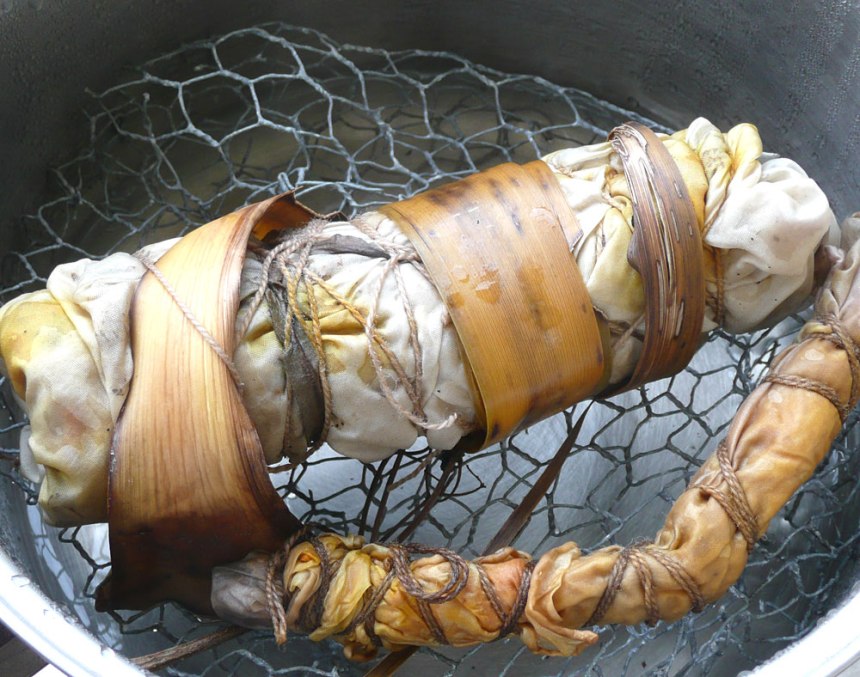
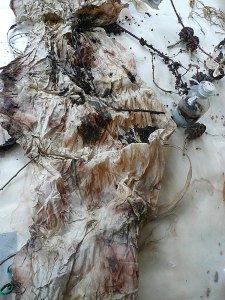
All the leaves were from the freezer. The full sheet of Pescia paper I folded to fit the steamer, as I wanted a large complete sheet for a project that is part of a forthcoming group show. Into the rolled paper and fabric from the alum bath, I put more of the same leaves and bound them up with unmordanted wide cotton bias binding at which point I introduced some dried harakeke roots (NZ flax plant, Phormium cultivars).  The image below shows these two  bundles in the steamer.
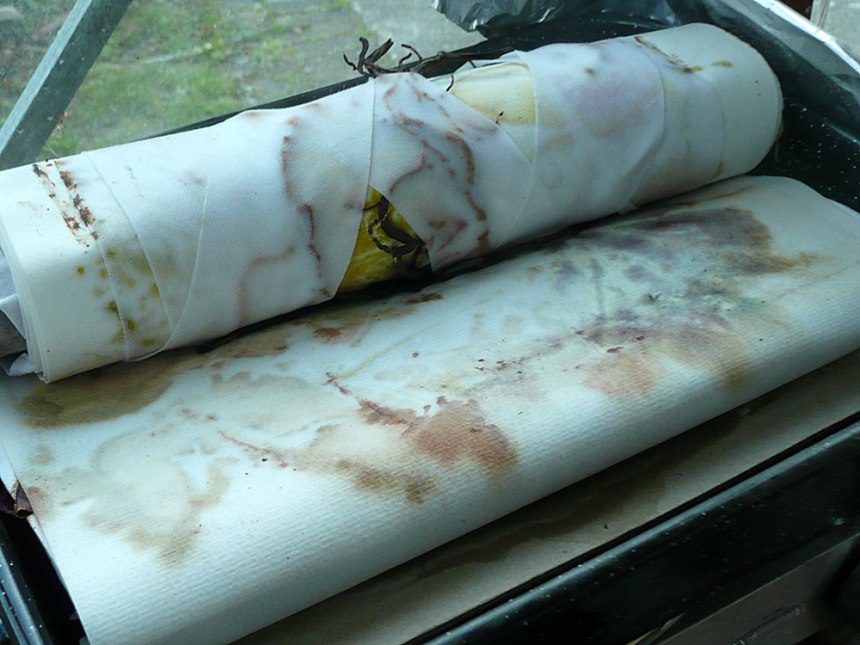
Darfield15

Below is the alum Fabriano paper on its cylindrical cardboard core again.  I make sure I roll the wet paper and leaves tightly when rolling up the bundle.  I do find the bias binding works well.

Darfield4

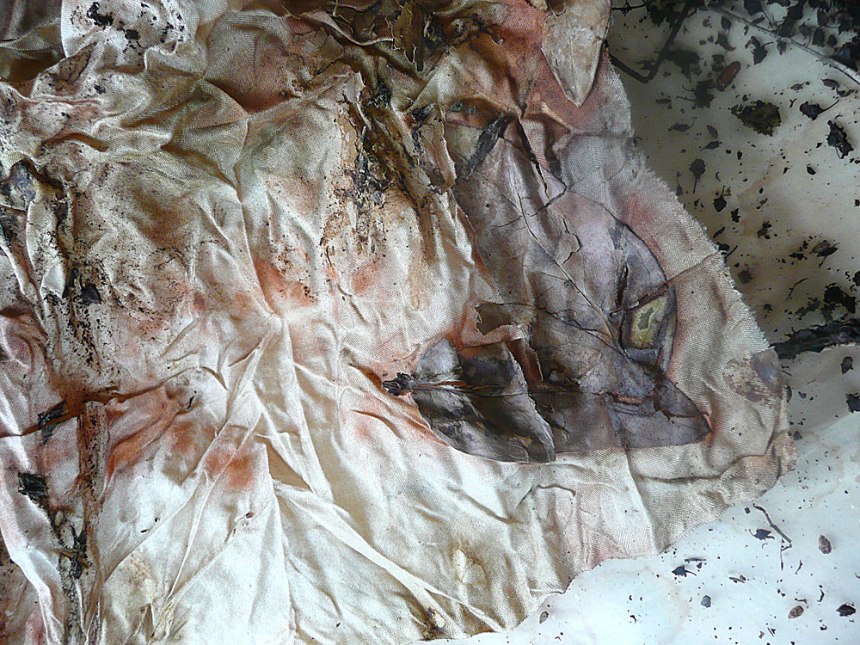
Unwinding this bundle.  It contained vine leaves, cotinus, acer, maple, sycamore and other deciduous leaves – I have to consult the owner about the more unusual plants…  The vine leaves were a glorious blend of reds, greys and black, so I was interested to see the quite stunning result – for me at least!
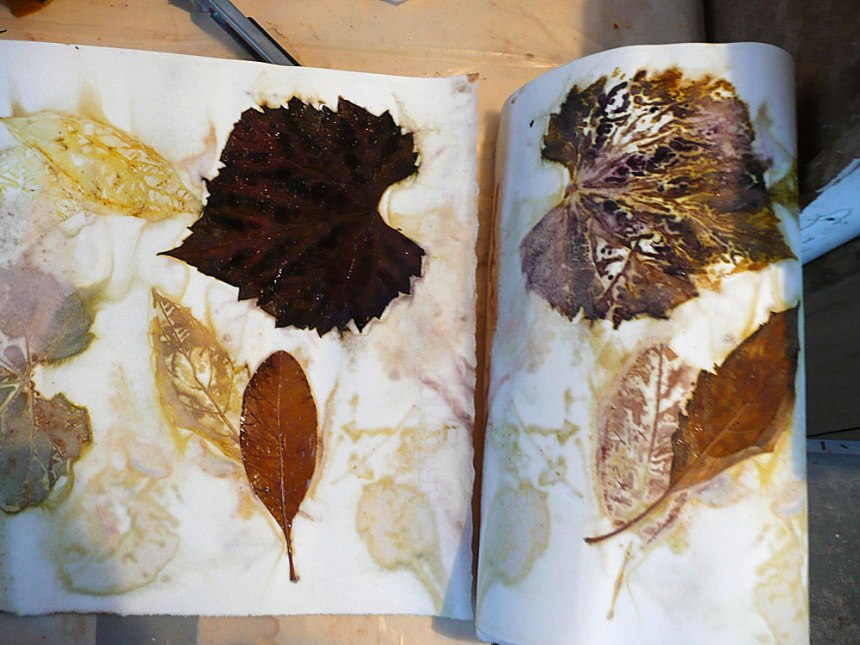
Darfield3

Another view of this bundle of two sheets of paper – it is the left hand side of the image above, the vine leaf removed.  Some of the vine leaf is still stuck to the paper.  It was removed when dry.
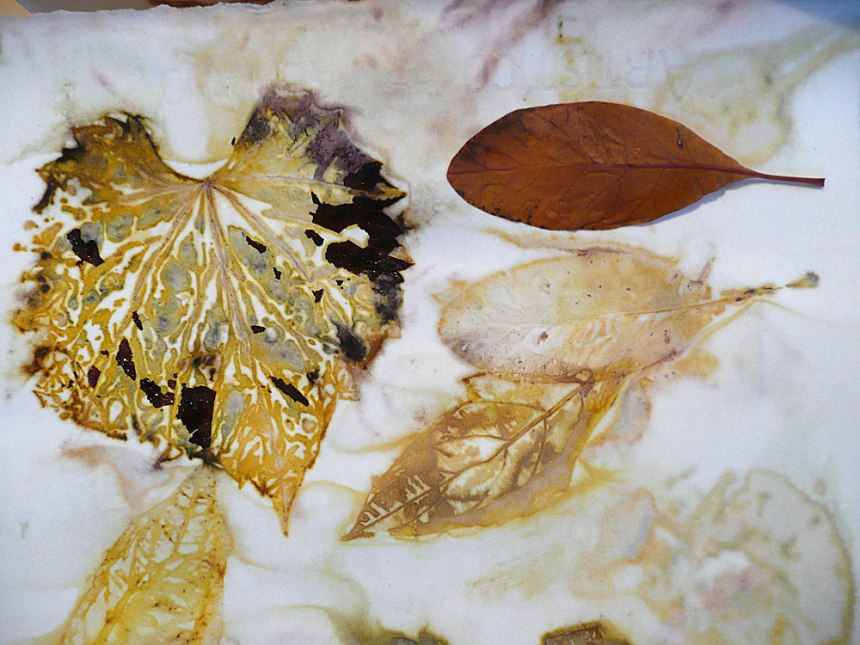
Darfield2

This is a further image of the still wet papers.
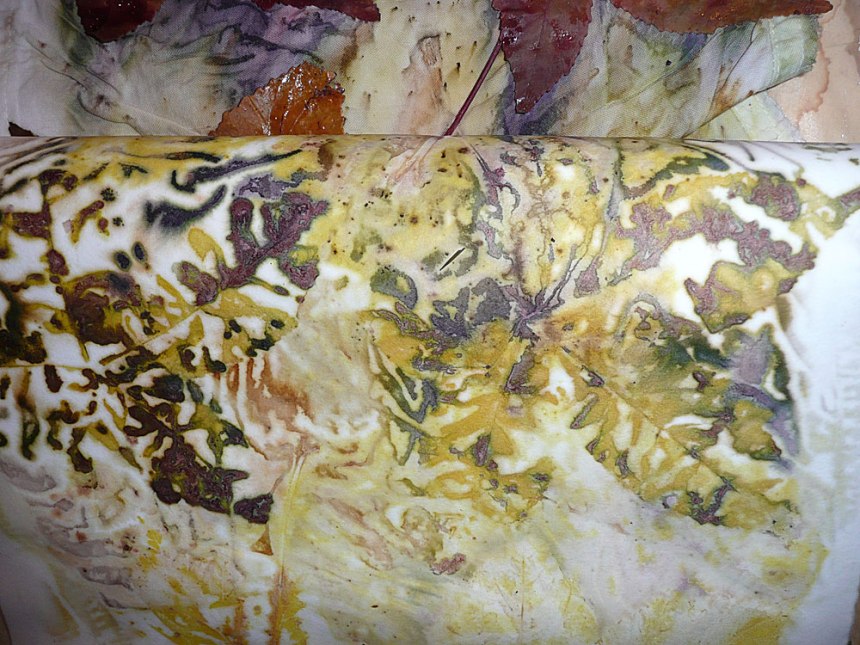
Darfield1

I particularly  like the shape of this leaf, which I think is from a tulip tree – Liriodendron.
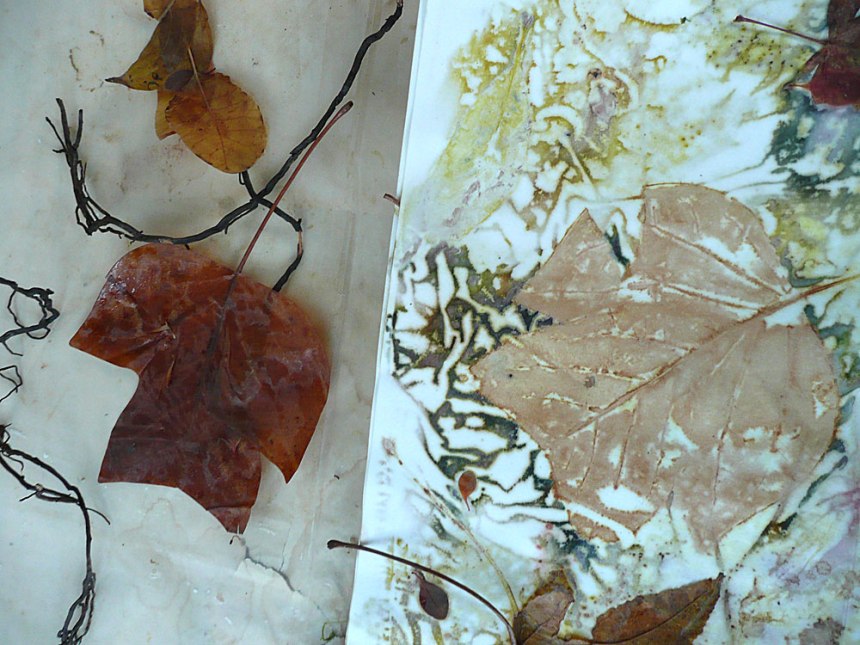
Darfield6

Here is the lining fabric and the cotton bias binding from the rust paper print.  (If you sew, you will know what that is!)
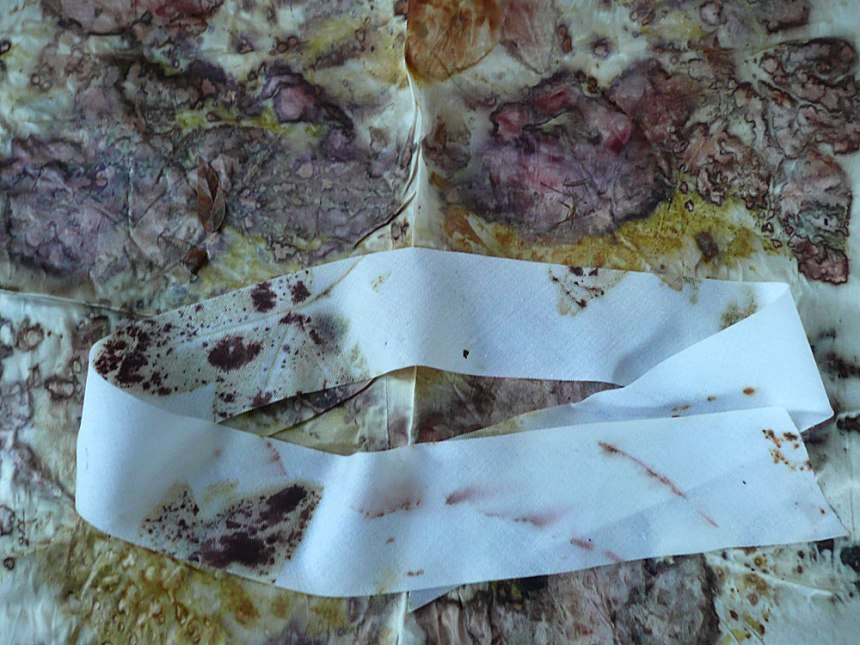
Darfield5

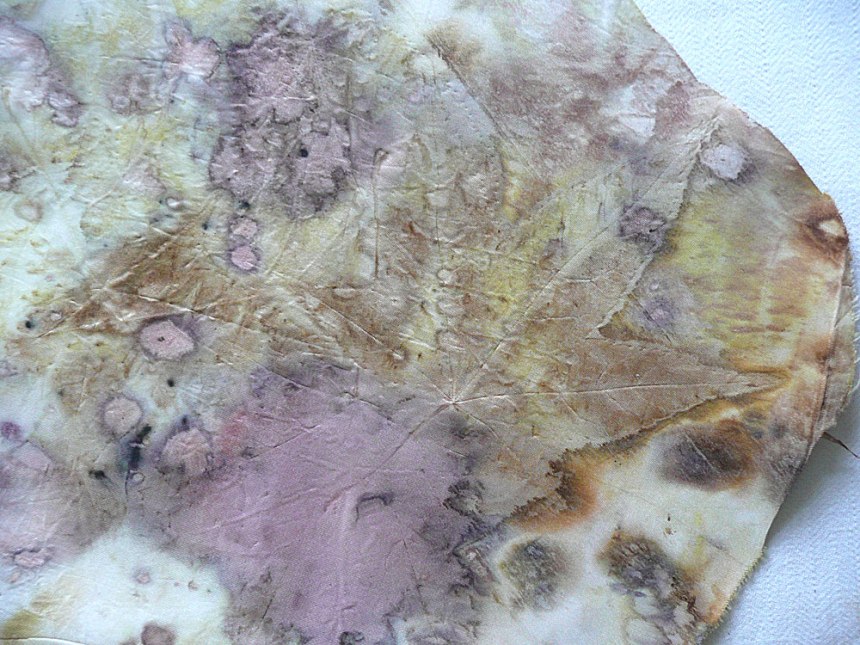
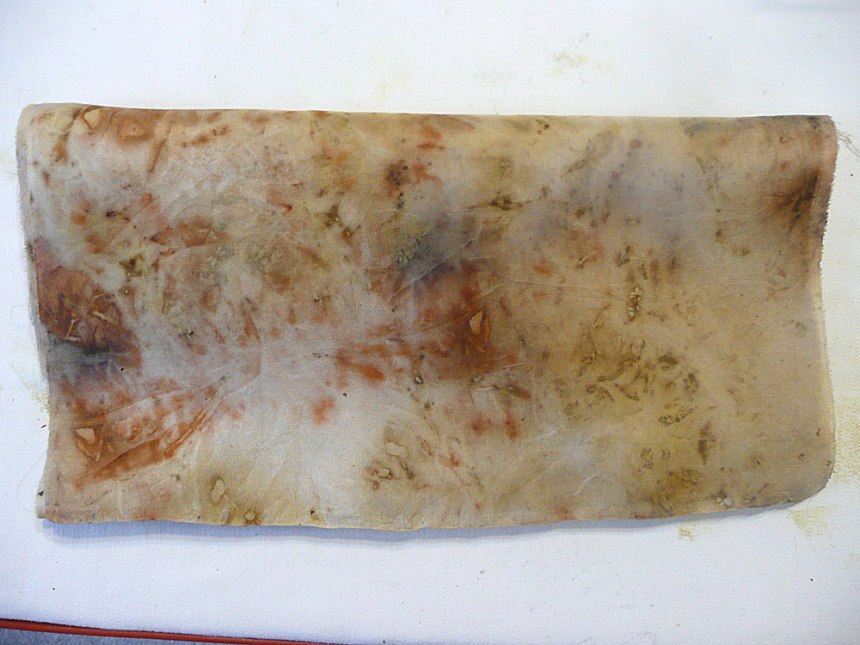
All the above image are when the material was wet.   So today I photographed the dried and ironed fabric.  Immediately below is the lining fabric, and another image of the same piece.  When I iron the fabric I like to keep the embossing from the leaf veins.
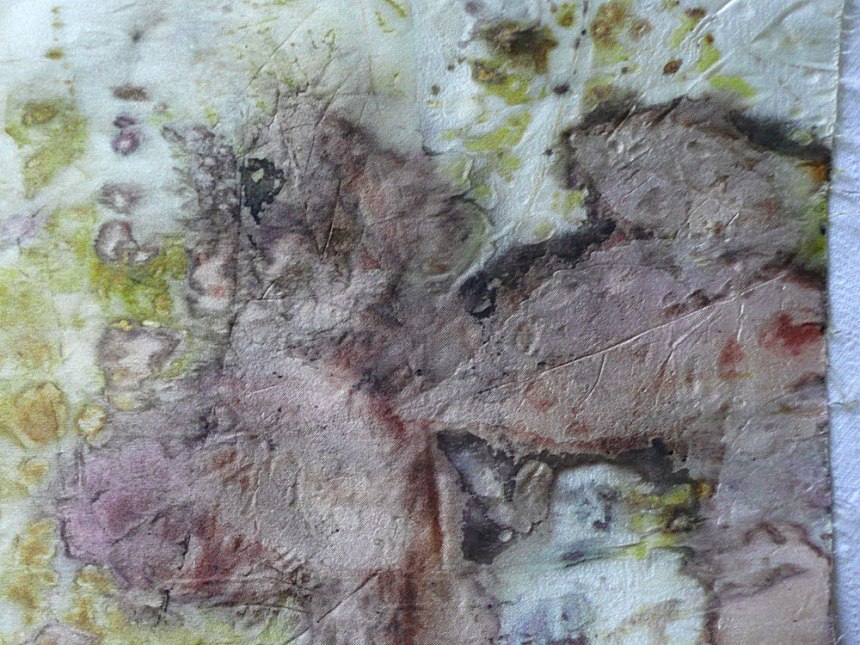
Darfield7

Darfield8

The definition of the leaves is a lovely instance of chance – the darker areas behind the leaf giving the appearance of depth.

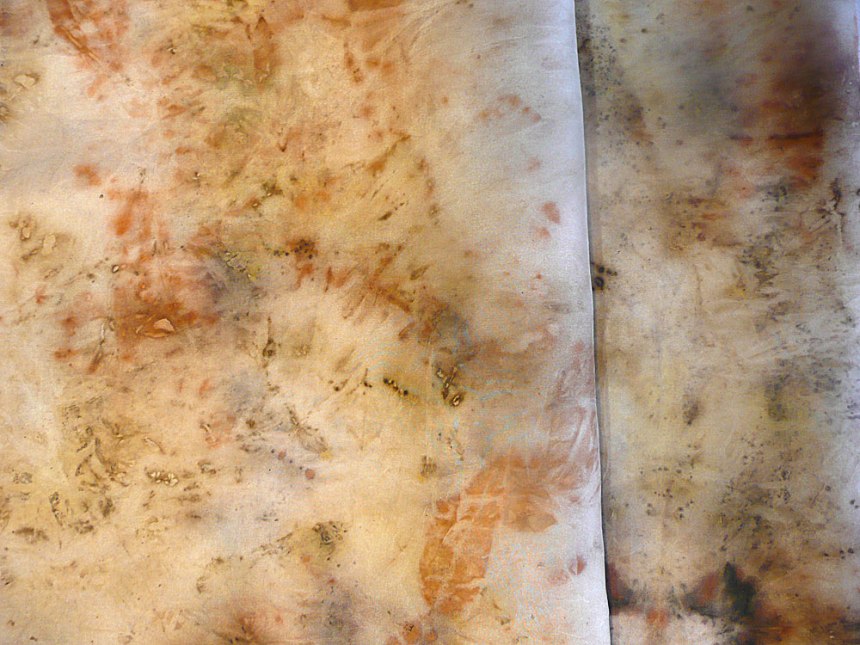
Finally, below is the cotton fabric from the alum and washing soda mordant bath: the leaf shapes not distinct.
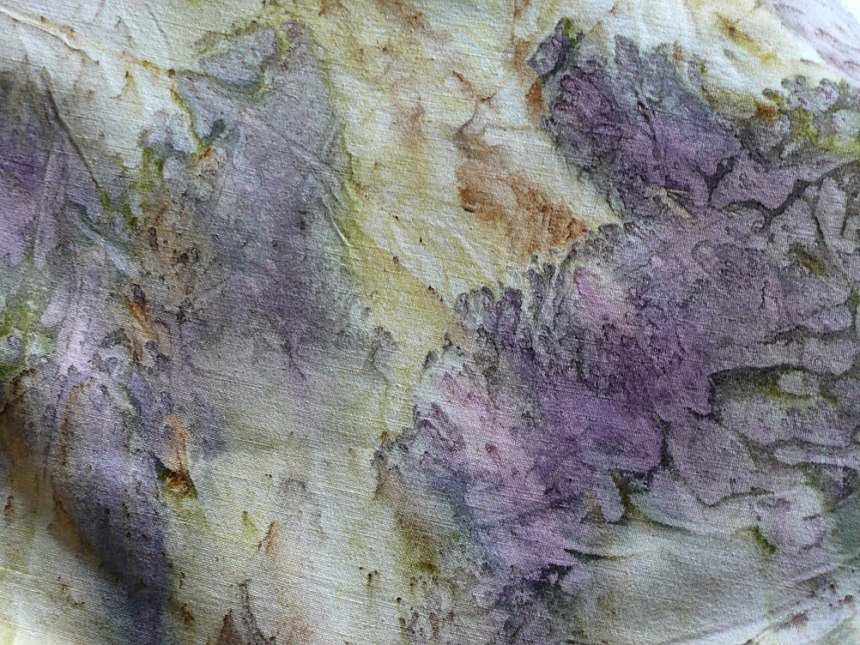
Darfield9

The tannin bath print (two images below) was not so spectacular as the ones from the alum bath; but still quite subtle.  The definition on the printing paper – Pescia (56 x 76 cms | 22 x 30 inches) – is not so good, but I think there was not enough pressure on the package even though it was well weighted down.  I wonder if the one hour steam was too long, so I will experiment with a shorter one.  It is almost as if there is too much water accumulating between the sheets of paper.  I may have soaked the paper for too long as well.  I should try taking off the excess water by pressing between sheets of butchers paper before laying on the plant material (as you do when printing).  This image was taken when the paper was dry.
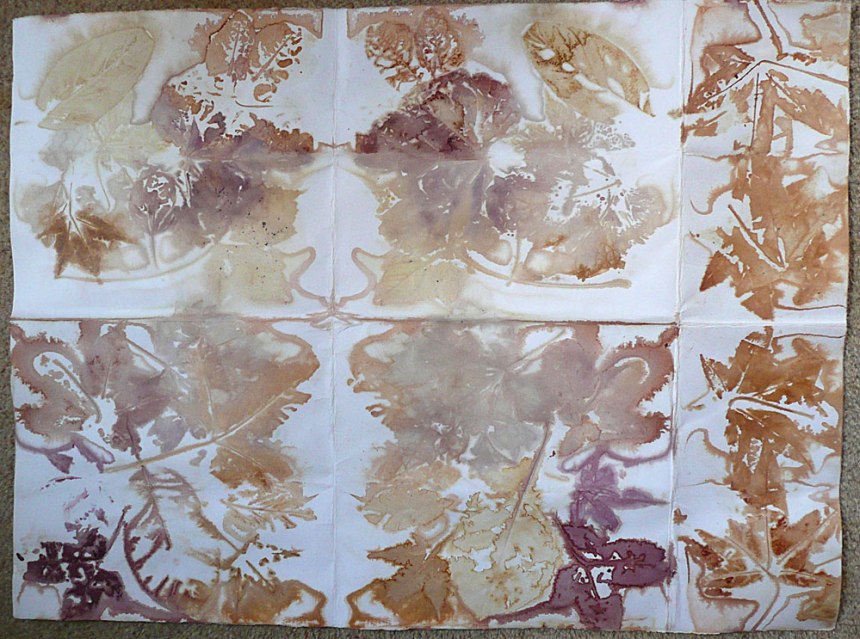
Darfield10

This is the ‘back’ below.  I do to know why it is so very mono-colour, but possibly the absence of the vine leaves explains this.  And the alum which always seems to give a yellow/green cast to the colour range.
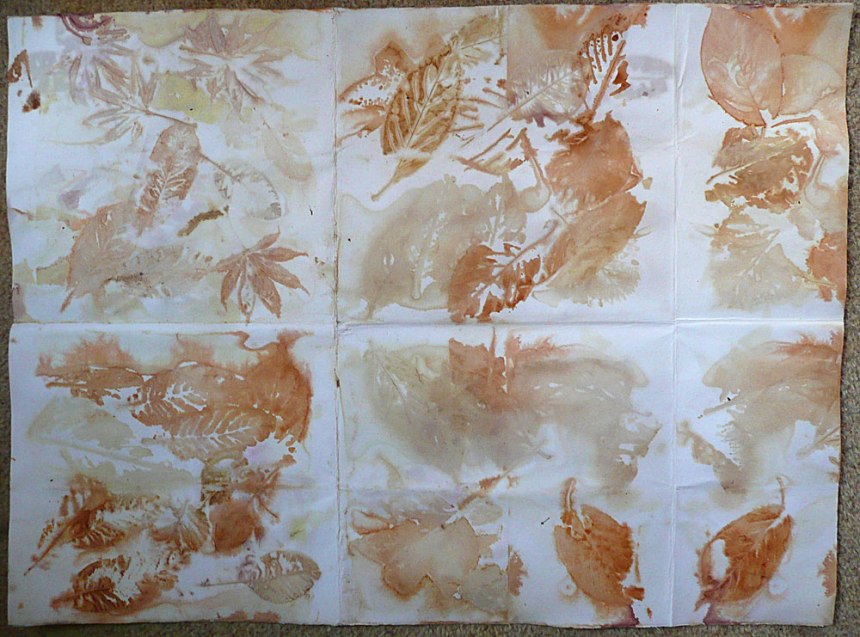
Darfield11

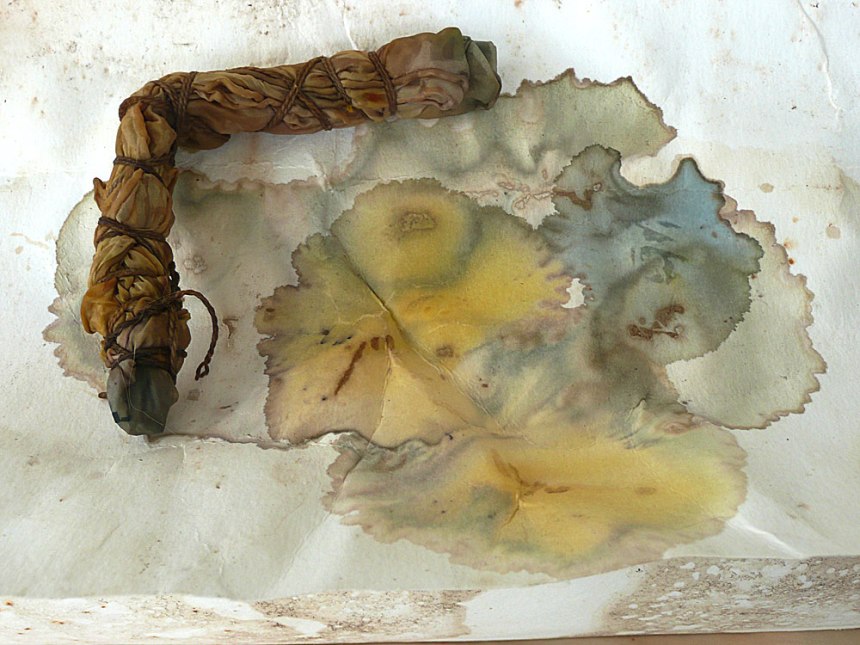
Here are other papers from this steam.  This is the third bundle, bound with bias binding.  The outer paper was the rust print.

Darfield16

In the photo below, the paper with the oil based ink dry point (to the right)  was included in the tannin bath.  All papers are dry.
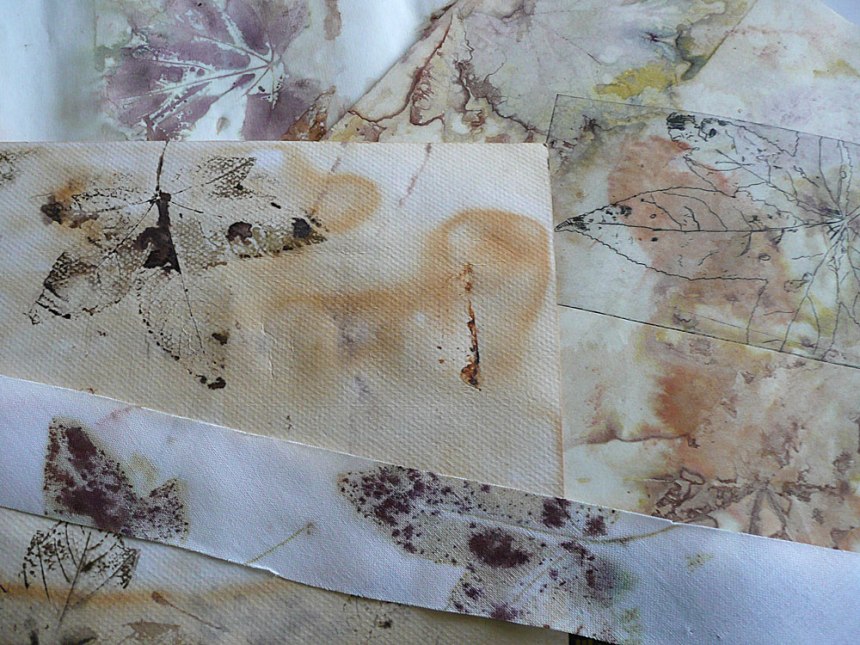
Darfield14

I have to say, my rust prints are very rusty.  For a couple of days nothing seems to happen, then there is more rust than I would like the next day.  This is what I mean.  This is the other side of the paper above – and the leaf print is very black!
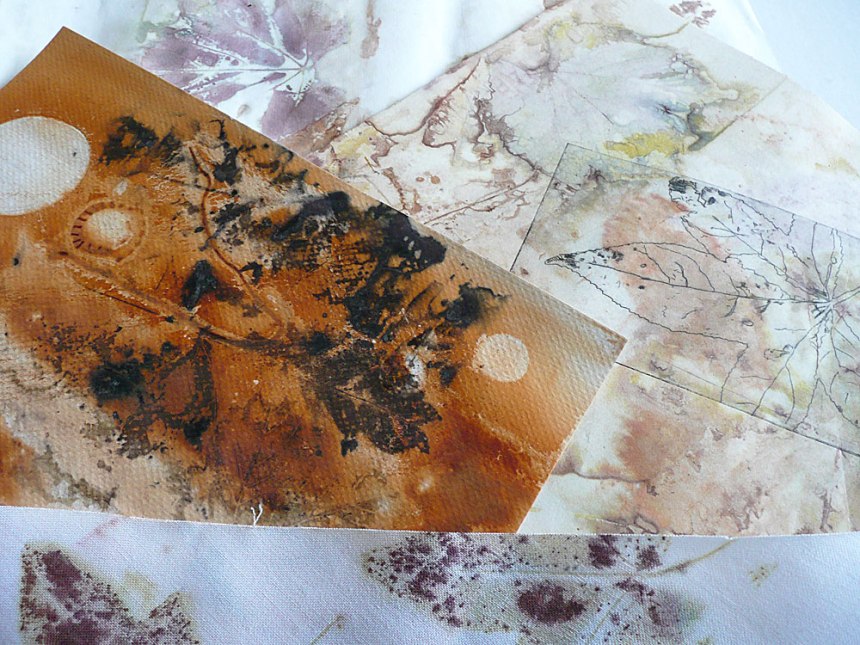
Darfield13

The top sheet of paper here has some lovely, abstract detail.
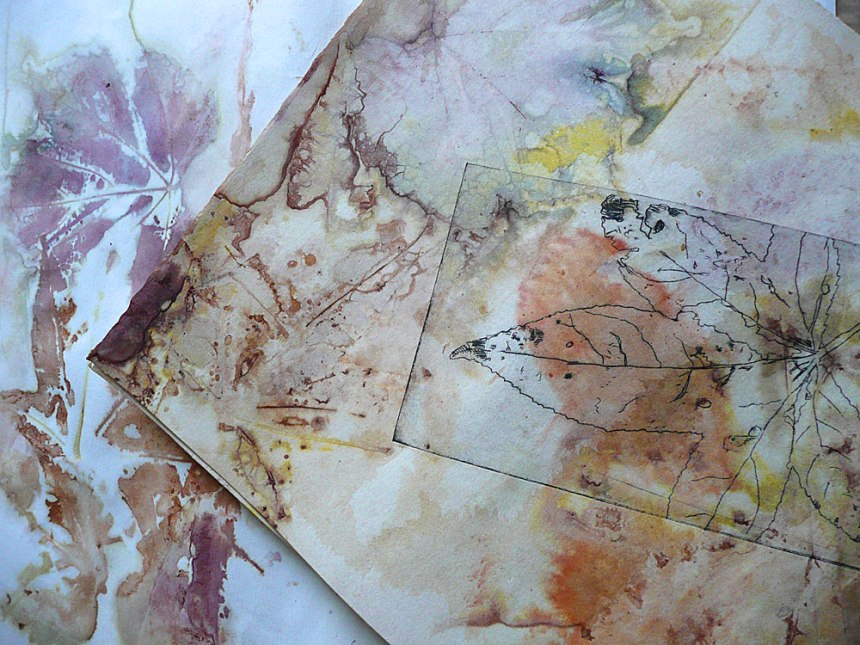
Darfield12

This was an exciting outcome for me.  I just love this process.  Many thanks to Faye and Dave Marshall for providing the leaves.

Cotinus Dye Journey

Dye Pre history:

29 January 2013

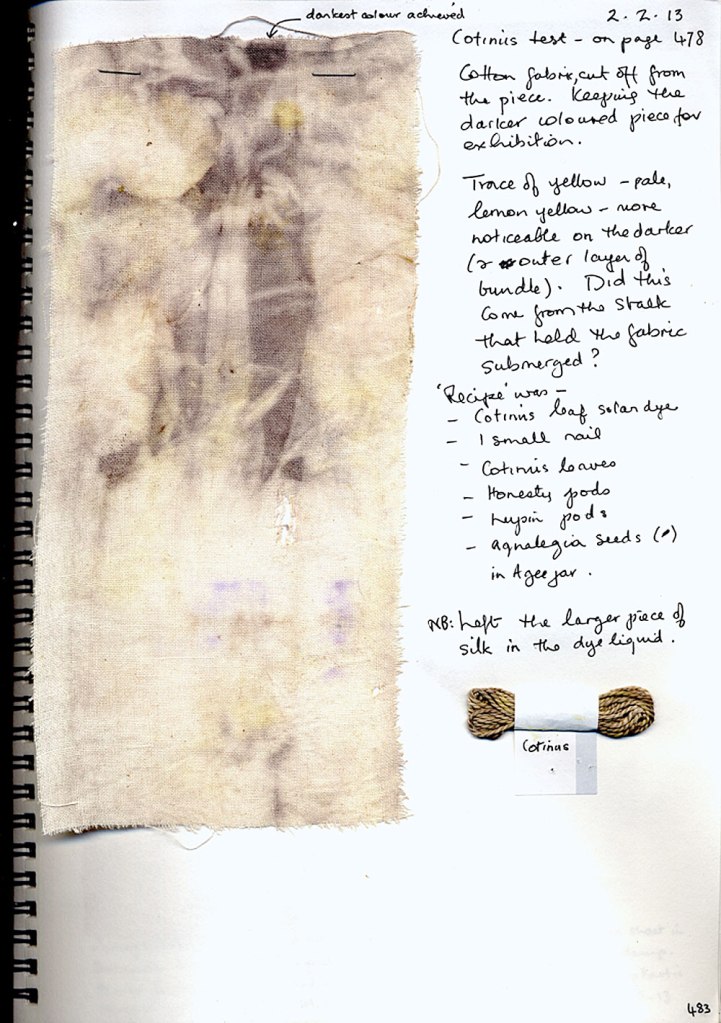
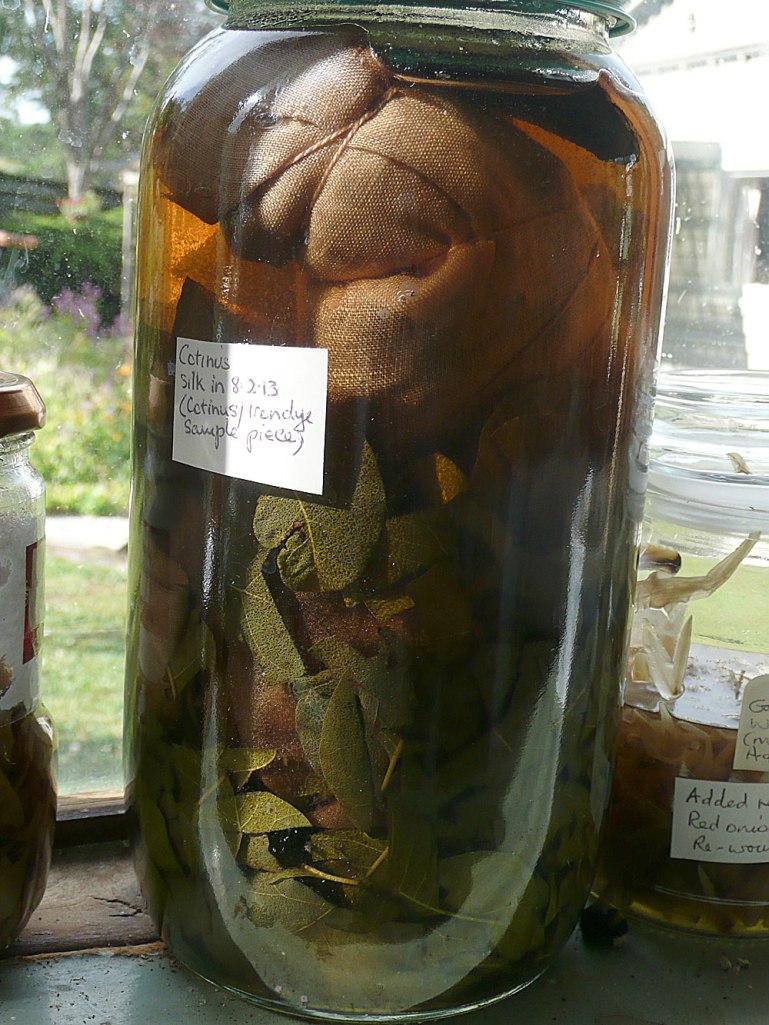
Solar dye created with Cotinus coggygria and a small iron nail.

Cotonus-jar

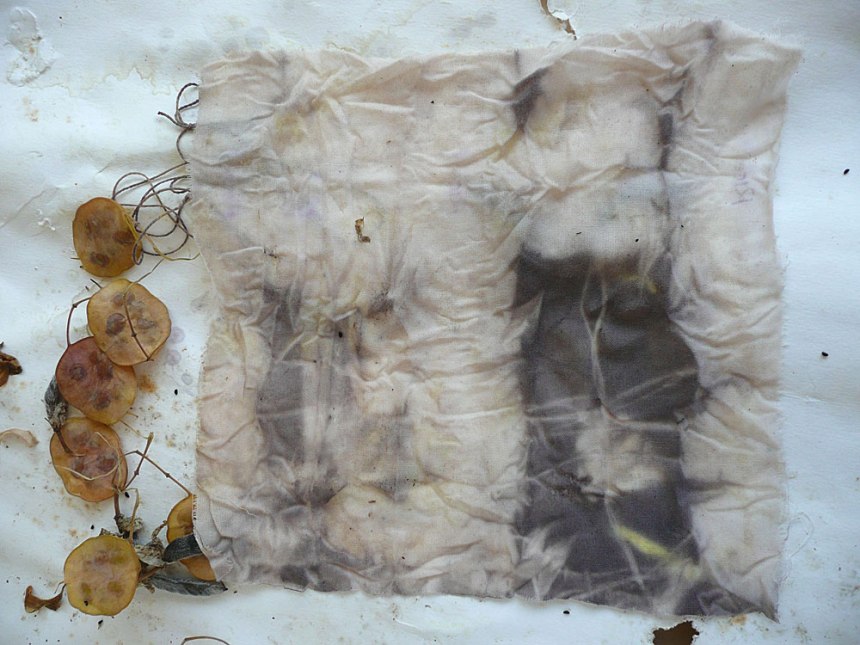
Added pink silk and white cotton bundles containing honesty seed pods, aquilegia seeds and lupin seed pods.  Cotton fabric on top held under water with a cotinus twig.

2 February 2013

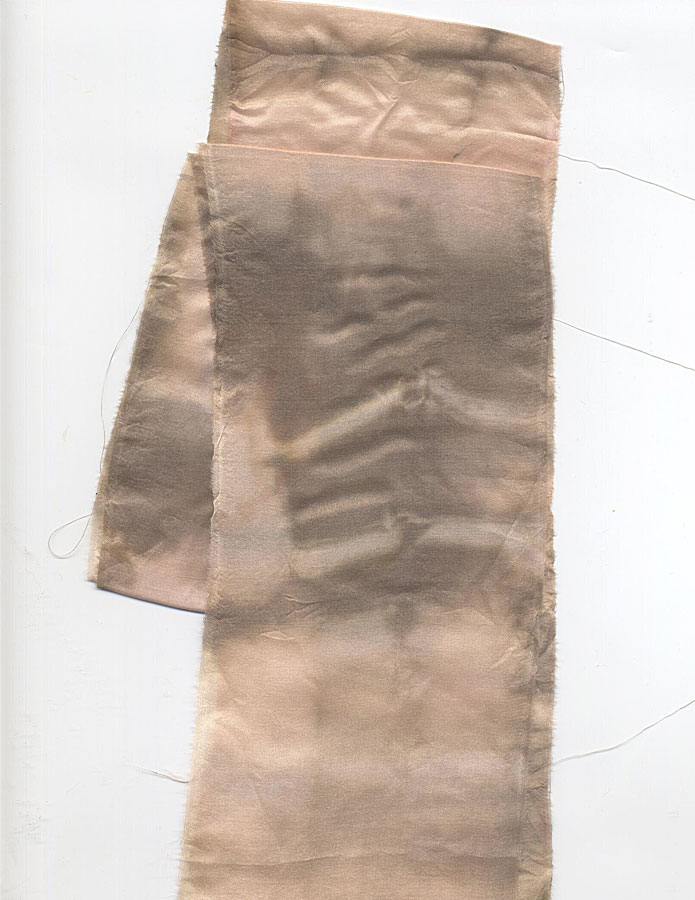
Bundles removed, inspected, and the silk returned as very little dye taken up in the centre of the bundle.  To brighten the colour I added some hypericum and hydrangea sola dye to the cotinus/iron brew.  The opened cotton bundle is below:

Cotinus-solar-cotton-bundle

ecoprint--cotton-continus

This is what happened to the silk bundle.

Cotinus-on-pink-silk-1

The ‘cotinus’ dye bath was not abandoned at this point but I put it in a larger jar to accommodate a linen bundle.

28 February 2013

Linen added.

Linen-cotinus-sequoia

Sequoiadendron giganteum cones, dark red prunus leaves and sequoia bark in a scarf length of white linen (mordanted previously in alum) and bound with linen and cotton thread, was next placed in the Cotinus leaf solar dye, but this left little colour, even after the linen and dye bath were simmered for one hour.  Even though the colour of the dye was dark perhaps I had exhausted the dye content.  I think it was worth the effort, the gentle colours – blue grey, pink and palest brown.

Cotinusdye-sequoiabundle

Eco Print Silk Bundles – Montbretia flowers

Another misadventure?  But with a happy outcome.

11Febsilksteam

In February, I used my last large piece of silk, to enclose montbretia flowers, hydrangea leaves, hypericum leaves, dock seeds on a stem x 4, and pink dahlia buds (broken up), and put on to steam for 30 minutes on a low heat (No 2 setting). Accompanying this bundle was a smaller one, containing the same material except without the dock seeds.  Put the lid on the pot and made sure the steam was not too fierce.

After a while, because of a strong blast of wind as the southerly front arrived, I had to concentrate on quickly picking up the cabbage tree leaves (Cordyline australis) off the back lawn.  I thought of the possible steam damage, and finding a new cabbage leaf (it’s supple) I had the idea of using that for an outer cover – which you can see above in the photo.  Wondered if it would transfer any colour as well.  A piece of bark, possibly Acacia melynoxilon, was also added on top.  The water seemed to have stopped steaming so I upped the temperature to 2.5 for the last ten minutes.

At this point the small bundle was taken out.  At both ends of the bundle I dropped on some red cabbage dye (turned blue by the action of some ash mordant) and then some wineberry dye in the middle.  It was left to dry on a piece of paper, but as a lot of the dye came out of the bundle, I put it back in the steam pot once that was turned off.

Montbretia-paper

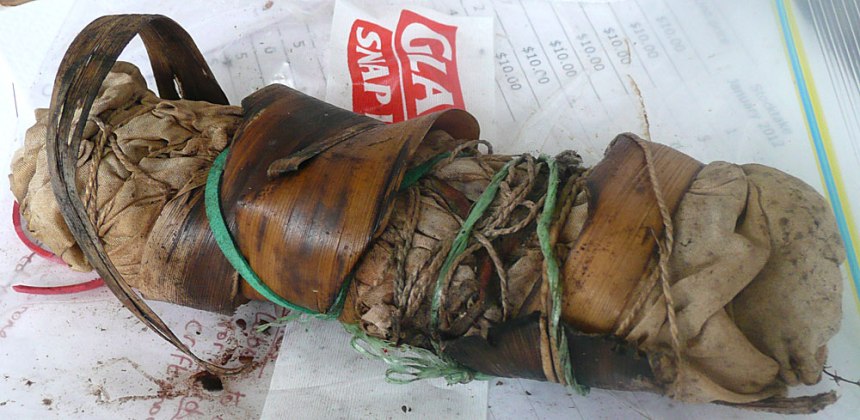
The large bundle was next subjected to 30 more minutes of steaming as some of the pink colour inside was not transferring to the silk.  The montbretia petals dyed the silk a lovely golden yellow.  When that was done, I left both bundles on the rack overnight.  I decided to keep both bundles to mature for one month, which I did by leaving them in separate open snap lock bags, and untying them on 11 March.

Month-bundle3

This was the result!  A rather sorry looking object, mouldy and still damp in the middle.

Here is the opened large bundle!

Montbretia-large

The large leaf here is hypericum, leaving a red stain.  Lots of decayed plant material.

Montbretia-decay

And this is the cleaned, ironed bundle:

Montbretia-silk-lge

Montbretia-silk-lge2

The smaller silk bundle:

Montbretia-small

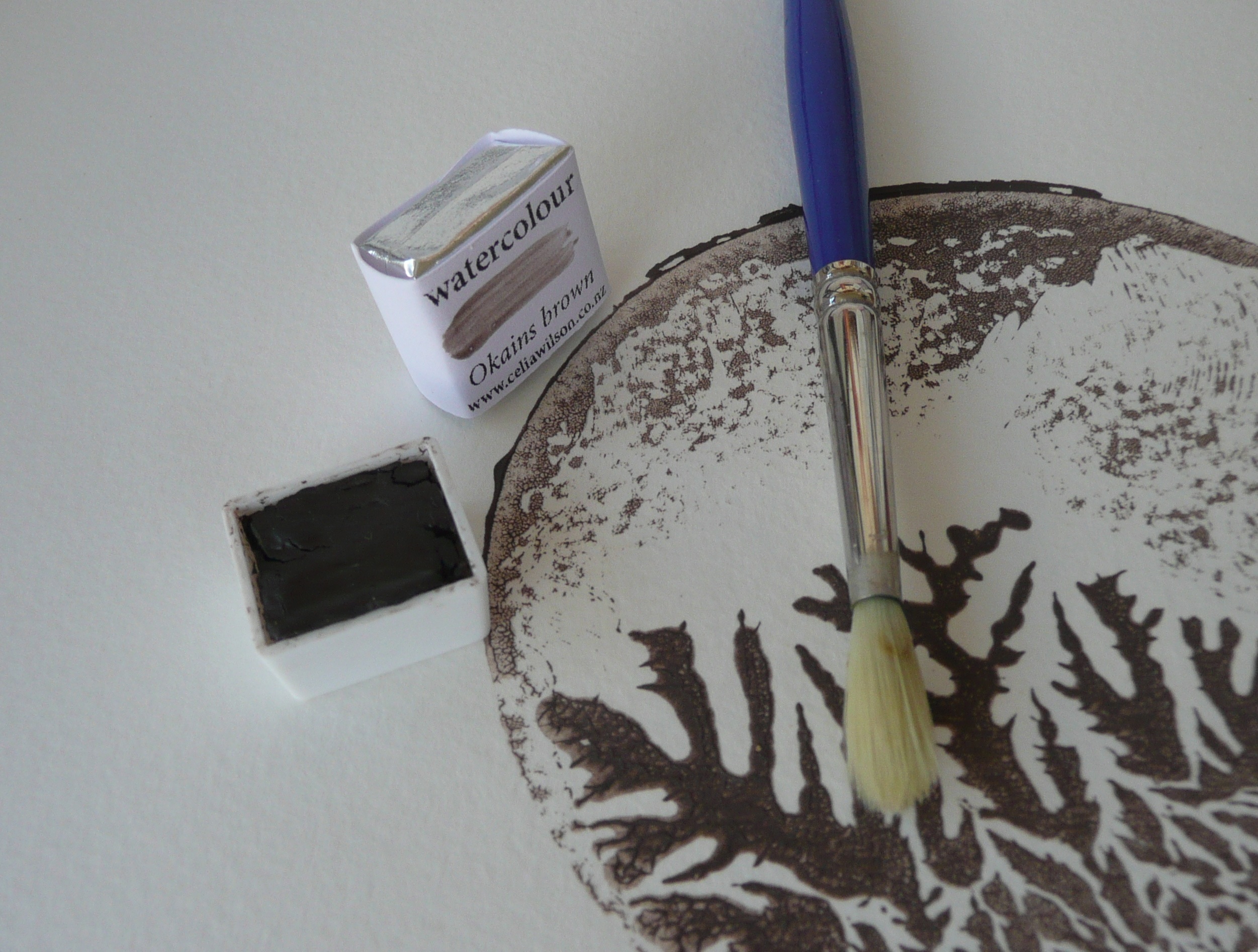
Okains Brown

I’m pleased to say that my paint making is getting better – not that there was a problem, but the paint was shrinking quite a lot as it dried.  Not surprising really as this is what clay does when it dries out.  I am an artist, not a chemist, so it is a trial and error process, especially as every pigment reacts differently.  I can now say that my half-pans of paint look more like the ‘real’ (commercial) thing.

Image

I wrote an essay on locally found pigments for my last year at university.  I was motivated in this research because I feel we take artists’ paint for granted!  I just accepted that these colours come out of a tube or a pot, without a second thought of their origins.  Then I realised, these paints are made overseas from materials themselves imported from other places, and I became curious about what pigments might be found in New Zealand.  

A painting’s main constituent – paint – and how paintings are physically made is not usually considered in art history or art theory but, of course, to a painter the paint, consciously and subconsciously, is of prime importance, as it is central to the act of painting.  The painting material itself also provides the artwork with context, subject matter, psychological content and visual stimulation.  I feel it is an overlooked component.  A painting’s material presence is often overlooked, partly because we are so used to viewing images in print or on the screen.  There is much on the subject of paint for conservation practices, and advice about art materials and techniques on the internet and in manuals, but a conversation on the ‘material memories’ (James Elkins, What Painting Is: How to Think About Oil Painting, Using the Language of Alchemy, 1999) contained in and shown by the paint or the act of painting is not usually considered.

If a painting, both in its subject matter and in its materials, is regarded as a repository of history, current circumstances – economic, environmental and ethical – encourage me to investigate the possibilities of using locally found pigments as an alternative or companion to commercial, imported pigments and paints.  The experimental use of these pigments will provide information as to how such material itself performs, in most cases unlike commercial paint which offers (thankfully!) large quantities of paint of uniform consistency and pigment distribution.  My use of relatively unrefined pigments has produced some exciting effects.

I find that locally found pigments each have an intrinsic or essential character.  The wish to explore and exploit these idiosyncratic qualities, specific qualities and problems, is perhaps seeking to return to individuality or a rejection of bland uniformity.  I started to experiment with ocherous and clay based paint in order to research the different optical effects (for example, chroma intensity or gloss or matt surfaces) and handling properties of paints, and to maximize the granulation and flocculation effects of some pigments in water-based mediums.  

I also experiment with plant based paint and the same granulation effect occurred, though with much finer particles, as was found with the colour extracted from the empty seed cases of Phormium tenax – Harekeke or the New Zealand flax plant.  The texture and color of the dry paint varied, and in places where the paint pooled, the dark areas of color produced a sheen on the surface of the dry paint.  (This P. tenax liquid contains no added substances and should probably be called a toner.)  The paint dispersed and dried differently from commercial paint by showing varied pigment dispersal and paint body per batch of paint.  The artwork thereby inadvertently and indirectly reveals a new aspect of the plant and, in the artwork, the plant has a new lease of life.

And, if you got through all that  –  have a great painting day!